
Download the PDFs
- The article: PDF, 18 pages, 3.4 MB
- The full report: PDF, 27 pages, 4.4 MB
- The slide deck: PDF, 23 pages, 1.0 MB
two large outdoor rinks opened [1][3]
a city centre rink due to open [2]
published session length [4]
“As well as workers, HSE strongly recommends that you include the visiting public in your first-aid, medical and ambulance needs assessment.”
HSE, event safety, incidents and emergencies [9]
By OTAS Insights · Published by OTAS Live Ltd
In the first ten days of November, temporary ice rinks began to open in UK city centres. A large outdoor rink in Manchester opened on 6 November [1]. A rink at a science centre in Newcastle opened on the same day [3]. A city centre rink in Sheffield is due to open on 13 November [2]. A large London park rink publishes dates from 19 November 2026 to 3 January 2027, with sessions of 45 minutes and a request that people arrive 20 minutes early [4][5]. Rinks in Glasgow and Plymouth publish opening dates from 20 November to 3 January. A Glasgow report says ice marshals and a first aider will be present [6]. A Plymouth code tells skaters to leave the ice for resurfacing [7]. Those published rules are a reminder of what a temporary rink actually is. It is a live, slippery floor in a winter crowd, with timed sessions, skate hire queues, and a need to reach someone quickly if they go down. This Insight is not about who runs a good rink. It is about agreeing, before the first skate, when a session pauses, who stays off the ice, and how you reach a casualty.
In short: a temporary ice rink will not wait for a meeting once a session has started. Before you open, agree the words that pause the ice, and keep marshals off the sheet. Plan the changeover so queues do not block the way off the ice. Walk the route that takes a casualty to treatment.
What was published this month
Rink openings and session rules, as published [1] to [7]. We describe events and venues rather than naming them in the text. Some source links carry names. We do not judge any operator.
Openings in November
- Manchester A large outdoor rink opened on 6 November 2026, reported the next day [1].
- Newcastle A rink at a science centre also opened on 6 November 2026 [3].
- Sheffield A city centre rink is due to open on 13 November 2026 [2].
- London park A large park rink publishes dates from 19 November 2026 to 3 January 2027 [5].
- Glasgow and Plymouth Both publish opening dates from 20 November 2026 to 3 January 2027 [6][7].
What the public is told
- Session length One large London park rink publishes 45 minute sessions and asks people to arrive 20 minutes early [4].
- Children That rink says children aged 3 to 12 need a skating adult aged 18 or over [4]. This Insight does not discuss injury cases.
- Marshals and first aid A Glasgow news report says ice marshals and a first aider will be present [6].
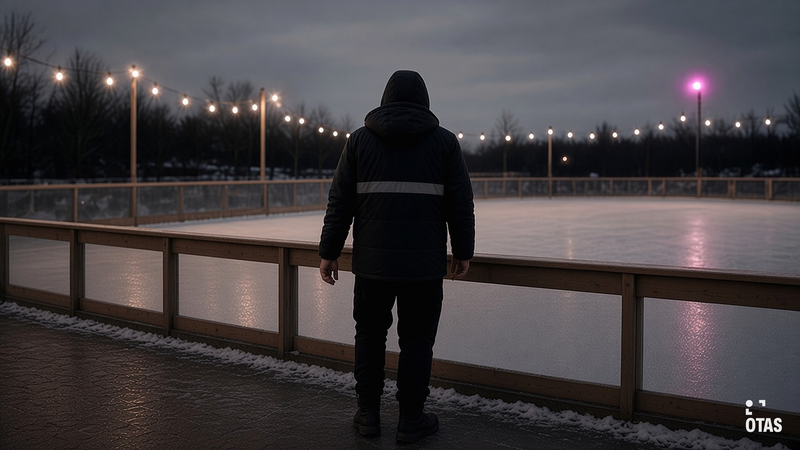
- On the ice A Plymouth rink code says no chains of three or more, no phones or bags on the ice, and that people must leave the ice for resurfacing [7].

What the guidance says about rinks, first aid and the public
In brief, from HSE, NHS, Resuscitation Council and industry guidance [8] to [23]. Not legal or medical advice.
Your duty and the public
- The Act. In Great Britain, an employer must conduct the undertaking so that, so far as is reasonably practicable, people who are not employees are not exposed to risks to their health or safety [21]. Temporary rinks are usually open to the public, including children.
- Northern Ireland. Northern Ireland has its own health and safety law, with a similar duty to people who are not employees [22].
- Incidents. HSE event guidance says you must have plans to respond to incidents and emergencies. HSE strongly recommends that you include the visiting public in your first aid, medical and ambulance needs assessment [9][10][14].
- Managing the event. HSE also sets out what organising and managing an event involves, including clear roles and plans that people can follow [20].
The ice, the cold and a casualty
- Head injury. NHS advice says to call 999 if someone has hit their head and, for example, cannot stay awake or has been knocked out and has not woken up. It also says to call 999 if they have a fit, have problems with walking, balance or speaking, or their behaviour has changed. Call 111 if they are being sick, feel dizzy or have other symptoms you are worried about [15]. A medical provider note on rink cover says staff should not assume a person is fine because they stood up [8].
- Cold. NHS advice describes hypothermia as a dangerous drop in body temperature below 35C and a medical emergency. Wet clothes and staying out in the cold too long can cause it [16]. A casualty lying on the ice can lose heat while access is arranged [8]. People waiting in a queue can also get cold.
- Defibrillator. The Resuscitation Council says a public access defibrillator should be easy to find and ready to use, with people who know where it is [17].
- Medical cover. A UK medical provider note on ice rink cover, published on 7 October 2026, discusses casualty access onto and off the ice, cold exposure, handover when school groups skate, and RIDDOR [8]. This is practice comment, not official guidance.
- The Purple Guide. The Purple Guide to Health, Safety and Welfare at Music and Other Events covers event planning, including medical and first aid. Use the edition that applies to your event [19].
- Crowd and site. HSE event guidance on crowd management and on venue and site design is still the starting point when a rink sits in a wider winter event. Queues, ways off, and a treatment area are site design choices, not only medical ones [12][13].
- Outdoor kit. If the rink uses temporary barriers, plant or other outdoor equipment, HSE event guidance on outdoor equipment still applies alongside the ice plan [11]. Plant and resurfacing. Refrigeration plant, electrics and resurfacing machines need their own competent risk assessment, separate from session first aid [8].
- Cold alerts. In England, the UKHSA Weather Health Alerting System issues cold health alerts from 1 November to 31 March. It does not cover Scotland, Wales or Northern Ireland, so check the Met Office warnings and local public health advice there. A cold alert does not, by itself, close a rink. It should change how long you let people wait, and how you treat a casualty who has been on the ice [23].
General information from published guidance and law, as of 10 November 2026. Not legal or medical advice.
Why a temporary rink is a crowd plan, not only a skate plan
OTAS guidance, drawn from the published rules and the official guidance above.
Pause the ice, then reach the casualty
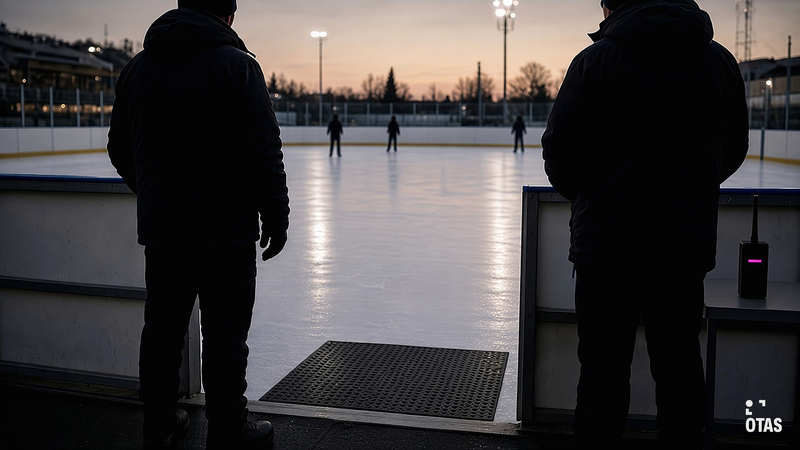
- The floor is live. Once a session starts, the ice is a moving, slippery floor with limited ways on and off. A person down in the middle of it is not like a person down on a dry concourse. Skaters are still moving. Noise is high. From the barrier it can be hard to see whether they can get up.
- The pause comes first. If you try to reach a casualty through moving skaters, you add risk. Pause the session. Hold people at the barrier or the gate. Then go in by the route you have walked. A planned resurfacing is already a pause of this kind. One published code tells skaters to leave the ice while it is prepared [7]. Your casualty pause can use the same words and the same way off.
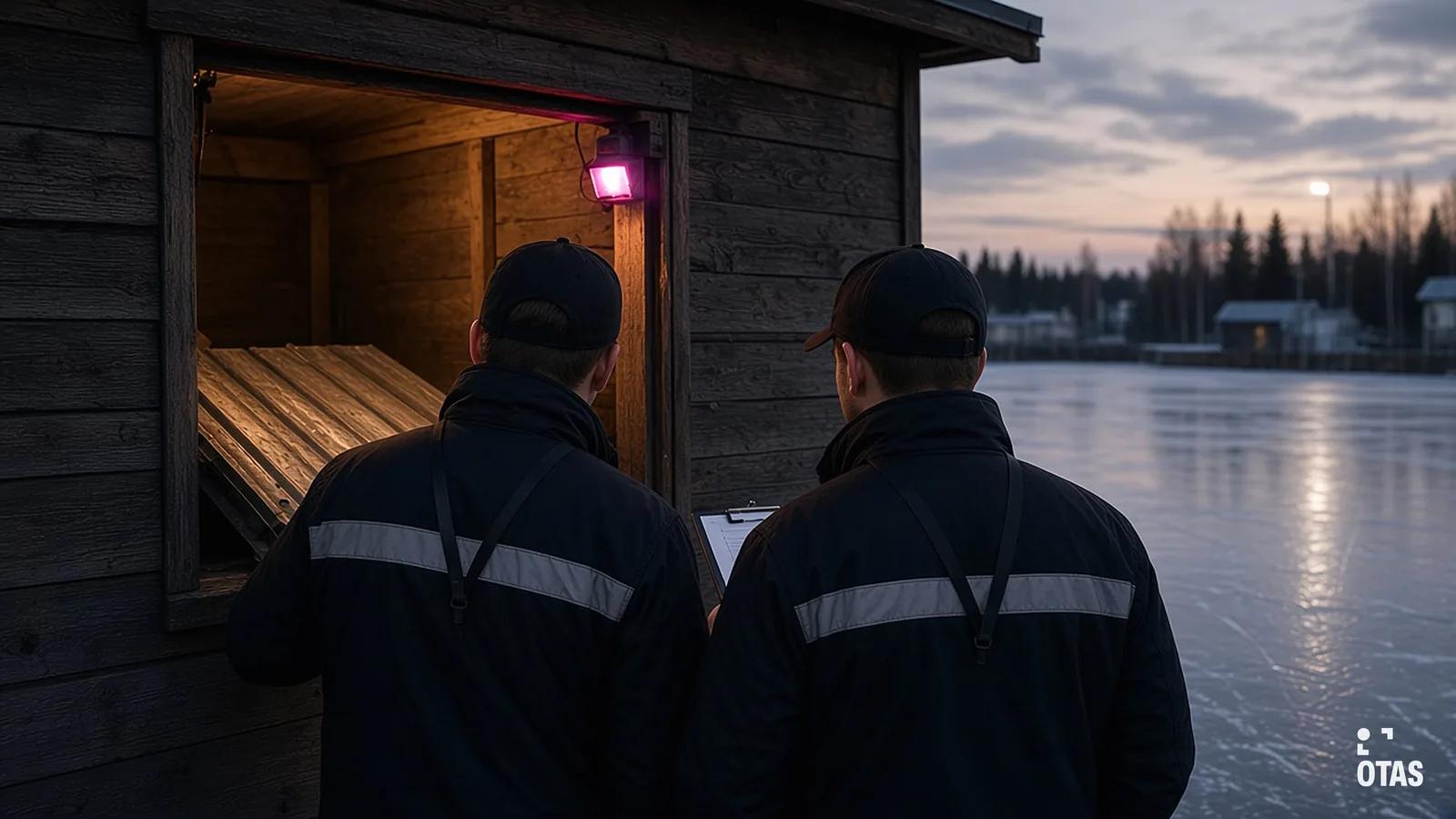
- Marshals stay off the sheet. Staff who stand on the ice without the right footwear, training and a reason for being there can fall, or get in the way. A published report and a published code put marshals and first aiders at the rink, and they put skaters off the ice for resurfacing [6][7]. Watching from the barrier or the gate is the default. Step on the ice only when the plan needs it, and only if you are trained and equipped.
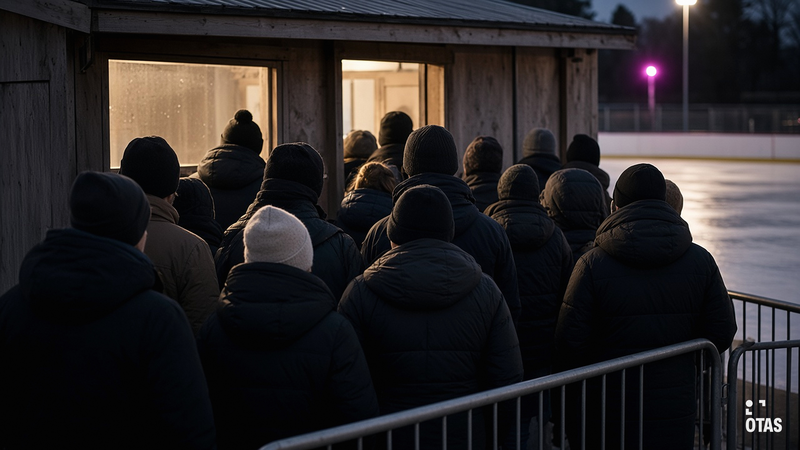
- Changeovers make crowds. A 45 minute session with a request to arrive 20 minutes early means one group is leaving while the next is already waiting [4]. Skate hire, lockers, cameras and family groups all meet at the same barrier. School groups add a handover as well as a queue [8]. If that queue sits on the only way off the ice, you have blocked your own medical route. Hold the next session until the gate is clear.
- Cold does not wait. People waiting to skate, and a person who is down on the ice, are in the cold. Wet clothes and staying out in the cold too long can cause hypothermia [16]. A casualty lying on the ice can lose heat while access is arranged [8]. Your plan has to move both of them, and it has to say where people wait if a pause runs on.
Signs your rink plan will not hold
Each of these is OTAS guidance, drawn from HSE and from published rink practice.
Signs your rink plan will not hold
- 01No pause words
The plan says monitor the ice but does not say who stops the session or what the public will hear [9][20].
- 02Staff on the ice
Marshals stand on the sheet to watch, without the kit or a reason to be there [6][7].
- 03Blocked gate
The skate hire queue, a camera point or a family group sits on the only way off the ice.
- 04No route walked
Nobody has walked a stretcher or chair from the centre of the ice to the treatment area [8][9].
- 05First aid for staff only
Cover is planned for the crew, not for the public on the ice [9][10].
Plan the pause, from the first meeting to the session
Five stages. OTAS guidance unless a source is shown.
Five stages, from the limits to the session
Limits
Agree who may be on the ice, in what footwear, and when the sheet is closed for resurfacing or a pause [7]. Record the session length and the arrive early time you will publish [4].
The pause
Write the words that pause a session and the words that restart it. Name one person who calls it, and a deputy. Tell marshals, skate hire and medical staff what they will hear.
The route
Walk a casualty from the centre of the ice to the treatment area, including the gate, any step or mat, and the way past the queue [8][9]. Time it. Keep that way clear in every session.
The changeover
Plan how one session leaves and the next arrives so that skate hire queues do not block the gate [4]. Brief the same plan for school groups and family sessions [8].
On the session
Marshals watch from the barrier or the gate, not from the sheet, unless they are trained and equipped to step on it. If someone is down, pause first, then reach them. Log the time, the call and the handover.
Pause, act and restart
OTAS guidance unless a source is shown.
| Situation | Watch | Act | Pause |
|---|---|---|---|
| A fall | Skater down, gets up, stays on the ice | Marshal reports it. Named person watches from the gate | Pause if they cannot get up, or if you suspect a head injury [15] |
| A person still down | No movement, or they cannot get off the ice | Pause the session. Hold people at the barrier. Clear a lane | Medical team goes in by the walked route |
| Changeover crush | Queue at skate hire reaches the gate | Hold the next session. Keep the way off the ice clear | Pause entries until the gate is clear |
| Cold | People waiting look very cold, or a casualty is on the ice [16][23] | Move people to shelter. Treat the casualty as a cold casualty as well | Do not restart until they are off the ice and the route is clear |
Table 3. Pause, act and restart. OTAS guidance unless a source is shown.
Action box
Operational
- Know the words
- Watch off the ice
- Keep the gate clear
Know the words that pause and restart the session. Watch from the barrier or the gate. Report a person down at once. Keep the way off the ice clear. Follow the pause when it is called.
Tactical
- Brief the pause
- Run the changeover
- Log the handover
Brief the pause words at the start of each shift. Keep the changeover moving so the gate stays clear. Meet the medical team at the agreed point. Log the time of every pause and handover.
Rink pause checklist
OTAS guidance unless a source is shown.
Before the first session
- Pause words written and recorded.
- One named person, and a deputy.
- Casualty route walked and timed [8][9].
- Defibrillator location known to the team [17].
- Changeover plan agreed so the gate stays clear [4].
During the session
- Marshals watch from the barrier or the gate.
- The way off the ice is kept clear.
- A person down is reported at once.
When a pause is called
- Say the words. Hold people at the barrier.
- Clear a lane, then reach the casualty.
- Log the time and the handover.
- Restart only when the ice is clear, staff are in position and the named person has agreed.
What we do not know yet
- How each rink that opened this month has written its pause words, if it has them. That is not public.
- What medical cover, equipment and access routes each site has agreed with its provider. The public pages describe presence, not the detail [6][8].
- How changeovers are being run in practice in the first days of opening. No independent review had been published as of 10 November.
- Whether any safety advisory group has published extra rink conditions for this season. None had been found in the sources opened for this Insight.
Coming up: more rinks, school groups and peak weeks
More temporary rinks open in the second half of November, and school and family sessions will fill the days before Christmas [2][5][6][7]. The plan that works is the one you can run at a changeover, in the cold, when someone is down in the middle of the ice.
Frequently asked questions
Should we stop the whole rink if someone falls?
Not every fall needs a full stop. A pause, a clear lane and a restart may be enough. Agree in advance what you will do for a simple fall, a suspected head injury and a person who cannot get up [15]. The named person makes that call.
Can marshals stand on the ice to keep a better view?
Only if they are trained and equipped to be there, and only when the plan needs them on the sheet. Watching from the barrier or the gate is the default in this Insight. Published codes already send skaters off the ice for resurfacing [7].
Do we need a defibrillator at a temporary rink?
HSE strongly recommends that your first aid needs assessment includes the public [9][10]. The Resuscitation Council says a public access defibrillator should be easy to find, with people who know where it is [17]. Ask your medical provider what is right for your site.
What about school groups?
Treat them as a changeover and a handover plan, not only a booking. Know who is in charge of the group, how you will pause the session, and how you will hand a child to the group leader and, if needed, to medical staff [8]. Do not discuss injury cases in briefings as stories.
Does this replace our risk assessment?
No. This is general information for event professionals. Your own risk assessment, your medical provider and your safety advisory group decide what applies to your rink.
Related OTAS Insights
These are links to other OTAS Insights pieces, not to any OTAS Live product or service.
- When the weather makes the call
- Rides at winter events: when riders make the ride unsafe
- Overhead banners and arches at winter markets
Interest: OTAS Live Ltd, which publishes OTAS Insights, sells event operations services, handbooks and training related to this topic.
Law: this Insight summarises HSE, NHS, Resuscitation Council and industry guidance and health and safety law in Great Britain as published on 10 November 2026. Northern Ireland has its own health and safety law. It is not legal or medical advice. Ask your medical provider and your safety advisory group what applies to your rink.
References
Web sources opened 10 November 2026 and labelled by source type. Links are for checking only. Listing a source does not mean it endorses OTAS or has worked with us.
- Regional newspaper report on a large outdoor ice rink opening in Manchester, 7 November 2026 manchestereveningnews.co.uk
- Sheffield City Council news, date revealed for a city centre artificial ice rink, 9 November 2026 sheffield.gov.uk
- Centre for Life news, outdoor ice rink launched in Newcastle, 8 November 2026 life.org.uk
- Hyde Park Winter Wonderland, ice skating attraction page, session length and child supervision rule hydeparkwinterwonderland.com
- Hyde Park Winter Wonderland, getting here, opening dates 19 November 2026 to 3 January 2027 hydeparkwinterwonderland.com
- Glasgow Times report on the Glasgow Green ice rink, dates, ice marshals and a first aider glasgowtimes.co.uk
- Plymouth Winter Wonderland ice rink page, dates 20 November 2026 to 3 January 2027 and skater code plymwinterwonderland.co.uk
- LightMed, ice rink medical provision, 7 October 2026 lightmed.co.uk
- HSE, event safety, incidents and emergencies hse.gov.uk
- HSE, first aid legislation hse.gov.uk
- HSE, event safety, outdoor equipment hse.gov.uk
- HSE, event safety, venue and site design hse.gov.uk
- HSE, event safety, crowd management hse.gov.uk
- HSE, first aid needs assessment, including members of the public hse.gov.uk
- NHS, head injury and concussion nhs.uk
- NHS, hypothermia nhs.uk
- Resuscitation Council UK, Public access defibrillators: a guide for communities resus.org.uk
- HSE, first aid at work, the health and safety (first aid) regulations hse.gov.uk
- The Purple Guide (subscription) thepurpleguide.co.uk
- HSE, event safety, managing an event hse.gov.uk
- Health and Safety at Work etc. Act 1974, section 3 legislation.gov.uk
- Health and Safety at Work (Northern Ireland) Order 1978, article 5 legislation.gov.uk
- UKHSA, Weather Health Alerting System gov.uk
If someone went down in the middle of your rink in the next session, who would pause the ice, and how would you reach them?
If you need support setting a session pause, a marshal plan and a medical access route for your rink, reach out to us to see how we can support you.
Events industry since 2008, internationally since 2015. OTAS Live Ltd. By OTAS Insights. Edited by Kris Dailly.
Download the PDFs
- The article: PDF, 18 pages, 3.4 MB
- The full report: PDF, 27 pages, 4.4 MB
- The slide deck: PDF, 23 pages, 1.0 MB
Work with OTAS
Opening a temporary ice rink this winter?
Corrections to published Insights articles are listed in our corrections log.