
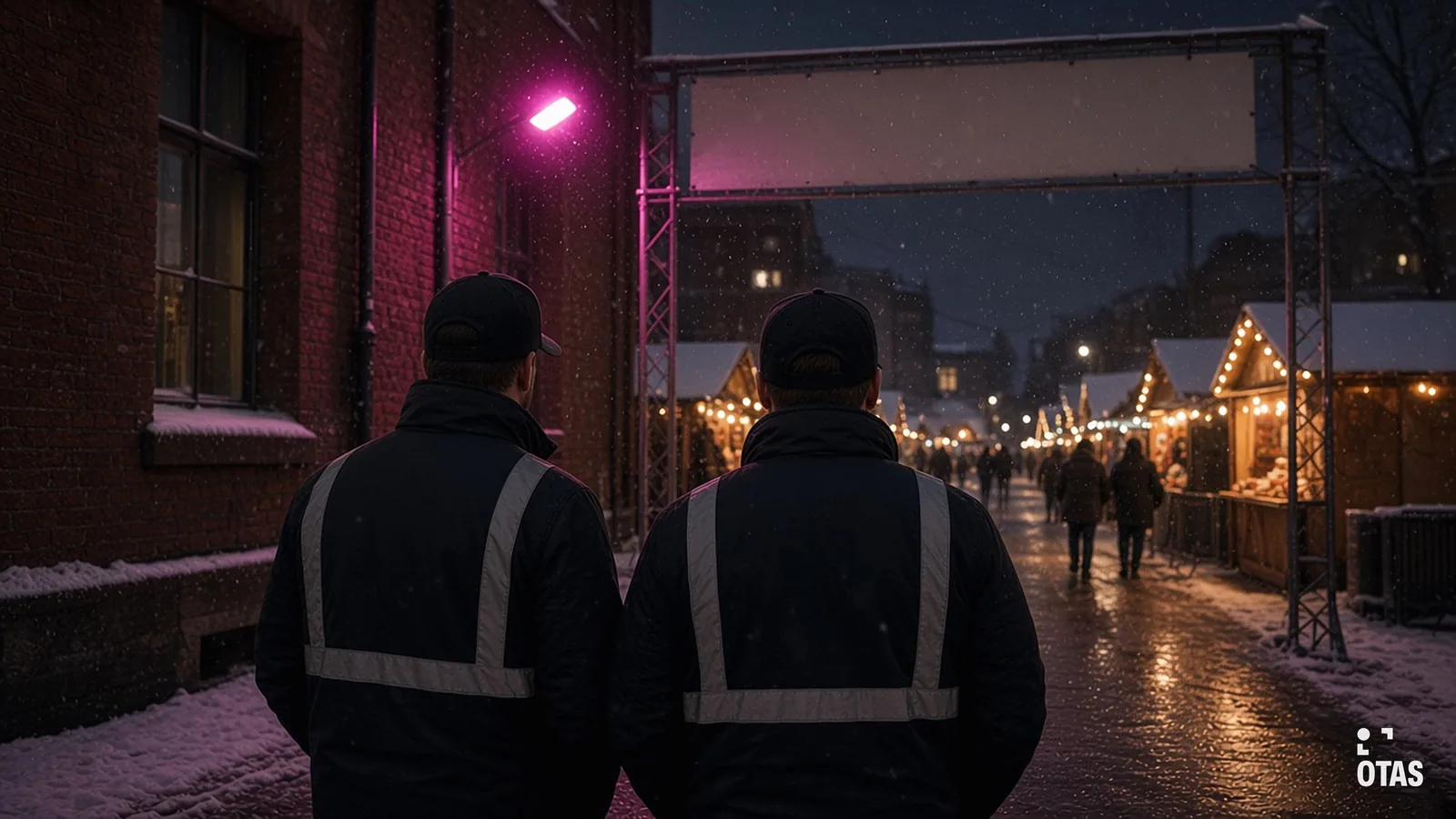
Download the PDFs
- The article: PDF, 28 pages, 5.0 MB
- The full report: PDF, 38 pages, 7.0 MB
- The slide deck: PDF, 27 pages, 1.5 MB
visitors hit, police said [1]
km/h: highest warned storm gusts [2]
evening lost, open next day [1][3]
“Wind conditions should be monitored using an anemometer (wind speed device) and action taken if there is any risk of them being blown over.”
The Purple Guide, temporary demountable structures [5]
By OTAS Insights · Published by OTAS Live Ltd
On the afternoon of Friday 23 October 2026, a metal truss carrying a banner over the way in to an autumn market in a small German town came down [1]. Police said it probably fell in a gust of wind [1]. Two visitors were hit. One was seriously injured. The other was critically injured and flown to hospital by rescue helicopter after a resuscitation attempt [1][2]. On 6 November police said that he had died, and that the other visitor had left hospital [11]. The national weather service had warned of storm gusts of 60 to 75 km/h for the uplands in the region [2]. Criminal police are still investigating [11]. Winter markets in the UK are going up now, and most have a banner or arch over the way in. That is where the crowd is densest, and these items are often treated as signs rather than structures.
In short: treat every banner, arch and span over a crowd route as a structure. Know its wind limit with the banner on, measure the wind close to it, and give one named person the authority to close the route under it.
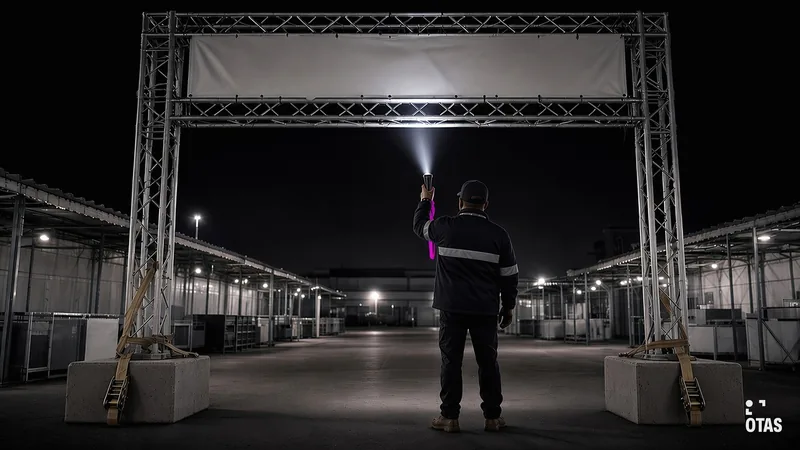
What happened at the way in
Two police releases and five news reports, read on 9 November 2026, set out the incident. We do not name the town or the event. Where the reports differ, we say so [1][2][3][4][11][12][13].
The incident
- When Friday 23 October 2026, at around 16:30 local time, which is 15:30 UK time [1].
- Where Over an access path from a side street to the central square of the market [1]. A regional paper said the truss served as “a kind of entrance portal” to the event (OTAS translation) [4].
- What A metal truss with a banner attached came down, “probably due to a gust of wind”, police said (OTAS translation) [1]. A regional news site called it an advertising truss belonging to a fairground trader, put up over a passage [12].
- The weather The national weather service had warned of storm gusts of 60 to 75 km/h for the uplands and other areas in Rhineland-Palatinate and Hesse [2].
Injured
- Two visitors Two visitors were injured. One was seriously injured. The other was critically injured and flown by rescue helicopter [1].
- Resuscitation The public broadcaster reported that he was flown to hospital “after a resuscitation attempt” (OTAS translation) [2].
- The rumours “Contrary to early rumours on social media”, no further people were injured, police said (OTAS translation) [1].
- Since On 6 November police said the 72 year old visitor had died, and the second visitor, aged 58, had left hospital [11]. A dpa report carried by the FAZ said the same [13].
The response
- Police Criminal police are investigating. The truss was seized as evidence [1]. On 6 November police said they could give no further details on the investigation [11].
- The organiser Set up a crisis team at once and ended the Friday evening [1]. The drone show was cancelled [2].
- Welfare Witnesses and affected visitors were supported by emergency pastoral care [1]. Psychological support was offered [2].
- The next day The market went on as normal on the Saturday, and runs to the Monday [2][3].
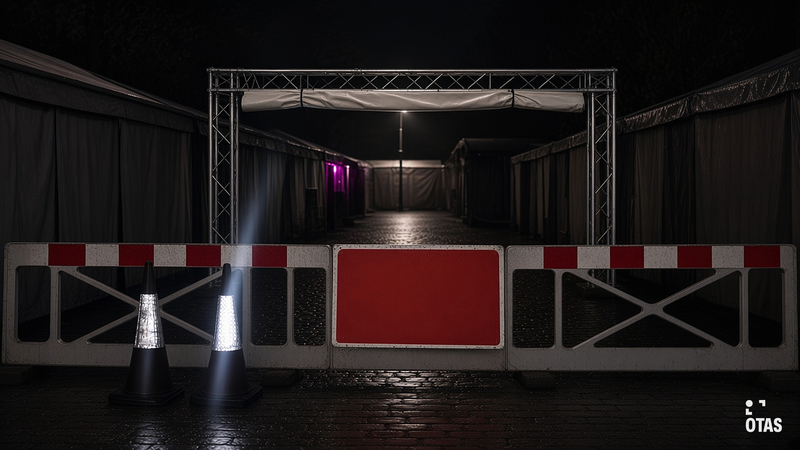
Where the reports agree, and where they differ
A police release and three news reports, written within three days. Read them side by side before you draw a lesson [1][2][3][4].
| Point | What the reports say |
|---|---|
| Structure | Early police reports said scaffolding. Police later said a truss with a banner [1][2]. We say a metal truss carrying a banner |
| Position | Over an access path, police said [1]. “A kind of entrance portal”, a regional paper said [4]. Both fit. We say over the way in |
| Cause | “Probably” a gust of wind, police said [1]. The investigation is open. We do not state a cause |
| Wind | A regional storm gust warning of 60 to 75 km/h [2]. Not a reading at the market |
| Injured | Two visitors. Police corrected social media rumours of more [1]. One “in danger of life” on 24 October [3] |
Table 2. How the reports compare, read on 2 November 2026.
What UK guidance says
UK event guidance does not set one wind speed for banners and arches [5][14]. It sets a method. Secure to the wind rating, measure the wind, act, and get a handover. Short quotes below.
Temporary structures [5]
- “All structures must be appropriately secured to the ground taking account of their wind ratings and the weather during the event.”
- “Wind conditions should be monitored using an anemometer (wind speed device) and action taken if there is any risk of them being blown over.”
- For larger structures, the supplier “should provide a signed handover inspection report saying that the structure is safe and ready to use.”
Weather [6]
- “Monitor weather forecasts both in advance and during the event.”
- Plan how the weather might affect the event, including high winds. Plan how you would respond.
Crowd hazards [7][8]
- HSE lists “Collapse of a temporary structure” among hazards from the venue or event activity [7].
- HSE lists “climbing onto equipment/structures” as dangerous behaviour [7].
- HSE points to good practice on building and taking down temporary demountable structures [8].
Engineering guidance [14][15]
- The Institution of Structural Engineers publishes guidance on temporary demountable structures. This includes towers and masts. It covers their procurement, design and use. Its fourth edition is supported by HSE [14].
- One UK city council asks every event in its park for a wind management plan. The plan lists the maximum wind speed for each structure. It also sets the action to take at 60% and 80% of the maximum wind load capacity [15].
- The same guide says smaller structures, including signs, “must be adequately secured or ballasted” [15].
Met Office warnings [9]
- Warnings are coloured “yellow, amber or red” on “a combination of both the impact the weather may have and the likelihood”.
- “Yellow and Amber warnings represent a range of impact levels and likelihoods. This means it is important to read each warning”.
The common thread is a number and a person. A wind limit for each item. Someone measuring against it.
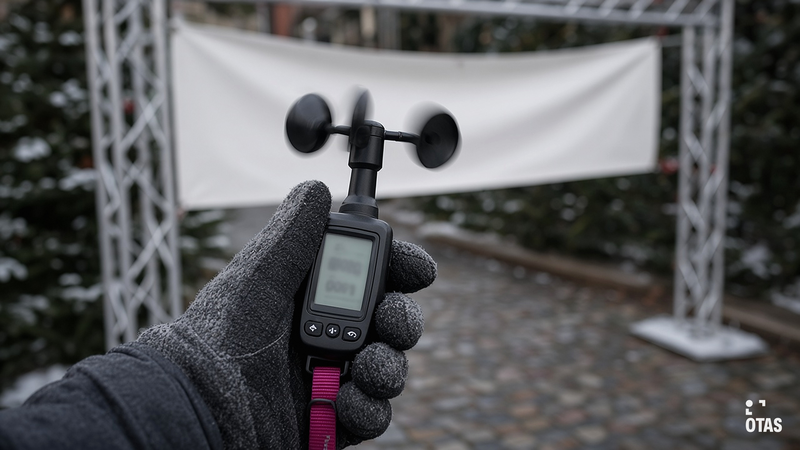
Using Met Office warnings
A warning is a prompt to read, not a decision. The quotes are the Met Office [9]. The lessons are OTAS professional practice.
What the Met Office says [9]
- Colours Warnings are “yellow, amber or red” on “a combination of both the impact the weather may have and the likelihood”.
- Reading “Yellow and Amber warnings represent a range of impact levels and likelihoods. This means it is important to read each warning”.
- The change As of October 2026, the impact matrix shown in its warnings video “has slightly changed”.
How to use it (OTAS practice)
- Monitor the forecast and warnings before and during the event [6][9]. Check them each morning and each afternoon (OTAS practice).
- Read the impact and likelihood box, not just the colour [9].
- Once any warning is in force, read the anemometer every 15 minutes (OTAS practice).
- A warning is regional. Your thresholds come from your own readings at the structure.
The law in brief
In brief, and not legal advice. The incident was outside the UK.
Health and Safety at Work etc. Act 1974 [10]
- Section 22 lets an inspector serve a prohibition notice where activities involve “a risk of serious personal injury”.
HSE event guidance [7][8]
- HSE lists “Collapse of a temporary structure” among crowd hazards [7].
- HSE points to good practice on building and taking down temporary demountable structures [8].
What it may mean for you (OTAS reading)
- An overhead item over a crowd route is the kind of activity an inspector can stop.
- A register, a handover and a wind log are your record that the item was managed.
Why entrances carry the most risk
Three risks meet at an entrance arch. The facts below come from the sources. The lessons are OTAS guidance.
The wind plan for an overhead item
- The crowd is densest. The way in is where people bunch and queue. In this case the truss stood over an access path into the central square [1]. The Purple Guide says crowd planning starts with how people access the event and move around the site [21].
- People are right underneath. A fall over a route lands on people, not on an empty field. Two visitors were hit [1].
- A banner catches the wind. A banner turns a light frame into a sail. OTAS professional practice: treat any banner, mesh or sign on a frame as a wind loaded structure.
- It is filed as a sign. Arches and banners are often treated as signs rather than structures, so they can miss the structures register. HSE lists “Collapse of a temporary structure” among crowd hazards [7].
- A yellow warning hides detail. Met Office warnings combine impact and likelihood, so “it is important to read each warning” [9]. Words like gale on the Beaufort scale describe wind force, not your limit [16]. Set thresholds in measured speeds.
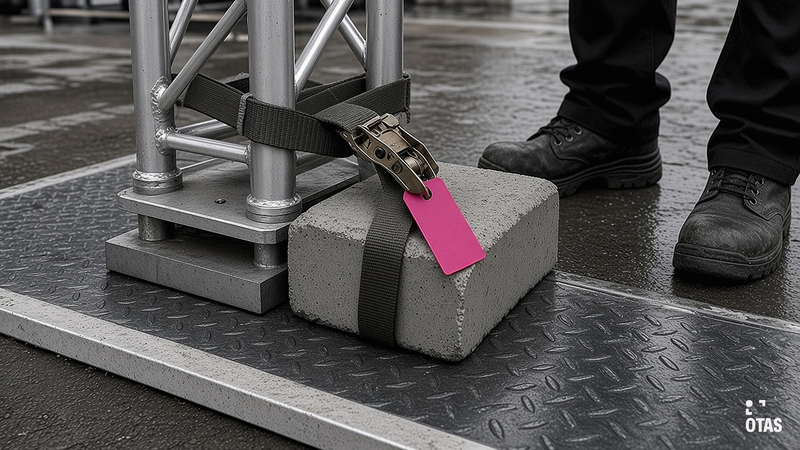
A banner turns a frame into a sail
OTAS professional practice. A method, not a set of figures. Your supplier and a competent engineer give the numbers.
What changes with a banner
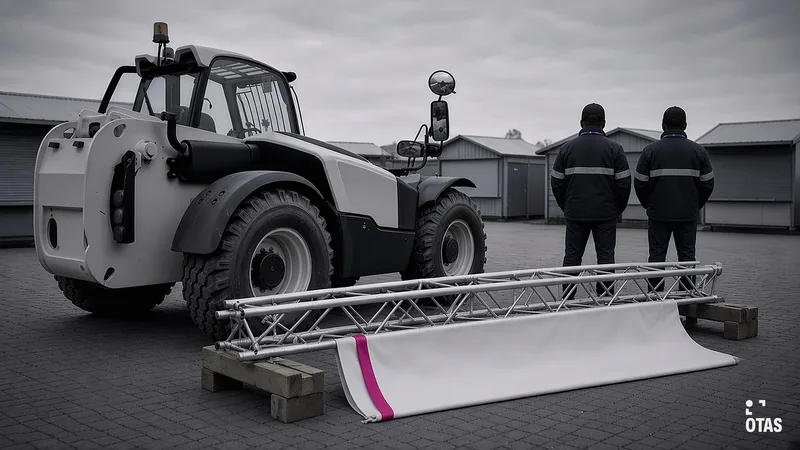
- Wind load A banner fills the gaps in an open truss and catches the wind. Treat any banner, mesh or sign on a frame as a wind loaded structure.
- The design Check whether the supplier's design allows for the banner, mesh or sign actually fitted.
- Mesh and slots Use banners with wind slots or mesh where the design allows.
- The first move Taking the banner off or rolling it removes the sail. Clear the route under it first, then make it your first threshold action.
Five questions to ask your supplier this week
OTAS professional practice. Ask in writing and keep the answers with the register.
The questions
- 1. The design Does the design for this item allow for the banner, mesh or sign we are fitting?
- 2. The wind limits What is the operating wind speed with the banner on, and the action speed?
- 3. The fixing What ballast or fixing does it need, and how should we check it each day?
- 4. The handover Will you give us a signed handover inspection report for this item? The Purple Guide expects one for larger structures [5].
- 5. The call out Who is on call to inspect it again after high winds or a vehicle strike?
Signs an overhead item needs action
Signs 1 and 2 follow the Purple Guide and the Met Office [5][9]. Sign 3 is HSE [7]. Signs 4 and 5 are OTAS professional practice.
Signs an overhead item needs action
- 01The wind is rising
The Purple Guide says to monitor wind with an anemometer and act “if there is any risk of them being blown over” [5].
- 02A warning is in force
Read the warning, not just its colour. Yellow and amber cover “a range of impact levels and likelihoods” [9].
- 03People climbing on it
HSE lists “climbing onto equipment/structures” as dangerous behaviour [7].
- 04Ballast or fixings moved
Blocks shifted, straps slack, or a vehicle has touched the base.
- 05The banner is straining
The banner is billowing, the frame is moving or the ties are working loose.
Five decisions for every overhead item
OTAS professional practice unless a source is shown. Make them before the market opens, not on the windy day.
Five decisions for every overhead item
Register it
Any truss, arch, gantry or span over a public route is a temporary demountable structure, not signage. Put it on the structures register, and in your risk assessment [18].
Know its limit
Ask the supplier for the operating wind speed with the banner on, and the action speed. Write both numbers on the register and the control room board.
Measure the wind
The Purple Guide names the anemometer [5]. Use a fixed anemometer at the height of the item, or read a handheld one close to it and allow for stronger wind higher up. Read it every 30 minutes, and every 15 minutes once any warning is in force.
Act at each threshold
At the first threshold, clear and cone the route under it, then the supplier's competent crew takes the banner off or rolls it. Nobody works on it at height with people underneath. At the action threshold, close the route and divert. Above the operating limit, lower or remove. One UK council park guide sets action points at 60% and 80% of the maximum wind load [15].
Sign it off
A signed handover inspection report for larger structures [5]. Get one for every overhead item regardless of size, plus a daily visual check record.
The structures register
One line for every overhead item. OTAS professional practice.
| Field | What to record |
|---|---|
| Item | Arch, banner truss, gantry or festoon span |
| Location | The route it spans |
| Supplier | Company and on call contact |
| Design wind speed | Operating and action speeds, with the banner on |
| Ballast or fixing | The method, and the daily check |
| Handover | Date and who signed it |
Table 4. A structures register line. OTAS professional practice.
Wind monitoring and thresholds
The Purple Guide names the method [5]. The timings and actions are OTAS professional practice. The wind speeds for each item come from its supplier.
| Condition | What happens |
|---|---|
| Normal | Anemometer [5] read at height, close to the item, every 30 minutes (OTAS practice) |
| Warning issued | Readings every 15 minutes |
| First threshold | Route under it cleared and coned, then banner off or rolled by competent crew |
| Action threshold | Route under it closed, crowd diverted |
| Over the limit | Item lowered or removed |
Table 5. A threshold ladder for overhead items. OTAS professional practice.
Closing and diverting an entrance
OTAS professional practice. Plan it on a calm day so it works on a windy one. HSE asks organisers to plan for incidents and emergencies [20], and to base crowd controls on the risk, including the routes in and out [22].
Before the market opens
- A named person with authority to close the entrance route.
- An alternative entrance route planned and signed in advance.
- Cones and barriers stored near the way in.
When the call comes
- An exclusion zone at fall height plus a margin when wind thresholds are hit.
- Stewards turn people to the second way in before they reach the arch.
- The safety officer closes the route and authorises reopening.
Before reopening
- The supplier contact inspects the item again.
- The daily visual check is recorded before people walk under it.
After an incident: scene, welfare and messages
What happened in this case is sourced. The lessons are OTAS professional practice.
What happened here
- The scene The truss was seized as evidence [1].
- Welfare Witnesses were supported by emergency pastoral care [1]. Psychological support was offered [2].
- The rumours Police had to correct rumours of more casualties on social media [1].
- The decision The organiser set up a crisis team at once and ended the evening [1].
What to do (OTAS practice)
- Once casualties are cared for and the area is made safe, preserve the structure and the scene for investigation. Do not tidy up.
- Welfare support for witnesses and staff, not only for the injured.
- A holding statement ready to post, so facts move faster than rumours.
- Reopen only after the scene is released and every other overhead item is checked.
Roles for overhead items
Four roles, each with one named person on every market day. OTAS professional practice.
| Role | What they own |
|---|---|
| Site manager | The register and the daily checks |
| Weather lead | Readings, the forecast and the threshold calls |
| Safety officer | Closing routes and authorising reopening |
| Supplier contact | On call to inspect again |
Table 6. Roles for overhead items. OTAS professional practice.
Action box
Operational
- Know the signs
- Radio it
- Help cone and divert
Know the signs. If the banner strains, the ballast moves or people climb the frame, radio it. Keep people moving under the arch, not queuing. Help cone and divert when the call comes.
Tactical
- Read the wind
- Close the route
- Run the daily checks
Own the readings and the thresholds. The weather lead reads the wind and the forecast. The safety officer closes the route and authorises reopening. The site manager runs the daily checks.
Strategic
- Register every item
- Wind limits in contracts
- A second way in
Make overhead items part of the structures register and the budget. Ask for wind limits with the banner on in every supplier contract. Plan and sign an alternative way in before opening.
A checklist for overhead items
OTAS professional practice unless a source is shown.
Before opening
- Every overhead item on the structures register.
- Operating and action wind speeds from the supplier, with the banner on.
- A signed handover for every item [5].
- An alternative entrance route planned and signed.
Each market day
- Ballast and fixings checked, and checked again after any vehicle strike.
- Forecast and warnings monitored before and during the event [6][9], and checked each morning and afternoon (OTAS practice).
- Anemometer readings logged at height, close to the item [5].
When the wind rises
- Route under it cleared, then banner off or rolled, at the first threshold.
- Exclusion zone at fall height plus a margin.
- The named person closes the route and diverts the crowd.
What we do not know yet
- Why the truss came down. Police said probably a gust of wind, and the investigation is open [1][11]. A regional news site said it is not yet settled whether the wind or something else caused it [12].
- The wind speed at the market. The warning covered the uplands and other areas in two states [2]. It was not a reading at the site.
- The make, size and fixing of the truss, and whether it had a wind limit or a handover.
- Whether anyone will face charges. Police gave no further details on 6 November [11].
Coming up: the winter market season
Winter markets in the UK are going up now, through the windiest months of the year. Most have a banner or arch over the way in. The Met Office says that as of October 2026 the impact matrix shown in its warnings video “has slightly changed” [9]. Read the new matrix before your first market day, and brief your weather lead on it.
Frequently asked questions
Is a banner arch a structure or a sign?
Treat it as a structure. OTAS professional practice: any truss, arch, gantry or span over a public route is a temporary demountable structure and belongs on the structures register. HSE lists “Collapse of a temporary structure” among crowd hazards [7].
What wind speed should we close at?
There is no single number in the guidance we read. It depends on the design of the item with its banner on. Ask the supplier for the operating wind speed with cladding and the action speed, and set your thresholds from those.
Do we really need an anemometer?
The Purple Guide says “Wind conditions should be monitored using an anemometer (wind speed device)” [5]. OTAS professional practice: take readings at height and close to the structure, not from a phone forecast.
Do small arches need a handover?
The Purple Guide says that for larger structures the supplier “should provide a signed handover inspection report” [5]. OTAS professional practice: get one for every overhead item regardless of size, plus a daily visual check record.
Is a yellow warning safe to ignore?
No. The Met Office says yellow and amber warnings “represent a range of impact levels and likelihoods” and that “it is important to read each warning” [9]. Read the impact and likelihood, not just the colour.
A trader put up the arch. Is it still our problem?
HSE says that while some parts of crowd safety can be given to contractors, you keep overall responsibility for the safety of the public [19]. Employers must assess the risks to people affected by their work [18], and must not expose the public to risks, so far as is reasonably practicable [17]. Put every trader's overhead item on your register. That is a summary, not legal advice.
Can an inspector stop us?
Under section 22 of the Health and Safety at Work etc. Act 1974, an inspector can serve a prohibition notice where activities involve “a risk of serious personal injury” [10]. That is a summary, not legal advice.
Related OTAS Insights
These are links to other OTAS Insights pieces, not to any OTAS Live product or service.
- Signed off yesterday, failed today: temporary seating on show day
- When a rumour moves faster than your stewards
Interest: OTAS Live Ltd, which publishes OTAS Insights, sells event operations services, handbooks and training related to this topic.
Law: this Insight summarises parts of the law in Great Britain, and UK guidance, as published on legislation.gov.uk and by HSE and the Met Office. Northern Ireland has its own equivalent law. It is not legal advice. Ask your council and your structure supplier what applies to your event, and take advice.
References
Web sources opened 9 November 2026 and labelled with their publisher. German sources in OTAS translation. Some source web addresses include the town or event name. We do not use those names in the text.
- Police headquarters, Koblenz, follow up release on an accident at an autumn market, Presseportal, in German, 23 October 2026 presseportal.de
- SWR Aktuell, public broadcaster, metal frame falls over at an autumn market, in German, 24 October 2026 swr.de
- SWR Aktuell, public broadcaster, autumn market goes on after a serious accident, in German, 24 October 2026 swr.de
- Rhein-Zeitung, how the town and district responded to the accident, in German, 25 October 2026 (subscription, opening only read) rhein-zeitung.de
- The Purple Guide, temporary demountable structures, chapter summary, 26 January 2026 thepurpleguide.co.uk
- The Purple Guide, weather, chapter summary, 26 January 2026 thepurpleguide.co.uk
- HSE, crowd management, assess crowd safety risks and identify hazards hse.gov.uk
- HSE, event safety, temporary demountable structures hse.gov.uk
- Met Office, weather warnings guide, read 2 November 2026 weather.metoffice.gov.uk
- Health and Safety at Work etc. Act 1974, section 22, prohibition notices, legislation.gov.uk legislation.gov.uk
- Police headquarters, Koblenz, follow up release, the 72 year old visitor has died, Presseportal, in German, 6 November 2026 presseportal.de
- BEN-Kurier, regional news site, 72 year old dies after the accident at the autumn market, in German, 6 November 2026 ben-kurier.de
- FAZ, dpa report, 72 year old dies after an accident at a fair, in German, 6 November 2026 faz.net
- The Institution of Structural Engineers, Temporary demountable structures: guidance on procurement, design and use, fourth edition, 1 May 2017 istructe.org
- Bute Park event guide, Cardiff Council, temporary demountable structures, first published 4 February 2020 bute-park.com
- Met Office, Beaufort wind force scale metoffice.gov.uk
- Health and Safety at Work etc. Act 1974, section 3, duties to persons other than employees legislation.gov.uk
- Management of Health and Safety at Work Regulations 1999, regulation 3, risk assessment legislation.gov.uk
- HSE, set clear roles and responsibilities, updated 4 April 2025 hse.gov.uk
- HSE, managing crowds safely hse.gov.uk
- The Purple Guide, crowd management thepurpleguide.co.uk
- HSE, event safety, put crowd controls in place hse.gov.uk
If the wind rose at your way in tonight, who would close the route under the arch?
If you need support with a structures register or a wind plan for your market, reach out to us to see how we can support you.
Events industry since 2008, internationally since 2015. OTAS Live Ltd. By OTAS Insights. Edited by Kris Dailly.
Download the PDFs
- The article: PDF, 28 pages, 5.0 MB
- The full report: PDF, 38 pages, 7.0 MB
- The slide deck: PDF, 27 pages, 1.5 MB
Corrections to published Insights articles are listed in our corrections log.