
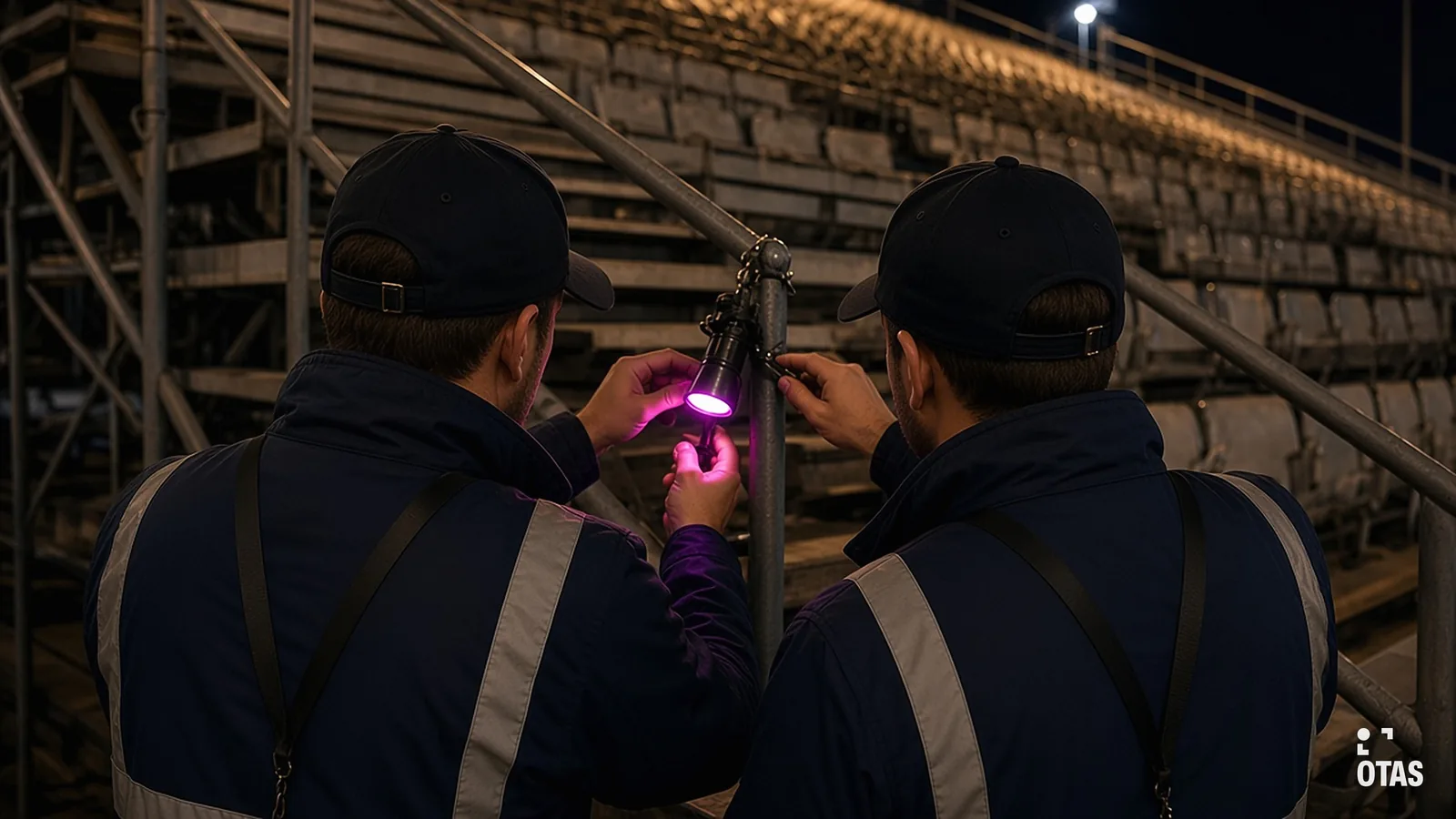
Download the PDFs
- The article: PDF, 21 pages, 4.8 MB
- The full report: PDF, 35 pages, 8.6 MB
- The slide deck: PDF, 24 pages, 1.6 MB
treated after a stand gave way [4]
taken to hospital [3][4]
after an engineer's sign off [1]
“The signing off procedure is more than a paperwork exercise.”
HSE research on temporary demountable structures [11]
By OTAS Insights · Published by OTAS Live Ltd
On the afternoon of 1 November 2026, part of a temporary grandstand gave way during a music concert on a beach at Coolangatta in Queensland, Australia [1][2]. One report said the stand moved like a wave [4]. Police later said 22 people were treated and four went to hospital [4]. The organiser said the stand had been signed off by an engineer the day before [1][7]. The show paused, the stand was cleared and the concert carried on about an hour later [2][3]. Queensland Police and Workplace Health and Safety Queensland are investigating, and the city council has said it will review [1][4][6]. The cause has not been made public. This Insight is for organisers who put temporary seating into an event. It covers what UK guidance expects, why a sign off is not the end of the checks, what to look at on show day, and when to close a stand.
In short: the sign off is where show day checks begin. Get the handover paperwork, walk the stand on the day, watch it while it is full, and agree before you open who can close it.
What was reported
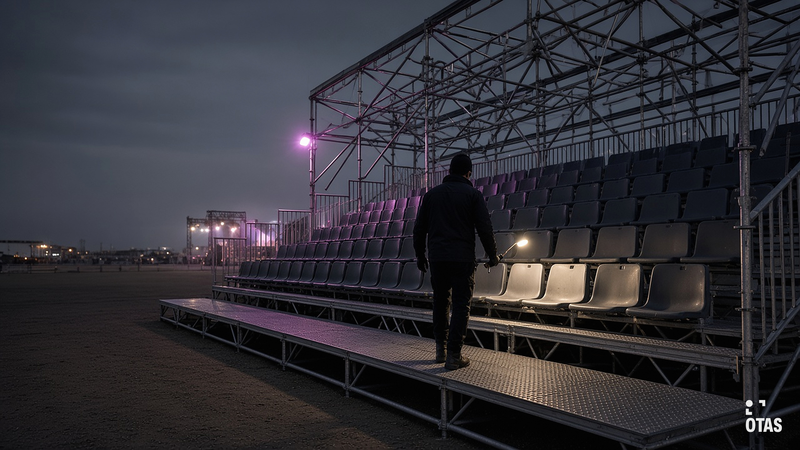
Two collapses at events, in Queensland in 2026 and in Lincolnshire in 2004, and a regulator alert from 2016 [1][8][9]. We describe places rather than naming events, organisers or suppliers. Where a cause is claimed, we say who claimed it.
Coolangatta, Queensland, 1 November 2026
- Where A temporary grandstand at a touring music concert on the beach at Coolangatta, Queensland [1][6].
- What happened Part of the stand gave way in the afternoon. Reports give times between about 2pm and 2.50pm [1][2][5]. One report said the stand moved like a wave, and that a woman's ankle was trapped [4].
- Injuries Early reports said three people had minor injuries [1]. Police later said 22 people were treated and four were taken to hospital [4]. Another report listed a collarbone, an ankle and two back injuries [3].
- How many were on it A trade report said 700 to 1,000 of the 10,000 people at the show were on the structure [6].
- The sign off The organiser said the stand had been signed off by an engineer the day before [1]. The council issued the event permit and said it would review [1].
- Afterwards The show paused, the stand was cleared and the concert carried on about an hour later [2][3]. Police and Workplace Health and Safety Queensland are investigating [4][5][7]. The mayor has asked to see the findings, and future concerts on the beach are under review [6].
Lincolnshire, August 2004
- Where Temporary seating in a large marquee at a festival on a showground near Lincoln [9][10].
- What happened HSE research says the crowd was invited to stand and jump together, and the seating, which was not anchored, moved forward by about 1.5 m and then collapsed [11].
- Injuries BBC News reported four people seriously hurt and 12 with minor injuries [9]. New Civil Engineer reported 21 people treated in hospital [10].
- The question asked at the time New Civil Engineer reported that investigators were looking at whether the stand had slipped off the timber blocks it stood on, on grass [10].
Queensland, 2016 alert
- What the regulator said Workplace Health and Safety Queensland warned about temporary modular grandstands after two people were seriously hurt when part of a platform dropped [8].
- Causes it listed Corrosion of scaffold parts, set up on soft or sloping ground where a stand can slide or tilt, storm damage, and loads greater than a platform was designed for [8].
- What it asked for An inspection before each event, written down with the name and signature of the competent person and the date [8].
What these cases do and do not show
Facts and judgement are kept apart here. The facts carry source numbers. The rest is OTAS guidance.
| Item | What is reported | What is not known |
|---|---|---|
| Coolangatta 2026 | Signed off the day before, the organiser said. 22 treated, 4 to hospital [1][4] | The cause, what the sign off covered, and what changed after it |
| Lincolnshire 2004 | Crowd jumped, unanchored seating moved and collapsed [11] | Not in question: HSE research sets out the sequence [11] |
| Queensland 2016 | Part of a platform dropped, corrosion a major factor [8] | Which parts a visual check could have found [8] |
Table 3. Facts and open questions in the three cases. Facts from [1][4][8][11].
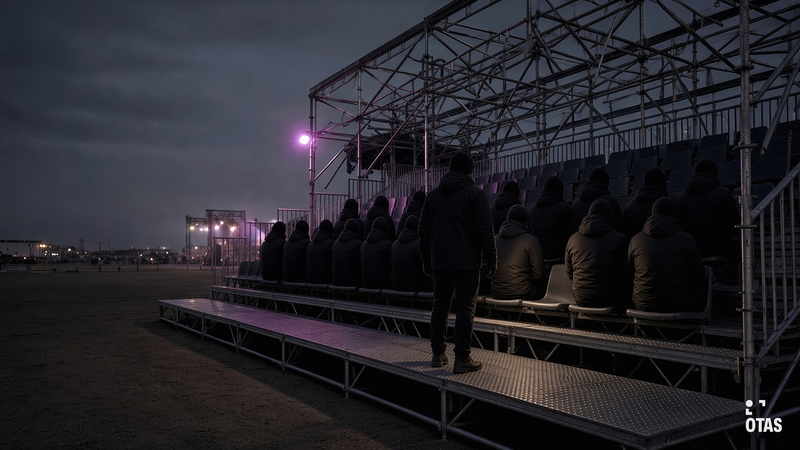
The lesson for organisers does not depend on the cause. In each case a stand that had been put up for the public failed while people were on it. The design, the build, the ground and the way the crowd used it all matter, and show day is when they come together.
What GB guidance says about temporary seating
In brief, from HSE guidance and research [11][12][13][14][15], the CDM Regulations 2015 [16], IStructE guidance [17][18], the Sports Grounds Safety Authority [19][20][21] and the Purple Guide [22]. Not legal advice.
Who holds the duty
- At an event the organiser is usually the CDM client [15]. Where there is more than one contractor, the client appoints a principal designer and a principal contractor. If it does not, it takes on their duties itself [15][16].
- HSE says the whole event can be one CDM project, and the build and breakdown need a construction phase plan [14].
- There must be clarity over who is in control of the structure at each stage [15].
- IStructE guidance treats the client as the duty holder, and asks for written evidence that the people doing the work are competent [18].
Who enforces
- HSE says local authorities generally enforce health and safety at events. HSE enforces the erection and dismantling of temporary demountable structures [13].
- At sports grounds, SGSA guidance says ground management cannot delegate its responsibility for a demountable stand to the event promoter or the designers [20].
Before the public are let in
- IStructE guidance, as summarised in HSE research, recommends an independent check that the stand has been built to its design, and a completion certificate [11].
- HSE research says the signing off procedure is more than a paperwork exercise. It is the main way the limits of the structure are passed on to the people who use it [11].
- The Purple Guide asks for a signed handover inspection report from the supplier [22]. One borough council asks for a competent person's sign off form before the event starts [23].
- SGSA guidance for sports grounds lists inspection and testing every year, every three months and before each event [20].
While the stand is in use
- Crowd movement matters. HSE research describes a stand that moved and collapsed when a crowd jumped together [11].
- HSE says organisers should put crowd controls in place based on the risk, including the number of people, the space and the routes in and out [24].
- HSE research describes suppliers staying on site after handover to watch the load in, known as babysitting [11].
- Plan for the weather, including what happens if the wind goes beyond the design limits [18][22].
- Checks continue during the event, especially in wind or poor weather [23].
HSE research found that in some cases sign off systems appeared weak [11]. A signature on a handover form is only as good as the check behind it and the people who read it.
The paperwork to collect before the public sit down
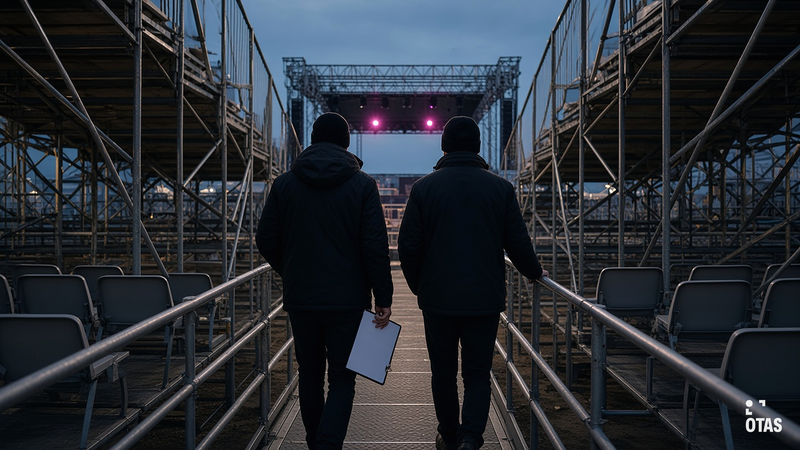
Collect these for every temporary stand. Sources shown. Not a full list. Ask your council and safety advisory group what they need.
| Document | What to check |
|---|---|
| Design and calculations | For this stand, this use and this ground, with the loads and wind limits [17][18] |
| Competence | Written evidence that the designer and builder are competent for this work [18] |
| Independent check | Who checked the stand was built to its design, and when [11] |
| Handover report | Signed by the supplier, with the limits in plain words [11][22] |
| Construction phase plan | For the build and breakdown, if your event is a CDM project [14][16] |
| Show day record | The walk before doors, with name, signature and date [8] |
Table 4. Paperwork for each stand. Sources shown.
Read the handover report, not just the signature. It should tell you how many people the stand is for, whether they may stand, what wind it can take and what to do if the weather goes beyond it [11][18].
Who owns what around a temporary stand
Five roles, each with one named person. Drawn from HSE CDM guidance [14][15] and HSE research [11].
| Role | What they own |
|---|---|
| Organiser, as CDM client | The project, the appointments, the time and money for safe work, and the decision to open [15][16] |
| Principal designer or designer | The design of the stand and the limits it is built for [15][17] |
| Principal contractor or supplier | The build, the handover and, if agreed, staying on site after handover [11][15] |
| Independent checker | Checking the stand is built to its design [11] |
| Stand supervisor on the day | Watching the stand while it is full, and the call to close it |
Table 5. Roles around a temporary stand. Drawn from HSE [11][14][15] and IStructE [17].
Why show day is where stands fail
The Coolangatta stand was signed off the day before [1]. The Lincolnshire seating moved when the crowd jumped [11]. The rest of this section is OTAS guidance, drawing on HSE, IStructE and WHSQ.
From the handover to a full stand
- The ground changes. Rain, tides, traffic and the build itself change the ground. WHSQ warns that a stand on soft or sloping ground can slide or tilt [8].
- The load changes. A full stand is not an empty stand. People stand up, sway and jump together, and gangways carry people moving fast [11].
- The stand gets changed. Rails come off for a camera, a panel is moved for access, bracing is borrowed. Small changes after sign off can undo the design.
- The weather changes. Wind and rain on show day may not be what the design assumed. IStructE asks for a plan for weather beyond the limits [18].
- Nobody owns it after handover. The supplier has gone, the stewards watch the show, and the sign off sits in a folder. HSE research calls for clarity over who is in control [11][15].
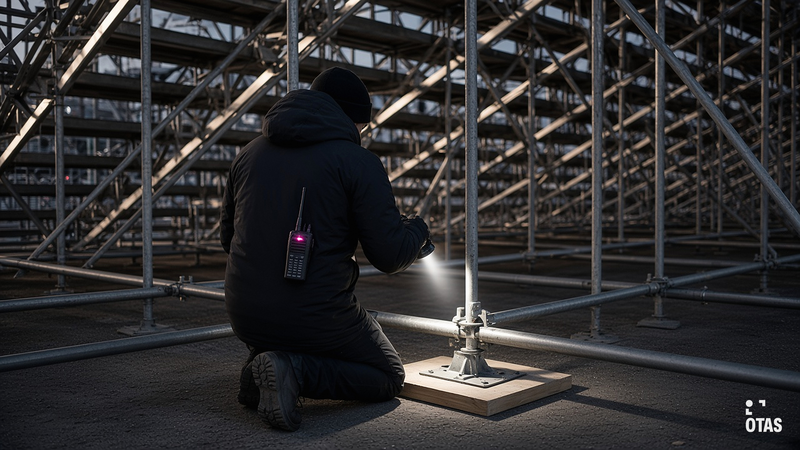
Tool: show day stand walk
Use this before doors, and again after any weather change. OTAS guidance, drawing on WHSQ [8], HSE research [11] and SGSA Annex D [20].
Feet and ground
- Every base plate sits square on its pad, and the pads sit on firm ground [8].
- No pad has sunk, moved or been washed out. Water is not running under the stand [8].
- Nothing has been parked against or driven into the frame.
Frame and deck
- No bracing, clips or boards missing or loose [8].
- No visible corrosion or damage at joints [8].
- Nothing added to or taken off the stand since the handover.
Rails, gangways and stairs
- Guardrails and handrails complete, with no gaps a child could get through [8].
- Gangways and stairs clear, with lighting for after dark.
- Exits from the stand open and signed.
Weather
- Wind and rain checked against the limits in the handover report [18][22].
- A plan if the weather goes beyond them.
Signs a temporary stand needs checking now
Each of these is OTAS guidance, drawn from the reports, WHSQ and HSE research.
Signs a temporary stand needs checking now
- 01Movement
A section sways, bounces or shifts when people move, more than the rest of the stand [4][11].
- 02Feet and ground
Plates off their pads, pads sinking, washed out or wet ground [8][10].
- 03Missing parts
Gaps in rails, loose boards, bracing or clips missing [8].
- 04Changed since sign off
Something moved, added or taken off after the handover.
- 05Over full
People standing in gangways, on rails or more people than seats.
Tool: close the stand triggers
When a stand, or part of it, should be cleared, and who acts. Agree these with the supplier before opening. OTAS guidance, drawing on WHSQ [8] and HSE research [11].
If a stand moves in a way it should not, the safe call is to clear that section first and ask why later. Agree the radio call and who makes the decision, and make sure every steward on the stand knows them.
| Trigger | Who acts | What happens next |
|---|---|---|
| A section moves, bounces or shifts | Stand supervisor | Clear the section, call the supplier |
| A plate, pad or the ground has moved | Stand supervisor | Close that section until checked [8] |
| Parts missing or damaged | Stand supervisor | Close that section until fixed [8] |
| Wind or rain beyond the limits | Organiser, on the supplier's advice | Clear the stand [18][22] |
| Crowd jumping or standing on a seated stand | Stewards, then the show caller | Ask the stage to calm it, stop if needed [11] |
| Anyone hurt or trapped | Stand supervisor | Stop the show at the stand, clear the section around them, call first aid and the supplier |
Table 6. Close the stand triggers. Who acts is OTAS guidance.
Plan temporary seating from order to the last seat
Five stages, from the order to the close down. OTAS guidance unless a source is shown.
Five stages, from the order to the close down
Order
Ask the supplier for the design, the loads and wind limits it is built for, the ground it needs and evidence of competence [17][18]. Agree who checks it independently [11].
Build
Agree who is in control during the build, and record any changes to the design [14][15]. Check the ground and the pads before the stand goes up [8].
Hand over
Get a signed handover report from the supplier, with the limits in plain words [11][22]. Check it matches what is built.
Show day
Walk the stand before doors, with the supplier if possible. Brief stewards on the signs and the stop. Watch the weather [8][20][23].
In use
Keep a named person watching the stand while it is full. If in doubt, stop the show at that stand and clear it. Keep it closed until it is checked [8].
Tool: steward brief for a temporary stand
Read to every steward working on or near the stand. OTAS guidance, drawing on WHSQ [8] and HSE research [11].
Your job
- Watch the stand and the people on it, not the show.
- Keep gangways and stairs clear. No standing on seats or rails.
- Know your section, your exits and the radio call.
If you see a sign
- Movement, a gap, a loose part or people over the limit: call it in straight away.
- Keep people off the section, calmly, until the supervisor decides.
If the stand is cleared
- Use calm, short words. Move people down the nearest stair and away from the stand.
- Help anyone who needs it. Nobody goes back on until the supervisor says so.
Tool: stage and PA words for a seated stand
Short words, ready before the show. Agree them with the stage manager. OTAS guidance, drawing on HSE research on crowd movement [11].
Before the show
- "Welcome. If you are in the seating, please stay seated and keep the stairs clear."
If the crowd starts jumping
- "Thank you, you sound amazing. For your safety, if you are in the seating please stay seated."
If a section needs clearing
- "Can I ask everyone in the seating on the left to calmly follow the stewards down the nearest stairs. Thank you."
A stand designed for people sitting may not be designed for people jumping together [11]. Ask the supplier what the stand is designed for, and brief the stage so the act does not ask the seated crowd to jump.
The first ten minutes after a stand moves or fails
OTAS guidance. Agree it with the supplier, the stage and event control, and brief it to every steward on the stand.
First minute
- The stand supervisor calls it in. The show caller stops the show if needed.
- Stewards move people off the affected section, calmly, by the nearest stairs.
- Nobody climbs on the stand to help, except trained staff if it is safe.
Next five minutes
- First aid reaches anyone hurt. Event control calls 999 if needed and sends a steward to meet the ambulance.
- The area under and around the stand is cleared.
- The supplier is called back to site.
Up to ten minutes
- The whole stand stays closed until it is checked by a competent person [8].
- Event control decides whether the show carries on, and where people sit.
- Someone records times, witnesses and what was seen. Ask whether the incident is reportable to the enforcing authority.
Action box
Operational
- Walk it before doors
- Keep gangways clear
- Call in the signs
Walk the stand before doors. Look at the feet, the ground, the rails and the gangways. Keep gangways clear while the stand is full. If you see a sign, call it in and keep people off that section.
Tactical
- Check the handover
- Brief the signs
- Name the watcher
Get the handover report and check it matches what is built. Brief stewards on the five signs and the stop. Name who watches the stand during the show and who can close it.
Strategic
- Act as the client
- Get limits in writing
- Name who reopens
Act as the CDM client. Order seating from a competent supplier with the design and limits in writing. Agree the independent check, who stays on site after handover, and who decides when a closed stand reopens.
Readiness checklist
OTAS guidance unless a source is shown.
Before ordering
- Design, loads and wind limits in writing [17][18].
- Evidence of competence [18].
- CDM roles agreed [15].
Before doors
- Independent check done [11].
- Signed handover report read and filed [11][22].
- Show day walk signed and dated [8].
- Close the stand call tested.
During the show
- A named person watching the stand.
- Weather watched against the limits [22].
- Gangways kept clear.
After
What we do not know yet
- What caused the stand at Coolangatta to give way, which investigators have not said.
- What the engineer's sign off covered, and whether anything changed after it.
- How many people were on the affected section, and whether they were sitting or standing.
- What the council review will decide about future concerts on the beach.
Coming up: winter events with seating
Ice rinks, carol concerts, light shows and New Year events often put temporary seating on town squares, parks and car parks in the dark and the wet. Ground, wind and crowd mood all change through a winter evening. Plan the show day checks and the stop before the first night [8][11].
Frequently asked questions
The engineer signed it off. Is that not enough?
A sign off tells you the stand was right when it was checked. HSE research says sign off is more than a paperwork exercise, it is how the limits of the structure are passed on [11]. Show day checks look for what has changed since.
Who is responsible for the stand, us or the supplier?
Both have duties. At most events the organiser is the CDM client, and keeps client duties even when contractors are appointed [15][16]. The supplier is responsible for the stand it designs and builds. Agree in writing who is in control at each stage [15].
Who enforces this?
HSE says local authorities generally enforce health and safety at events, and HSE enforces the erection and dismantling of temporary demountable structures [13].
How often should a temporary stand be checked?
WHSQ asks for an inspection before each event, written down [8]. SGSA guidance for sports grounds lists checks every year, every three months and before each event [20]. One council asks for regular checks in wind [23]. On show day, walk it before doors.
What should stewards on a stand do if it moves?
Call it in, keep people off that section and move them calmly to a safe area. The named person decides whether to stop the show at the stand. Keep it closed until it is checked [8].
Does the Green Guide apply to our event?
The Green Guide and SGSA guidance are written for sports grounds [19][20]. Many event safety advisers use them as a benchmark for demountable stands elsewhere. Ask your safety advisory group what it expects.
Related OTAS Insights
These are links to other OTAS Insights pieces, not to any OTAS Live product or service.
Interest: OTAS Live Ltd, which publishes OTAS Insights, sells event operations services, handbooks and training related to this topic.
Law: this Insight summarises HSE guidance and research, the CDM Regulations 2015, which apply in Great Britain, IStructE and SGSA guidance, the Purple Guide and council guidance, with a Queensland regulator alert. It is not legal advice. Northern Ireland has its own CDM Regulations from 2016. Ask your council, your safety advisory group and your seating supplier what applies to your event.
References
Web sources opened 9 November 2026 and labelled with their publisher.
- 7NEWS, injuries after grandstand collapses during a show in Queensland, 1 November 2026 7news.com.au
- Brisbane Times, grandstand collapses at a Queensland music festival, 1 November 2026 brisbanetimes.com.au
- Nine, grandstand collapses at a Queensland music festival, 1 November 2026 nine.com.au
- Rolling Stone Australia, dozens injured after grandstand collapse, 2 November 2026 au.rollingstone.com
- ABC News, Queensland local news briefing, 2 November 2026 abc.net.au
- Pollstar, investigations begin over a Queensland grandstand collapse, 3 November 2026 news.pollstar.com
- Australasian Leisure Management, investigations launched after grandstand collapse in Queensland, 1 November 2026 ausleisure.com.au
- Workplace Health and Safety Queensland, safety alert, grandstand collapse, 2016, updated 2018 worksafe.qld.gov.au
- BBC News, witness saw terrifying collapse, Lincolnshire, August 2004 news.bbc.co.uk
- New Civil Engineer, collapsed stand could have slipped off blocks, 9 September 2004 newcivilengineer.com
- HSE research, identification of safety good practice in the construction and deconstruction of temporary demountable structures hse.gov.uk
- HSE, event safety, temporary demountable structures hse.gov.uk
- HSE, event safety, frequently asked questions hse.gov.uk
- HSE, how the CDM Regulations are applied and administered in the entertainment industry hse.gov.uk
- HSE, CDM Regulations, roles and duties in the entertainment industry hse.gov.uk
- The Construction (Design and Management) Regulations 2015 legislation.gov.uk
- The Institution of Structural Engineers, Temporary demountable structures: guidance on procurement, design and use, fourth edition istructe.org
- The Institution of Structural Engineers, procurement and use of demountable structures istructe.org
- Sports Grounds Safety Authority, demountable structures sgsa.org.uk
- Sports Grounds Safety Authority, Annex D, demountable stand checklist sgsa.org.uk
- Sports Grounds Safety Authority, Guide to Safety Certification, December 2024 sgsa.org.uk
- The Purple Guide, temporary demountable structures thepurpleguide.co.uk
- Hastings Borough Council, event planning, temporary structures hastings.gov.uk
- HSE, event safety, put crowd controls in place hse.gov.uk
If one section of your stand moved during the show tonight, would anyone be watching it, and could they stop the show?
If you need support with planning temporary seating at your event, reach out to us to see how we can support you.
Events industry since 2008, internationally since 2015. OTAS Live Ltd. By OTAS Insights. Edited by Kris Dailly.
Download the PDFs
- The article: PDF, 21 pages, 4.8 MB
- The full report: PDF, 35 pages, 8.6 MB
- The slide deck: PDF, 24 pages, 1.6 MB
Work with OTAS
Putting temporary seating into your event?
Corrections to published Insights articles are listed in our corrections log.