
Download the PDFs
- The article: PDF, 21 pages, 3.1 MB
- The full report: PDF, 34 pages, 5.3 MB
- The slide deck: PDF, 24 pages, 1.1 MB
injuries found, the organiser said [1]
per group in the exit [1]
the ages on the listing [2]
“During an incident, initial decision-making should not be delayed pending instruction or action from the police.”
ProtectUK [14]
By OTAS Insights · Published by OTAS Live Ltd
On the evening of Thursday 29 October 2026, rumours of a stabbing spread during an under 16s night at a club in Wolverhampton, Birmingham Live reported [1]. The organiser's ticket listing gives the night as 5pm to 9pm, for ages 12 to 16 [2]. The organiser said no stabbing took place [1]. It said an incident at the end of the road involved a young male and a group of young lads who had not been inside [1]. It said on site paramedics found no injuries, and attendees left in groups of five through a controlled exit [1]. It said a small number of parents forced their way in and abused and threatened staff [1]. West Midlands Police could not find a log for the street or the venue, the paper reported [1]. This Insight is for event teams who run events for young people, or any crowd. It covers how rumours spread, what UK guidance expects, and how to get the true message out first, hold a calm exit and hand young people safely to their parents.
In short: a rumour will reach parents before it reaches you. Decide before doors who speaks, what they say and where, run a calm exit if you need one, and hand every young person to a known adult.
What was reported
One local report, two false alarms from 2017 and a regulator's finding from 2024 [1][3][5][7]. We do not name the venue, the organiser or anyone involved. Where a claim is made, we say who made it.
Wolverhampton, 29 October 2026
- The event An under 16s night at a club in Wolverhampton. The ticket listing gives ages 12 to 16, 5pm to 9pm [2]. Birmingham Live gave the date as Thursday 29 October [1].
- The incident outside The organiser said an incident at the end of the road involved a young male and a group of young lads. None of them had been inside or tried to get in [1].
- The rumour Rumours of a stabbing spread and worried parents rushed to the site, the paper reported [1]. The organiser said the police presence caused concern, after numerous reports with false information [1].
- The care The organiser said on site paramedics assessed the young male and found no injuries, and its welfare team kept him safe inside until his father arrived [1].
- The exit The organiser said it brought in a controlled exit at once, releasing attendees in groups of five [1].
- The doors The organiser said a small number of parents forced their way in and subjected staff to verbal abuse and threatening behaviour [1]. One parent said her daughter was kept inside until she pointed her out, and stewards then let her go to her [1].
- The police West Midlands Police could not find a log for the street or the venue, and the paper asked it to search nearby streets [1].
London, 24 November 2017
- What happened Reports of gunshots at a busy Tube station on a Friday evening led to an evacuation and armed police. Police found no evidence of shots, and believed an altercation between two men on a platform came first [3].
- How it spread People came up to street level confused, some reporting loud bangs, and panic passed down the street and onto social media, the BBC reported [3].
- Injuries 16 people were treated after they were hurt leaving the station [3].
Turin, Italy, 3 June 2017
- What happened Thousands watched a football final on a big screen in a city square. A bang was heard and rumours of an explosion spread [4]. One witness said people shouted that there was a bomb [5].
- Injuries About 1,500 people were hurt as the crowd rushed out of the square, police said. Some were hurt when a barrier gave way [4].
England, summer 2024
- What the regulator found Ofcom said illegal content and disinformation spread widely and quickly online after the killings in Southport in July, and that posts from high profile accounts reached millions of users [6][7].

What these cases do and do not show
Facts and judgement are kept apart here. The facts carry source numbers. The rest is OTAS guidance.
| Item | What is reported | What is not known |
|---|---|---|
| Wolverhampton 2026 | A stabbing rumour, none took place, the organiser said. Parents forced their way in [1] | What happened outside, and how the rumour began [1] |
| London 2017 | Gunshot reports, no shots found, 16 hurt leaving [3] | Not in question: police set out the sequence [3] |
| Turin 2017 | A bang, rumours of an explosion, about 1,500 hurt [4][5] | Not covered here: the later legal cases |
Table 3. Facts and open questions in the cases. Facts from [1][3][4][5].
The lesson for organisers does not depend on what started each rumour. In each case people acted on what they had heard before anyone in charge told them what was true. The gap between the rumour and the true message is the gap to close.
What UK guidance says
In brief, from Cabinet Office crowd guidance [8], ProtectUK and JESIP [14][15][16], the Licensing Act 2003 and its guidance [17][18], the Purple Guide and NSPCC [20][21][22][23] and HSE [24]. Not legal advice.
Communicate with the whole crowd
- Cabinet Office guidance lists communication with the whole crowd, audio and visual, as key. This is particularly so in emergencies. It goes with leadership and guidance to start crowd movement [8].
- ProtectUK advises having social media and press holding statements ready. It also advises actively monitoring news, CCTV and social media during an incident [14].
- ProtectUK says the decision to evacuate, invacuate or lock down is usually made by the venue or event management. It should not wait for police [14]. If the threat is outside, it may be safer to stay inside [14].
Share what you know with the services
- Report to police early. Do not wait for all the information [14].
- JESIP's M/ETHANE model gives a set order for passing information to the emergency services. The order is: whether it is a major incident, exact location, type, hazards, access, casualties and services needed [16].
Young people and parents
- In England and Wales, protecting children from harm is one of the four licensing objectives [17]. The guidance describes it as protecting children from moral, psychological and physical harm [18].
- The Purple Guide says it is good practice to appoint two people to look after lost children. It says to make sure everyone knows who is responsible. It also says never to broadcast a lost child's details in a way that adds risk [20].
- One safety advisory group procedure asks for two staff with a found child and a set welfare point. It also asks for a check of the collecting adult's identity, for example by photo ID [23].
The law that is coming
- The Terrorism (Protection of Premises) Act 2025, known as Martyn's Law, received Royal Assent on 3 April 2025 [19]. Premises and events in scope will need procedures for evacuation, invacuation, lockdown and communicating with people [19]. Its duties are not yet in force and guidance is being published. Check whether it will apply to you.
None of these sources says how to beat a rumour. Together they say the same thing: decide early, say one true thing clearly and often, and keep the people you are responsible for safe while you do.
Tool: holding messages, ready before doors
Short, true and calm. Adapt them before the event and agree who can send each one. OTAS guidance, drawing on ProtectUK [14] and Cabinet Office guidance [8].
To staff, on the radio
- "All staff, there is a rumour of an incident. We have no confirmed incident inside. Hold your positions, keep doors calm, send parents to the meeting point."
On the PA
- "There is no confirmed incident inside. Please stay where you are and follow the stewards. We will update you in five minutes."
Online and to parents
- "We are aware of rumours about tonight. There is no confirmed incident inside, and young people inside are being looked after. Parents, please go to the meeting point at the side entrance. We will post an update by 7.30pm."
Only say what you know is true. If you do not know yet, say that you are checking and when you will update. Then update on time [14].
Who owns what when a rumour starts
Five roles, each with one named person. OTAS guidance, drawing on ProtectUK [14] and JESIP [16].
| Role | What they own |
|---|---|
| Event manager | The decision to hold, exit early, invacuate or lock down [14] |
| Event control | Checking facts, logging, calling police with M/ETHANE [16] |
| The speaker | The true message on the PA, online and to parents |
| Head of security | Door staff, the doors and any exit route |
| Welfare lead | Young people waiting, the meeting point and the handover to parents [20] |
Table 4. Roles when a rumour starts. OTAS guidance, drawing on ProtectUK [14] and JESIP [16].
Why rumours move faster than staff
In Wolverhampton, parents arrived after rumours spread [1]. In London in 2017, panic passed onto social media from people leaving a station [3]. The rest of this section is OTAS guidance, drawing on Cabinet Office crowd guidance [8][9] and University of Sussex research [10][11][12][13].
From a rumour to a safe handover
- Phones beat radios. A young person inside can message a parent in seconds. The parent may hear a rumour before your control room hears the facts.
- Fear fills gaps. Research finds people in emergencies act on the information they have and often help each other. Without true information, they fill the gap with the worst they have heard [11][12][13].
- Police presence looks like proof. The organiser said police presence caused concern [1]. Blue lights near a venue can confirm a rumour in people's minds, even when they are there for something else.
- Parents move towards danger. A parent who thinks their child is hurt will go towards them. Expect parents to try to get in, not wait outside.
- Silence looks like hiding. If the organiser says nothing, the rumour is the only story. A short true message beats a perfect late one.
Tool: rumour log for event control
Use this from the first call. OTAS guidance, drawing on ProtectUK [14] and JESIP [16].
When a rumour comes in
- Time, who reported it and how.
- What was said, word for word.
- Who is sent to check, and what they find.
Before you speak
- Is anyone hurt? Ask your medics.
- Is there a weapon or a threat? Ask your security lead.
- Has anyone called police? If not, decide now [14].
After you speak
- Time and words of each message, and the channels used.
- When the next update is due.
- Decisions and the reasons for them [14].
Signs a rumour is getting ahead of you
Signs 1 to 3 are drawn from the Wolverhampton report [1]. Signs 4 and 5 are OTAS guidance, drawing on the 2017 cases [3][4].
Signs a rumour is getting ahead of you
- 01Parents arriving early
Adults at the doors before the advertised end, asking about one incident [1].
- 02Phones up, heads down
People inside or outside reading or filming, then turning to each other.
- 03Pressure at the doors
People trying to get in, not out, and arguing with door staff [1].
- 04A sudden surge
People moving fast away from one point after a noise or a shout [3][4].
- 05Calls about something you have not seen
Your control room hears about an incident from outside first [3].
Tool: hold, exit or lock down
Who decides, and when. Agree these with the venue and police before doors. OTAS guidance, drawing on ProtectUK [14].
If the threat is outside, keeping young people inside may be safer than letting them out into a crowd of worried adults [14]. If you exit early, do it as a staffed, steady flow to a collection point.
| What you know | Usual first step | Who decides |
|---|---|---|
| A rumour, nothing confirmed | Hold, check facts, send the true message | Event manager |
| An incident outside, not linked | Hold inside, close doors to entry, tell parents where to go [14] | Event manager |
| A confirmed threat outside | Invacuate or lock down, call police [14] | Event manager, then police |
| A confirmed threat inside | Evacuate away from it, call police [14] | Event manager, then police |
| Parents pushing in | Hold the doors, open the meeting point, send the speaker | Head of security |
Table 5. Hold, exit or lock down. First steps are OTAS guidance, drawing on ProtectUK [14].
Plan the rumour response from booking to the last pick up
Five stages, before and during the night. OTAS guidance unless a source is shown.
Five stages, from planning to the last pick up
Before
Write holding messages for the rumours you can expect, and agree who sends them on each channel [14]. Agree with police how you will share information on the night [16].
Brief
Brief every steward on the rumour plan, the radio words and where parents are met. Name the person who speaks to parents.
Check
When a rumour starts, check the facts fast with your own staff and medics. Report to police early, using M/ETHANE [14][16].
Tell
Send one short true message to staff, then on the PA, on social media and to parents at the doors. Repeat it [8][14].
Hand over
If you exit early, do it in a calm, staffed way. Young people stay inside or at a collection point until a known adult is there [20][23].
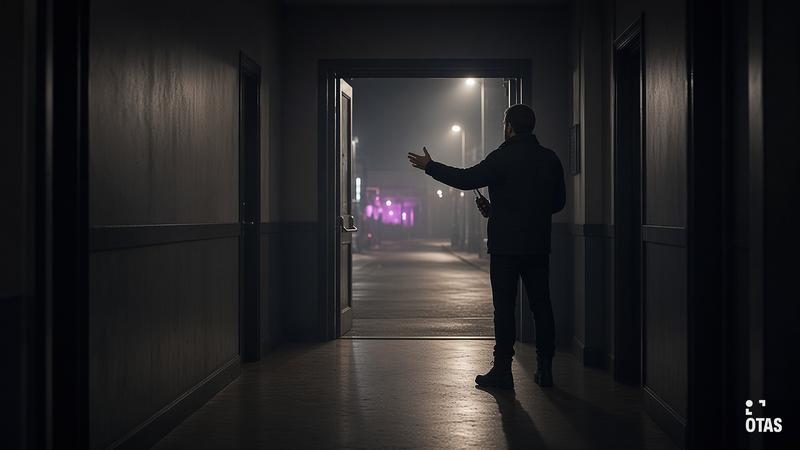
Tool: steward brief for a rumour
Read to every steward before doors. OTAS guidance.
If you hear a rumour
- Call it in, with what you heard and who from.
- Do not repeat it to the crowd or to parents.
- Wait for the message from control.
At the doors
- Keep calm, keep doors closed to people pushing in.
- Give parents the true message and send them to the meeting point.
- Call for help if anyone is aggressive.
With young people
- Keep them together and inside unless told to move.
- Nobody leaves except to a known adult at the collection point.
Tool: parent meeting point and handover
Set this up before doors, even if you never use it. OTAS guidance, drawing on the Purple Guide [20], the NSPCC [21][22] and a safety advisory group procedure [23].
The meeting point
- A set place away from the main doors and the exit route, lit, with a barrier and room to queue.
- A steward and the speaker, with radios.
- A copy of the true message, updated by control.
The handover
- The young person waits inside or at the welfare point with two staff [20][23].
- The adult gives the young person's name. A steward fetches them.
- Check the adult is known to the young person. If in doubt, check identity, for example photo ID [23].
- Record the time and who collected them.
If a young person cannot be found
- Follow your missing child procedure, and tell police if needed [20][22].
- Never broadcast a child's details in a way that adds risk [20].
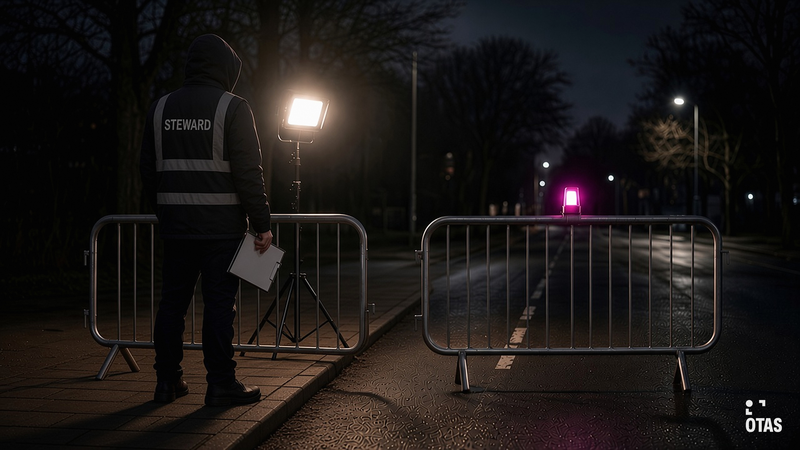
The first ten minutes after a rumour starts
OTAS guidance, drawing on ProtectUK [14] and JESIP [16]. Agree it with the venue and brief it to every steward.
First minute
- The first steward to hear it calls it in.
- Event control logs it and sends someone to check.
- Door staff close the doors to entry and hold calm.
Next five minutes
- Medics and security confirm whether anyone is hurt or in danger.
- Event control calls police if there may be a weapon or injury, using M/ETHANE [16].
- The speaker sends the first true message to staff, then on the PA and online.
Up to ten minutes
- The event manager decides to hold, exit, invacuate or lock down [14].
- The meeting point opens and parents are directed to it.
- The next update is sent on time, even if nothing has changed.
Action box
Operational
- Call in rumours
- Calm the doors
- Hold until matched
Call in what you see and hear, including rumours. Keep doors calm and closed to people pushing in. Give parents the true message and send them to the meeting point. Keep young people inside until they are matched to a known adult.
Tactical
- Check facts fast
- One true message
- Staffed exit
Check the facts with your own staff and medics, and report early to police. Send one short true message to every steward, then on the PA and online. Run any early exit as a staffed, steady flow to a collection point.
Strategic
- Holding messages
- Police link agreed
- Name the speaker
Write holding messages and a parent handover plan before the event. Agree with police and the venue how information is shared. Name the speaker. Check whether Martyn's Law will apply to your premises or event.
Readiness checklist
OTAS guidance unless a source is shown.
Before the event
- Holding messages written [14].
- Speaker and deputy named.
- Police link agreed [16].
- Meeting point on the site plan.
Before doors
- Steward brief given.
- Radios and the rumour log in event control.
- Welfare team and collection point ready [20].
During
- Social media watched [14].
- Updates sent on time.
After
- Log kept, decisions recorded [14].
- A short debrief, and a note to parents if needed.
What we do not know yet
- What happened at the end of the road. No official account has been published.
- How the rumour started, and how fast it spread.
- How long the controlled exit took, and how young people were matched to parents.
- Whether police logged a call on a nearby street. The paper asked the force to check [1].
Coming up: Christmas and New Year events for young people
School holiday discos, ice rinks, light trails and New Year's Eve events draw young people in groups, often dropped off and collected by parents. Dark evenings, busy streets and a police presence for other reasons all help a rumour spread. Plan the first message and the handover before the first night [14][20].
Frequently asked questions
Should we tell people about an incident before we know the facts?
Yes, in a short holding message. Say what you know, what you are doing and what people should do. ProtectUK advises having holding statements ready [14]. Update it as soon as you know more.
Will telling people cause panic?
Research finds mass panic is rare, and that people in emergencies usually act sensibly and help each other [11][12][13]. Clear, early information helps them do that.
Should we let parents in?
Not into a crowded venue. Meet them at a set point, give them the true message and match them to their child there. Keep the doors calm and staffed.
How do we release young people safely?
In a steady, staffed flow to a collection point, and only to a known adult. One procedure asks for an identity check of the collecting adult, for example by photo ID [23].
Do we need to call the police about a rumour?
If there may be a weapon or injury, yes. Report early, and do not wait for all the information [14]. Use M/ETHANE to pass on what you know [16].
Does Martyn's Law apply to us?
The Terrorism (Protection of Premises) Act 2025 received Royal Assent in April 2025 [19]. Its duties are not yet in force. Whether it applies depends on your premises or event and how many people attend. Check the government guidance as it is published.
Related OTAS Insights
These are links to other OTAS Insights pieces, not to any OTAS Live product or service.
Interest: OTAS Live Ltd, which publishes OTAS Insights, sells event operations services, handbooks and training related to this topic.
Law: this Insight summarises Cabinet Office, ProtectUK, JESIP, Purple Guide, NSPCC and safety advisory group guidance, with the Licensing Act 2003, its guidance and the Terrorism (Protection of Premises) Act 2025. It is not legal advice. Check your licence conditions and ask your council, the police and your safety advisory group what applies to your event.
References
Web sources opened 9 November 2026 and labelled with their publisher.
- Birmingham Live, parents force their way into an under 16s event following reports of a stabbing, 31 October 2026 birminghammail.co.uk
- Organiser's ticket listing for the Wolverhampton date of its Halloween tour, October 2026 reloadunder16s.com
- BBC News, platform altercation caused Tube panic, November 2017 bbc.co.uk
- BBC News, about 1,500 injured at a football screening in Turin, 4 June 2017 bbc.co.uk
- The Guardian, more than 1,500 fans injured in a Turin square, 3 June 2017 theguardian.com
- Ofcom, letter from the Chief Executive to the Secretary of State, 22 October 2024 ofcom.org.uk
- BBC News, Ofcom finds a clear link between online posts and violent disorder, 22 October 2024 bbc.co.uk
- Cabinet Office, Understanding crowd behaviours: guidance and lessons identified gov.uk
- Cabinet Office, Understanding crowd behaviours, summary of the five reports gov.uk
- University of Sussex, crowd panic research programme sussex.ac.uk
- Drury, J., Everyone for themselves? A comparative study of crowd solidarity among emergency survivors, British Journal of Social Psychology, 2009 bpspsychub.onlinelibrary.wiley.com
- Drury, J., Novelli, D. and Stott, C., Psychological disaster myths in the perception and management of mass emergencies, Journal of Applied Social Psychology, 2013 doi.org
- Barr, D., Drury, J. and others, Beyond stampedes: towards a new psychology of crowd crush disasters, British Journal of Social Psychology doi.org
- ProtectUK, evacuation, invacuation, lockdown, protected spaces protectuk.police.uk
- ProtectUK, communication protectuk.police.uk
- JESIP, M/ETHANE jesip.org.uk
- Licensing Act 2003, section 4, the licensing objectives legislation.gov.uk
- Home Office, revised guidance issued under section 182 of the Licensing Act 2003, published September 2026, updated 3 November 2026 gov.uk
- Home Office, Terrorism (Protection of Premises) Act 2025 collection, updated 10 September 2026 gov.uk
- The Purple Guide, safeguarding children and young people thepurpleguide.co.uk
- NSPCC Learning, safer activities and events learning.nspcc.org.uk
- NSPCC Child Protection in Sport Unit, missing children and young people at sports events, procedure and flowchart sport.nspcc.org.uk
- Cambridge Safety Advisory Group, lost children and vulnerable persons procedure cambridge.gov.uk
- HSE, event safety, put crowd controls in place hse.gov.uk
If a stabbing rumour reached parents before it reached your control room tonight, what would your first message say, and who would send it?
If you need support with planning communications and safeguarding at your event, reach out to us to see how we can support you.
Events industry since 2008, internationally since 2015. OTAS Live Ltd. By OTAS Insights. Edited by Kris Dailly.
Download the PDFs
- The article: PDF, 21 pages, 3.1 MB
- The full report: PDF, 34 pages, 5.3 MB
- The slide deck: PDF, 24 pages, 1.1 MB
Corrections to published Insights articles are listed in our corrections log.