
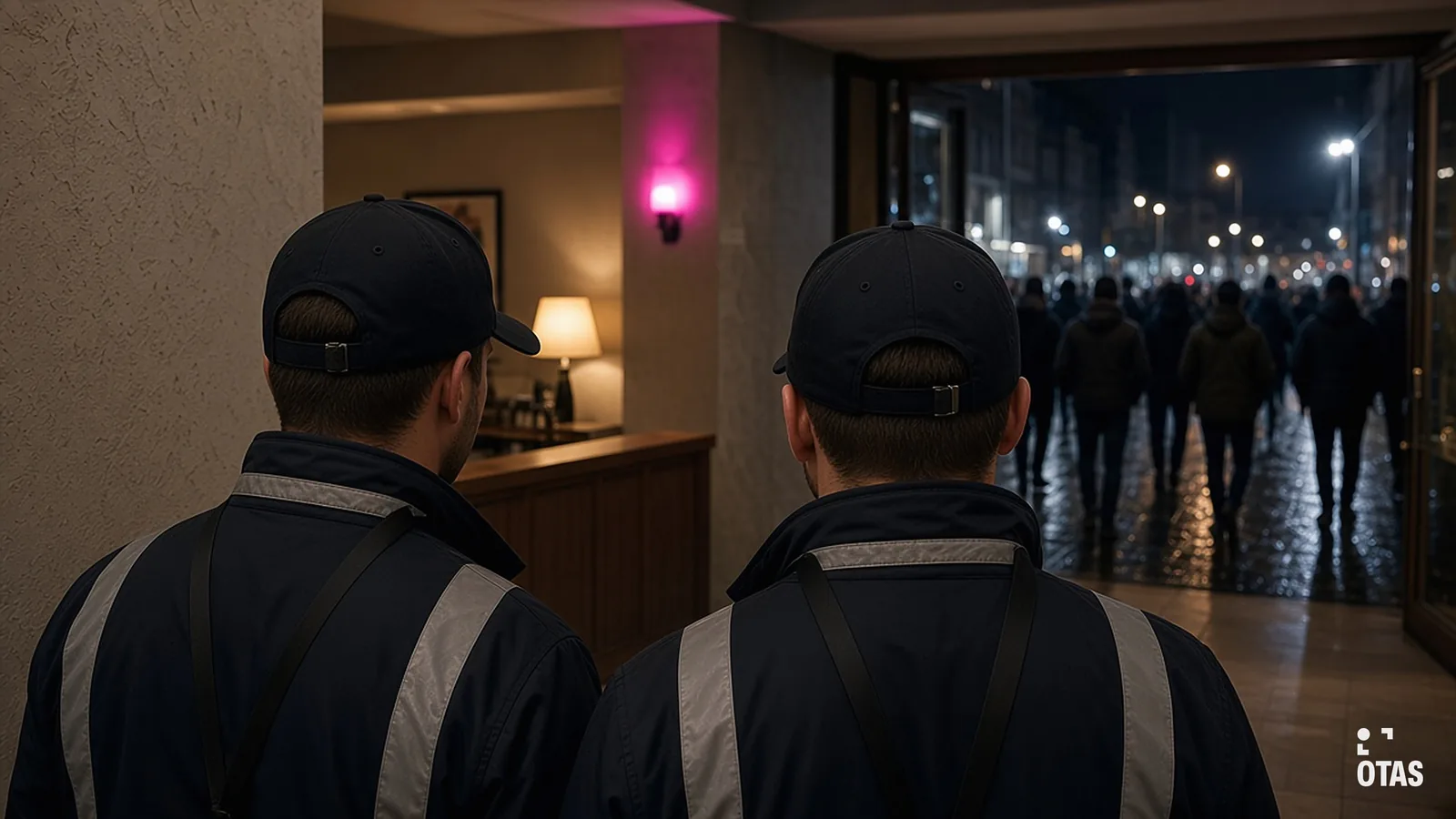
Download the PDFs
- The article: PDF, 21 pages, 4.8 MB
- The full report: PDF, 29 pages, 5.8 MB
- The slide deck: PDF, 22 pages, 1.2 MB
evacuations, three moments [1][2][3]
minutes into an arena show [3]
minutes into a set [2]
“In an emergency, they should also be able to evacuate quickly to a safe place.”
HSE, crowd management guidance [4]
By OTAS Insights · Published by OTAS Live Ltd
On Sunday 1 November a concert hall in Bristol carried out a precautionary evacuation after a hoax concern was raised with its security team once the show had ended [1]. Most of the audience had already left, and those still inside left quickly and safely [1]. Police carried out a full assessment and the area was declared safe [1]. Two nights earlier, on Friday 30 October, a fire alarm went off ten minutes into a set at a small Glasgow venue. Staff got the audience out safely, the crowd gathered across the road and the band played on in the street [2]. In May, an arena show in Birmingham was stopped about 45 minutes in and thousands of people were evacuated, on police advice. Nothing suspicious was found, and a man has since been charged [3]. This Insight is about the evacuation itself: who decides, how you sweep a building that is already emptying, and where the people outside go.
In short: an evacuation at the end of the night still needs a decision, a full sweep and a plan for the crowd outside. Agree before doors who calls it, what the audience is told, how each area is checked, and where people stand once they are out.
What was reported
Three reports, from Bristol, Glasgow and Birmingham [1][2][3]. We describe venues and artists rather than naming them in the text. Some source links carry names. We do not comment on any threat or how it was assessed.
Bristol, 1 November
- Where A concert hall in Bristol, on a Sunday night [1].
- When After the show had ended, when most of the audience had already left [1].
- What happened A hoax concern was raised with the security team, and the venue carried out a precautionary evacuation. Those still inside left quickly and safely [1].
- Afterwards Police carried out a full assessment and the area was declared safe. The report said it was not known whether any arrests had been made [1].
Glasgow, 30 October
- Where The bar of a small music venue in Glasgow city centre [2].
- What happened A fire alarm went off ten minutes into a band's set. Staff got the audience out of the building safely [2].
- Outside The crowd gathered across the road from the venue, and the band played an acoustic set in the street [2].
Birmingham, 1 May
- Where An arena show in Birmingham [3].
- What happened The show was stopped about 45 minutes in, and thousands of people were evacuated. The promoters described it as a precautionary evacuation by venue management on police advice [3].
- Afterwards Police said nothing suspicious was found. A man was charged with communicating false information, and the show was rescheduled [3].
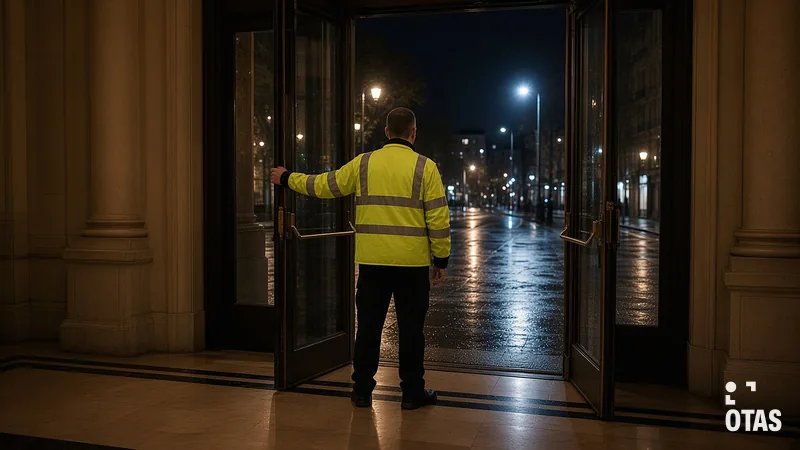
Three moments in the night
The three reports cover three different moments [1][2][3].
| Venue | When | The challenge |
|---|---|---|
| Glasgow | Ten minutes into a set [2] | A full room, and a crowd standing near the road outside |
| Birmingham | About 45 minutes in [3] | Thousands of people to move at once |
| Bristol | After the show [1] | A building already emptying, and fewer people inside |
Table 3. Three evacuations at three moments. Facts from [1][2][3]. The challenge column is OTAS guidance.
What UK guidance says about leaving
In brief, from HSE event safety guidance [4][5][6][7]. Not legal advice.
Plan the leaving
- HSE names leaving and dispersal as one of three phases to plan, alongside arrival and circulation [5].
- For larger crowds it says to encourage phased departures [5].
- People should be able to evacuate quickly to a safe place in an emergency [4].
Keep the routes ready
- Before people are let in, all exits should be unlocked, routes clear and emergency arrangements in place [5].
- HSE says to plan a control point, and back up loud hailers in case the PA fails [7].
Know who decides
- In a venue, your evacuation plan must fit the venue's fire risk assessment and emergency procedures. In England and Wales the responsible person must set these procedures and nominate enough competent people to carry out an evacuation [11]. In Scotland these duties are in Part 3 of the Fire (Scotland) Act 2005 and regulation 14 of the Fire Safety (Scotland) Regulations 2006 [12][13]. In Northern Ireland they are in Part III of the Fire and Rescue Services (Northern Ireland) Order 2006 and regulation 14 of the Fire Safety Regulations (Northern Ireland) 2010 [14]. Agree with the venue whether a fire alarm means leave at once or a short staff check first.
- The organiser keeps overall responsibility for the safety of the public [6].
- HSE says roles should be clear for both normal and emergency situations [6].
- After the event, HSE says to debrief and record what worked and what did not [4].
HSE also warns that crowd incidents can develop very quickly [7].
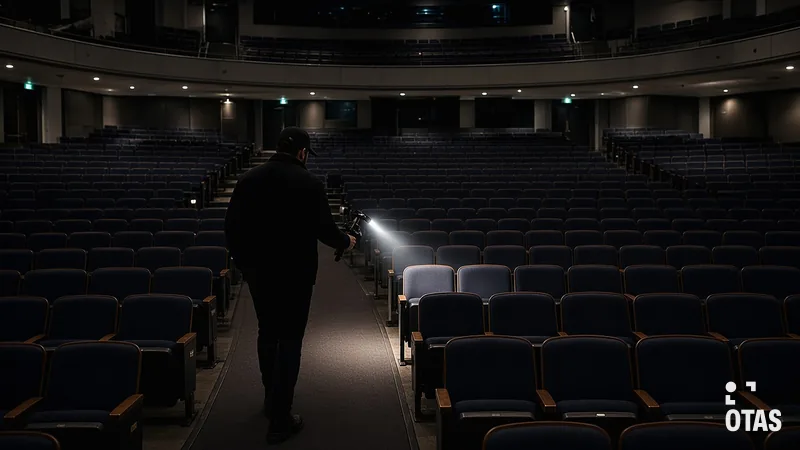
When leaving is not the safest option
Not every evacuation is for a fire. If the concern is a threat, leaving may not be the safest option.
Martyn's Law, the Terrorism (Protection of Premises) Act 2025, became law on 3 April 2025 and covers the whole UK, including Scotland. Its duties are not in force yet. The SIA, its regulator, expects them to start in spring 2027 [8]. Then premises in scope where 200 or more people may be present will need procedures for a suspected attack [8]. So will events of 800 or more where entry is checked, for example by ticket, pass, payment or membership [8]. The procedures cover evacuation, invacuation, lockdown and communication [8]. There is no legal duty yet, but planning for them now is sensible. This is a summary, not legal advice.
Plan where people go when leaving is not the safest option. For a threat, use the PA rather than the fire alarm, and move people well away rather than to the usual fire assembly point [10].
The evacuation script
Agree the words before doors. They need to sound different from the end of the show. OTAS guidance.
On the PA
- "Ladies and gentlemen, this is an evacuation. Please leave the building now by the nearest exit."
- "Follow the stewards. Do not stop for coats. Move away from the doors and stay off the road."
From stewards
- "This way, please. Keep moving, and cross only where we show you."
- "Is anyone else in there with you?"
Why closing is hard
In Bristol most people had already gone [1]. In Glasgow the crowd stood across the road [2]. The rest of this section is OTAS guidance, drawing on HSE.
An evacuation at the end of the night
- Fewer staff. Stewards are standing down, bars are closing and supervisors are on load out. The team that would run an evacuation is smaller.
- A mixed building. Some people are leaving, some are queuing for coats or toilets, some are still in their seats. Each needs a different message.
- False comfort. A building that looks empty may not be. Toilets, back rooms, lifts and quiet corners still need checking.
- The road. People leaving at night spill onto the street. An evacuation adds people standing still outside. In Glasgow the crowd gathered across the road [2].
- The message. Telling people to leave when they are already leaving is easy to miss. The words need to say this is different.
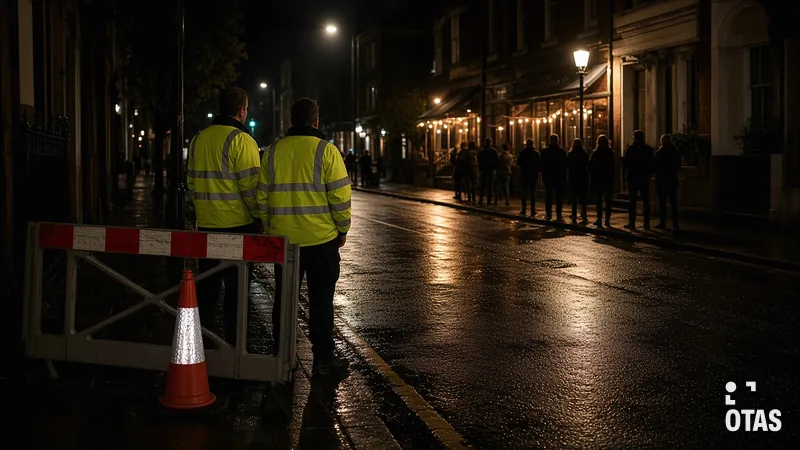
Seven things to agree before doors
These are the seven things to agree first. OTAS guidance unless a source is shown.
Before doors
- Who decides The named person who calls an evacuation, at any time of night [6].
- Staffing How many stewards stay on until the building is empty.
- Sweep areas Every area named, with a steward for each, including toilets and back rooms.
- People who need help to leave A plan for disabled people and anyone who cannot use the stairs, with named stewards, routes and refuges agreed with the venue before doors. Nobody is left in a refuge to wait for the fire service [9].
- The words The PA script and a loud hailer if the PA fails [7].
- Outside Where people stand, away from the doors and the road [4].
- The record Who confirms each area clear, and who logs it.
Signs your evacuation plan only works mid show
Each of these is OTAS guidance, drawn from the three reports and HSE.
Signs the plan only works mid show
- 01The plan assumes a full house
Every role and route is written for the middle of the show, not for doors or the end of the night.
- 02Sweep areas have no names
Nobody is named for toilets, back rooms, lifts or stairs once stewards stand down.
- 03No message for people leaving
The PA script only covers a seated or standing audience, not people already in the foyer.
- 04No place outside
The plan says leave the building, but not where to stand or how to stay off the road [4].
- 05No record
Nobody writes down who confirmed each area was clear, or when.
Plan the evacuation for every part of the night
Five stages, from the plan to the debrief. OTAS guidance unless a source is shown.
Five stages, from the plan to the people outside
Plan
Write who decides on an evacuation, and who advises them, for doors, the show and the end of the night [6].
Staff
Keep enough stewards on duty until the building is empty to sweep every area. Name each sweep area.
Tell
Use short, clear words on the PA and from stewards. Say this is an evacuation, not the end of the show. Have loud hailers ready [7].
Sweep
Check every area you can safely reach, including toilets, back rooms, lifts and stairs. Never enter smoke or fire. Report any area you could not check to control, so the fire service or police are told. Hold the final exits open until the sweep is done. Close internal doors behind you as each area is cleared, unless the venue plan says otherwise.
Outside
Move people to a safe place away from the doors and off the road [4]. Steward the kerb. Record who confirmed each area clear.
The people outside
Once people are out, the job is not over. OTAS guidance unless a source is shown.
At the kerb
- Off the road Steward the kerb and keep people on the pavement, especially on dark, wet streets.
- Away from the doors Move people far enough away that the exits stay clear for staff and the emergency services.
- Information Tell people what is happening, even if the answer is that you do not know yet.
Afterwards
- Agree with the police or fire service when people may go back in, or leave.
- Help people find coats, friends and transport.
- Hold a short debrief and record it [4].
- For a threat, follow police advice on where people go, and do not hold them close to the building [10].
Roles in an evacuation
Four roles, each with one named person. OTAS guidance, drawing on HSE [6].
| Role | What they own |
|---|---|
| Event safety officer | The decision, in line with the venue fire plan and with police or fire service advice |
| Head of security | The sweep, area by area |
| PA operator | The evacuation script, and the loud hailer if the PA fails |
| Outside supervisor | The kerb, the outside area and information for people |
Table 4. Roles in an evacuation. OTAS guidance.
Action box
Operational
- Know your area
- Check and report
- Keep off the road
Know your sweep area. On the call, check every part of it you can safely reach, including toilets and back rooms, and report it clear. Never enter smoke or fire. Report any area you could not check. Outside, keep people off the road.
Tactical
- Keep enough on
- Sweep area by area
- Hold final exits open
Keep enough stewards on until the building is empty. Run the sweep area by area, and hold the final exits open until every area is reported clear.
Strategic
- Name who decides
- Agree the outside
- Debrief, record
Write who decides on an evacuation at every part of the night. Agree the words and the outside area with the venue and the police. Debrief and record it.
Closing checklist
OTAS guidance unless a source is shown.
Before doors
- A named person who calls an evacuation at any time.
- A sweep plan with every area named.
- People who need help to leave: a plan for disabled people and anyone who cannot use the stairs, with named stewards, routes and refuges agreed with the venue before doors. Nobody is left in a refuge to wait for the fire service [9].
- An evacuation script, and a loud hailer [7].
- An outside area away from the doors and the road.
Last hour
- Enough stewards on to sweep every area.
- Exits kept clear until the building is empty.
- The PA staffed until the last person is out.
After
- A log of who confirmed each area clear.
- A short debrief with stewards and the venue [4].
What we do not know yet
- How the Bristol venue swept the building, and how long it took.
- What set off the fire alarm in Glasgow.
- The outcome of the Birmingham case, which is before the court.
Coming up: Christmas shows and late finishes
Christmas shows, comedy tours and late club nights run across the UK through December, many finishing late on dark, wet streets. An evacuation at the end of those nights needs the same plan as one in the middle of the show [4][5].
Frequently asked questions
Do we need to sweep if most people have already gone?
Yes. Toilets, back rooms, lifts and quiet corners still need checking. In Bristol most people had already left [1], but an evacuation means confirming everyone is out.
Who should decide to evacuate?
A named person in your plan, with the authority to act at any time of night. HSE says the organiser keeps overall responsibility for public safety [6].
What should we tell the audience?
Short, calm words that say this is an evacuation, not the end of the show, and where to go. Use the PA, stewards and loud hailers [7].
Where should people go once they are out?
To a safe place away from the doors, off the road, agreed in advance [4]. In Glasgow the crowd gathered across the road [2].
Does this Insight say when to evacuate for a threat?
No. It is about running an evacuation once it is called. Threat assessment is for the venue, the police and your security advisers.
Related OTAS Insights
These are links to other OTAS Insights pieces, not to any OTAS Live product or service.
Interest: OTAS Live Ltd, which publishes OTAS Insights, sells event operations services, handbooks and training related to this topic.
Law: this Insight summarises HSE guidance as published on hse.gov.uk, with SIA, NPSA and HM Government guidance and UK fire safety law. It is not legal advice. Ask your council, the police, the fire service and your safety advisory group what applies to your event.
References
Web sources opened 3 November 2026 and labelled with their publisher.
- Bristol Post, concert hall evacuated after hoax threat, 2 November 2026 bristolpost.co.uk
- Glasgow Times, Glasgow gig continues outside after venue evacuated, report of 30 October 2026 glasgowtimes.co.uk
- BBC News, show rescheduled after arena evacuation, 6 May 2026 bbc.com
- HSE, crowd management, assess the risks hse.gov.uk
- HSE, crowd management, controls hse.gov.uk
- HSE, set clear roles and responsibilities hse.gov.uk
- HSE, crowd controls inside the venue hse.gov.uk
- SIA, Understanding Martyn's Law and the SIA's role as regulator, gov.uk, 17 July 2026 gov.uk
- HM Government, Fire safety risk assessment: means of escape for disabled people gov.uk
- NPSA, Evacuation, invacuation and lockdown guidance npsa.gov.uk
- Regulatory Reform (Fire Safety) Order 2005, article 15 legislation.gov.uk
- Fire (Scotland) Act 2005, Part 3 legislation.gov.uk
- Fire Safety (Scotland) Regulations 2006, regulation 14 legislation.gov.uk
- Fire Safety Regulations (Northern Ireland) 2010, regulation 14 legislation.gov.uk
If an evacuation was called as your last encore ended, who would check the toilets?
If you need support with evacuation plans or sweep procedures for your venue or event, reach out to us to see how we can support you.
OTAS Live Ltd · Correct as of
Download the PDFs
- The article: PDF, 21 pages, 4.8 MB
- The full report: PDF, 29 pages, 5.8 MB
- The slide deck: PDF, 22 pages, 1.2 MB
Corrections to published Insights articles are listed in our corrections log.