
Download the PDFs
- The article: PDF, 20 pages, 3.6 MB
- The full report: PDF, 28 pages, 4.8 MB
- The slide deck: PDF, 22 pages, 1.1 MB
people died, police said [1][2]
injured, per police via Dawn [2]
people arrested, police said [1][2]
“Inadequate management of queues or delays may cause people to surge towards the doors when they are opened.”
HSE, crowd management guidance [4]
By OTAS Insights · Published by OTAS Live Ltd
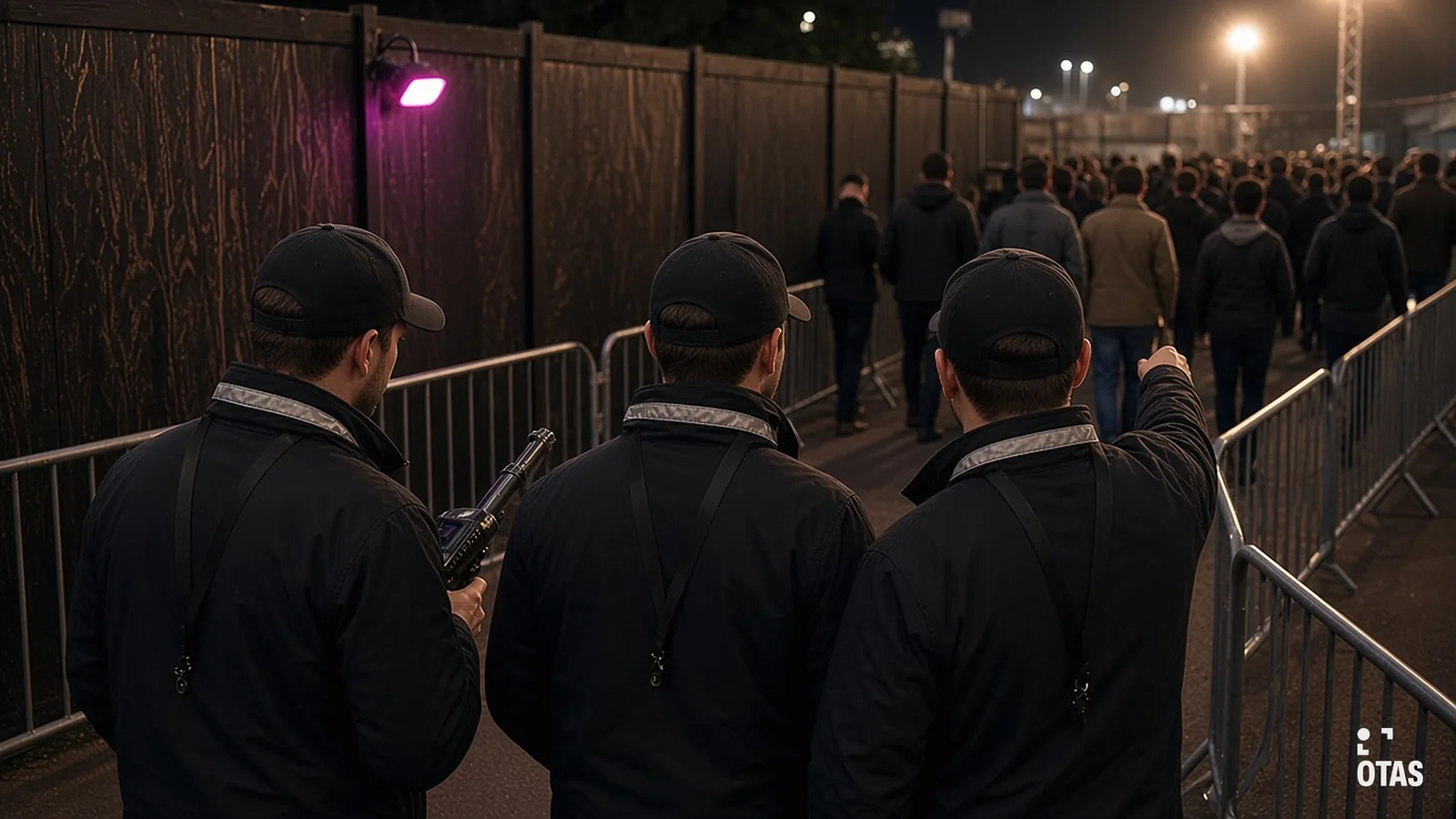
At a prize draw and wedding celebration at a sports ground in Sialkot, Pakistan, people were crushed at the gate as the crowd tried to get in [1][2][3]. Dawn reported the event on the night of Friday 30 October, with the police report dated 31 October [1]. A PTI report said it happened on Saturday evening [3]. Police said an announcement over the loudspeakers told everyone to enter the ground at the same time [1][2]. Two people died [1][2]. Police told Dawn that 18 people were injured [2]. PTI, quoting a police officer, reported more than two dozen [3]. The police case is open and nothing has been proven. This Insight is about the gate and the announcement, and what event teams in the UK can take from them this season.
In short: one call to come in at once can turn a queue into a crush at the gate. Decide before doors who may speak on the PA, open the gate in stages, keep the queue moving forward only, and give stewards a clear way to stop entry without force.
What was reported
Two reports in Dawn and one PTI report give most of what is known [1][2][3]. They differ on the day and on the number injured, so both are shown with their source.
The event
- What A wedding celebration with a prize draw, promoted to the public, at a sports ground in Sialkot [1][3].
- When Dawn reported Friday night, 30 October, with the police report dated 31 October [1]. PTI reported Saturday evening [3].
- The crowd Hundreds had gathered at the site when the gates opened, Dawn reported [1].
- The permit A district spokesperson said a permit was issued for a private gathering in an enclosed space, and was revoked after reports of irregularities from about 16:00 local time (11:00 UK time) [1][2].
At the gate
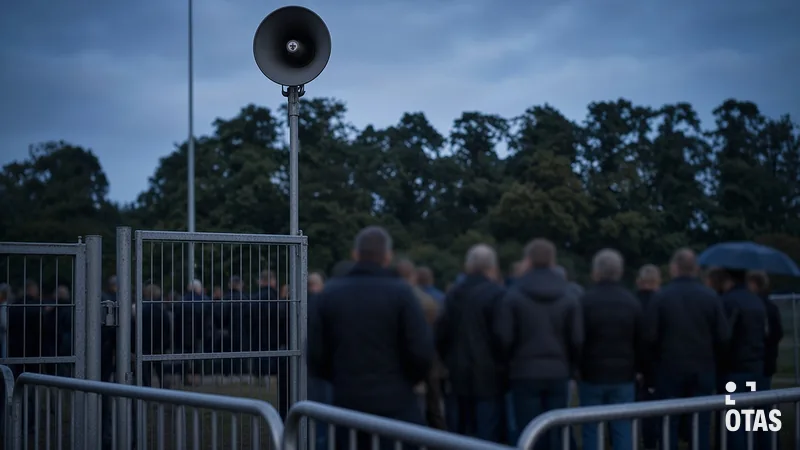
- The call Police said an announcement over the loudspeakers told everyone to enter the ground at the same time, and that this triggered the crush [1][2].
- The footage Dawn reported that video showed guards opening the gate, then a man asking them to push people out, and using a wooden club to do so himself [2].
- Witnesses A police officer told PTI that eyewitnesses blamed poor crowd management, confusing announcements and alleged use of force by security guards [3].
- The case Police registered a case against the organisers, the ground owner and up to 45 security guards, and arrested six people [1][2]. PTI reported that the event's host says the crush was an accident and that he was not at the ground when it happened [3]. Police said their investigation was continuing [1].
Where the reports differ
The reports do not agree on every detail. This is what each one said.
| Detail | Dawn | PTI |
|---|---|---|
| Day | Friday night, 30 October. Police report dated 31 October [1] | Saturday evening [3] |
| Injured | 18, from Sialkot police [1][2] | More than two dozen, from a police officer [3] |
| The call to enter | An announcement over the loudspeakers, police said [1][2] | An announcement from the stage, a police officer said [3] |
Table 3. Where the reports differ. Dawn [1][2], PTI via the Hindustan Times [3].
We use the police figure of 18 injured where one number is needed, and say where it comes from. Rescue services first counted 13 injured, and residents put the number higher [1].
What UK guidance says about entry
In brief, from HSE event safety guidance [4][5][6]. Not legal advice.
Plan the arrival
- HSE names arrival and entry, including access routes, queuing space and entrances, as one of three phases to plan [5].
- For larger crowds it says to encourage phased arrivals, for example with entertainment before the main event [5].
- Before people are let in, all exits should be unlocked, routes clear and emergency arrangements in place [5].
Manage the queue
- HSE says queues, signs, barriers and effective stewarding can be combined to manage crowd flow and pressure [5].
- People should be able to leave a queue without moving against those queuing behind them [5].
- Search procedures should not compromise safety by creating an overcrowding risk [5].
If more people come than can fit
- HSE says you need a way to monitor and estimate the numbers arriving, and to agree with police how extra people could be redirected [5].
- It suggests overflow space and extra routes to prevent crushing [5].
Free events
- Even if the event is free or takes place in the street or open spaces, HSE says the same crowd management principles apply [4].
HSE also says that inadequate management of queues or delays may cause people to surge towards the doors when they are opened [4].
The PA at doors
Police said the call to enter came over the loudspeakers [1][2]. OTAS guidance on the PA at doors follows.
Before the day
- Write the doors script: the time doors open, how entry works, and what to do while waiting.
- Write the hold script: a calm request to stop and wait, with a reason.
- Name who may use the PA at doors. Nobody else does.
On the day
- Keep a steward or supervisor next to the microphone at doors.
- Repeat the same message on the PA, on screens and from stewards.
- HSE says to plan for the PA failing, with back up loud hailers [7].
Why the gate is the pressure point
The reports describe one call to enter, a gate opening, and then an attempt to push people back [1][2][3]. The rest of this section is OTAS guidance, drawing on HSE.
How one call becomes pressure at the gate
- The call. An instruction heard by everyone at once moves everyone at once. People at the back cannot see the gate and keep moving forward.
- The wait. The longer a crowd waits, the more people arrive behind it. HSE warns that delays may cause people to surge when the doors open [4].
- The opening. A gate opening is the moment of highest pressure. If the space inside cannot take the flow, the pressure stays at the gate.
- Pushing back. Trying to push a crowd back out of a gate works against the people behind. Pressure needs somewhere to go.
- Mixed messages. A police officer quoted by PTI said eyewitnesses described confusing announcements [3]. If the PA and the stewards say different things, people trust neither.
Six actions before your next doors
These are the six things to do first. OTAS guidance unless a source is shown.
Before doors
- Capacity Set a number for the space inside and the queue outside, and plan for more [5].
- Script Agree the PA wording for doors, delays and holds.
- Roles Name who calls doors open and who calls a hold [8].
- Lanes Set out lanes with a way to step out of the queue [5].
- Count Count people in at the gate, and know the number inside [6].
- Overflow Agree where extra people go, and with police how to send them there [5].
Signs the gate is about to come under pressure
Signs 1 and 2 draw on the reports and on HSE. Signs 3 to 5 are OTAS guidance.
Warning signs at the gate
- 01A call that reaches everyone at once
An announcement, post or shout that tells the whole crowd to move together [1][3].
- 02A long wait at a closed gate
Delays at the doors can lead people to surge when they open, HSE says [4].
- 03The queue loses its shape
Lines merge into one mass, and people at the back start pushing forward.
- 04Nowhere to step out
People in the queue cannot leave it without moving against the people behind.
- 05Stewards start pushing back
Staff try to move people out of the gate by force instead of stopping the flow behind.
Plan the doors from the first post to the last person in
Five stages, from the promotion to the moment the gate closes behind the last person. OTAS guidance unless a source is shown.
Five stages, from the first post to the last person in
Before you promote
Set a capacity for the space inside and the queue outside. Say how entry will work in every post and on every poster. Plan for more people than you expect [5].
The site plan
Draw the queue, the lanes, the gate and the space just inside it. Add a way to step out of the queue and an overflow area [5]. Keep queues off emergency access routes [5].
Before doors
Exits unlocked, routes clear, emergency arrangements in place [5]. Agree the PA script. Name who calls the doors open, and who calls a hold.
Doors open
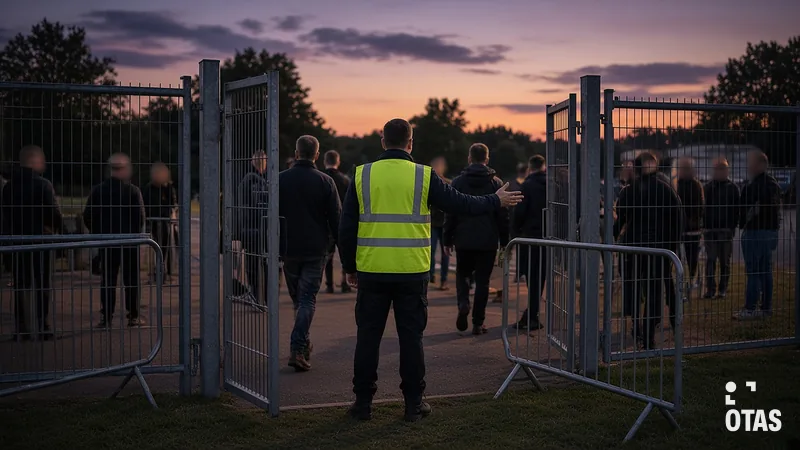
Open in stages, a few lanes at a time, at the rate the space inside can take. Count people in [6]. Keep the PA and the stewards on one message. Your safe capacity and entry rate should be worked out by a competent person, using your site plan, and agreed with your safety advisory group.
If it builds
Stop the flow at the back, not the front. If people are already moving through the gate and the space inside can take them, keep the gate open and keep them moving. If the space inside is full, stop entry at the back of the queue and open the overflow or extra routes. Never push people back out.
If pressure builds at the gate
A gate response, agreed before doors. OTAS guidance unless a source is shown.
The four steps
- Stop at the back Stop people joining the back of the queue. That is where the pressure comes from.
- Keep the front moving If people are already moving through the gate and the space inside can take them, keep the gate open and keep them moving. If the space inside is full, stop entry at the back of the queue and open the overflow or extra routes.
- One message Use the PA and the stewards to give one calm instruction, with a reason.
- Report Radio the location and what you see to the control point.
Never
- Push people back out of a gate.
- Use force to move a crowd.
- Let anyone outside the doors plan make an entry call.
HSE says people should be able to get out of a queue without moving against those queuing behind them [5].
Roles at doors
Four roles, each with one named person. OTAS guidance, drawing on HSE [8].
| Role | What they own |
|---|---|
| Event safety officer | The doors call and the hold call |
| Gate supervisor | The rate of entry and the count |
| PA operator | The doors script and the hold script, and nothing else |
| Queue supervisor | The back of the queue, the lanes and the overflow |
Table 4. Roles at doors. OTAS guidance.
Action box
Operational
- Forward only
- Radio pressure in
- Never push back
Keep the queue moving forward only. If pressure builds, radio it in and wait for the hold call. Never push people back out of the gate. Help anyone who falls or needs to step out.
Tactical
- Open in stages
- Count people in
- One message
Open the gate in stages. Count people in. Keep the PA and the stewards on one message. Stop the flow at the back if the front is under pressure.
Strategic
- Set the capacity
- Own the PA script
- Name the doors call
Set a capacity for the space and the queue. Agree the PA script and who may use it. Name who calls doors and who calls a hold. Plan for more people than you expect.
The doors checklist
OTAS guidance unless a source is shown.
Before the day
- A capacity for the space and the queue.
- A doors script and a hold script.
- Named people for the doors call, the hold call and the PA.
- An overflow plan agreed with police [5].
At doors
- Exits unlocked, routes clear, emergency arrangements in place [5].
- Lanes with a way to step out [5].
- Entry in stages, with a count [6].
- One message on the PA and from stewards.
After
- A log of doors time, numbers and any holds.
- A short debrief with stewards and supervisors [4].
What we do not know yet
- Exactly what was said over the loudspeakers, and who said it.
- How many people were at the ground, and how many the gate was meant to take.
- What the investigation will find. The case is open and nothing has been proven.
Coming up: free events with a set start time
Christmas lights switch-ons and winter market openings begin across the UK in the coming weeks. Many are free, and many have one moment when everyone wants to be in place. The same questions apply: who speaks at doors, how fast the gate opens, and where extra people go [4][5].
Frequently asked questions
Is this only a risk at free events?
No. HSE says delays at the doors can lead people to surge when the doors open [4]. Free events add the problem of not knowing how many will come.
Should we tell the crowd when the doors will open?
Yes, and keep telling them. Give the same time on the PA, on screens and from stewards. A police officer told PTI that eyewitnesses blamed confusing announcements [3].
Can stewards close the gate if it gets too busy?
Stopping the flow is the right call, but where you stop it matters. Stop people joining at the back. Closing the front while people are still pushing forward can make the pressure worse.
Who should be allowed to use the PA at doors?
Only the people named in your doors plan, reading from an agreed script. Hosts, artists and guests should not make entry calls.
What if far more people arrive than expected?
HSE says to monitor and estimate the numbers arriving, and to agree with police how extra people can be redirected, with overflow space and extra routes [5].
Related OTAS Insights
These are links to other OTAS Insights pieces, not to any OTAS Live product or service.
- Christmas lights switch-ons: a capacity without a turnstile
- When a social post draws a crowd: pop-up events without a plan
Interest: OTAS Live Ltd, which publishes OTAS Insights, sells event operations services, handbooks and training related to this topic.
Law: this Insight summarises HSE guidance as published on hse.gov.uk. It is not legal advice. Ask your council, the police and your safety advisory group what applies to your event.
References
Web sources opened 3 November 2026 and labelled with their publisher.
- Dawn, Sialkot police say six held after crush at mehndi event, 1 November 2026 dawn.com
- Dawn, case registered over crush that killed two and injured 18, 2 November 2026 dawn.com
- Hindustan Times, PTI report, two killed at wedding event in Punjab, 2 November 2026 hindustantimes.com
- HSE, crowd management, assess the risks hse.gov.uk
- HSE, crowd management, controls hse.gov.uk
- HSE, crowd management, monitoring hse.gov.uk
- HSE, crowd controls inside the venue hse.gov.uk
- HSE, set clear roles and responsibilities hse.gov.uk
If someone grabbed the microphone at doors on your next event, who would stop them?
If you need support with entry, queue and doors plans for a free event, reach out to us to see how we can support you.
OTAS Live Ltd · Correct as of
Download the PDFs
- The article: PDF, 20 pages, 3.6 MB
- The full report: PDF, 28 pages, 4.8 MB
- The slide deck: PDF, 22 pages, 1.1 MB
Work with OTAS
Running a free event with a set start time?
Corrections to published Insights articles are listed in our corrections log.