
Download the PDFs
- The article: PDF, 21 pages, 3.5 MB
- The full report: PDF, 32 pages, 4.8 MB
- The slide deck: PDF, 24 pages, 1.3 MB
backed a simpler event in one town [2]
one city's 2024 switch-on cost [4]
people in the SIA event test [11]
“Even if the event is free or takes place on urban streets or open spaces, you should still apply the same crowd management principles.”
HSE guidance on crowd management, assessing the risks [5]
By OTAS Insights · Published by OTAS Live Ltd
Town centre switch-ons are free, unticketed and held in squares and streets with many ways in. For 2026, several organisers have changed the format because the crowd outgrew the space. One market town moved its switch-on to a Wednesday, a midweek date chosen to reduce numbers, after a councillor at the front of the stage found the 2025 crowd “frightening” [2]. A Scottish council has written a capacity trigger into its plan, with access switching to a second street once the event area is full [1]. One city's switch-on cost rose from £5,389 to £15,058 in a year, covering stage, sound, safety and security, traffic management and medical cover [4]. The common thread is simple. An open space has no turnstile, so the capacity has to be designed, counted and enforced by people and plans.
In short: a free event in a public square still needs a capacity. Set one for each zone, count against it, agree who calls “full” and what happens next, and keep a clear lane for medics before the crowd forms.
What changed for 2026
Three organisers have published changes for this year. A council briefing, two local newspapers and BBC News set them out [1][2][3][4].
A market town in Cumbria
- The crowd A town councillor was at the front of the stage in 2025 and found the crowd “frightening” [2].
- The square The councillor's report said there was “no way of controlling the number of people that enter the confined space of the market square” [3]. It gave the reason “as it is a public space with multiple access points” [3].
- The date The 2026 event moves to Wednesday 18 November, a midweek date chosen to reduce numbers [2].
- The survey More than 400 people responded to a public survey. 75 per cent backed simplifying the event, and 17 per cent wanted no change [2].
A Scottish city
- The trigger “Once the event area reaches its agreed capacity between Tay Street and High Street, access will be via South Street, opposite Queen's Bridge” [1].
- The weekend The event weekend runs from 20 to 22 November 2026, with the switch-on on Saturday 21 November [1].
- The stage The main stage has been moved for this year [1].
- Still planned The council says the arrangements are “subject to final confirmation” [1].
An English city
- The cost The switch-on cost rose from £5,389 in 2023 to £15,058 in 2024 [4].
- What it covered “Stage, sound equipment, safety and security, traffic management and medical cover” [4].
- The weather The 2024 event was cancelled due to bad weather [4].
What the market town is exploring
The town council listed measures to explore for 2026 [2]. Some depend on the unitary council.
Measures to explore [2]
- Glass and dogs A Public Spaces Protection Order covering glass and dogs.
- Entry points Stewarded entry points, possibly staffed by local volunteer groups.
- The stage A smaller stage.
- Movement A one way system.
- Stalls Removal of market stalls, raised with the unitary council.
What the councillor's report described [3]
- “It would have been hard to reach someone in a medical emergency.”
- Wheelchair users were struggling.
- People carried glass from pubs into the crowd.
- Professional event management was estimated at £10,000 to £15,000.
The newspaper report described Martyn's Law as “coming into force in 2027” [3]. The regulator's own wording is that it is expected to come into force in spring 2027 [11]. We use the regulator's wording.
What the law says, and what guidance adds
In brief, and not legal advice. England, Wales and Scotland.
HSE and the Purple Guide
- HSE says: “Even if the event is free or takes place on urban streets or open spaces, you should still apply the same crowd management principles” [5].
- The Purple Guide says the principles of crowd management planning “apply even for small, free to enter and open access events taking place in streets or in public open spaces” [13].
- The Purple Guide was first published by HSE and has been run by an industry forum since 2012. It says it is “not designed to be prescriptive” [14].
England and Wales
- Regulated entertainment falls under the Licensing Act 2003. Its four licensing objectives are “the prevention of crime and disorder”, “public safety”, “the prevention of public nuisance” and “the protection of children from harm” [15].
Scotland
- A public entertainment licence is required where the council has chosen to license public entertainment, under section 41 of the Civic Government (Scotland) Act 1982 [16].
- A licensing authority may attach conditions “limiting the number of persons to be admitted to the premises” [16].
Responsibility
- HSE says: “While certain aspects of crowd safety can be allocated to contractors, for example stewarding, you retain overall responsibility” [9].
- HSE advises checking whether there is a Safety Advisory Group, and submitting your proposals to it [10].
Ask your council early which licence applies to your switch-on, and whether a Safety Advisory Group will review your plan [10].
Martyn's Law: what is known and not known
The Terrorism (Protection of Premises) Act 2025 received Royal Assent on 3 April 2025 [12]. The SIA is the regulator [11].
What the SIA says [11]
- Timing “It is expected that the Act will come into force in spring 2027.”
- Guidance Final guidance and a consultation report are due “in autumn 2026”.
- Events Events are likely in scope if they are accessible to the public, have entry checks, and “800 or more people will be present ... at the same time”.
- Premises Standard tier premises are 200 to 799 people. Enhanced tier premises are 800 or more.
- Procedures Four public protection procedures: evacuation, invacuation, lockdown and communication.
What it may mean for a switch-on (OTAS reading)
- The event test includes entry checks, such as checking a ticket or pass [11].
- A free, unticketed switch-on with no entry checks may fall outside the qualifying event definition. Check the final guidance.
- The four procedures are good practice for any crowd in a public square, in scope or not.
Costs and budgeting
Costs are rising, and the rise is in the safety lines.
| What | Figure |
|---|---|
| One city's switch-on, 2023 | £5,389 [4] |
| The same switch-on, 2024 | £15,058 [4] |
| What the 2024 cost covered | Stage, sound equipment, safety and security, traffic management and medical cover [4] |
| Professional event management, estimate for a town council event | £10,000 to £15,000 [3] |
Table 2. Switch-on costs from BBC News [4] and the News and Star [3].
Budget the safety lines first: stewarding, barriers, traffic management and medical cover. Then fit the show to what is left. That is OTAS guidance.
Why an open square is hard
HSE guidance on crowd management sets out the problem and the tools. The rest of this section is OTAS guidance.
Zones on switch-on night
- No turnstile. A free switch-on has no ticket count. The councillor's report described a public space with multiple access points [3].
- Zones, not one figure. For outdoor spaces with less defined boundaries, HSE says to “break the task down into zones, such as arrival and exit points, viewing areas” [5].
- The smallest part. Capacity is limited by the narrowest part of the route, not the size of the square. HSE lists “Stalls and concessions obstructing crowd movement” as a hazard [5].
- The countdown. HSE says to anticipate surges “as the main act comes on stage” [8]. At a switch-on, that is the countdown.
- Everyone leaves at once. After the lights go on, the crowd leaves together. Plan exits and transport for the 15 minutes after the switch-on.
Capacity by zone: a worked method
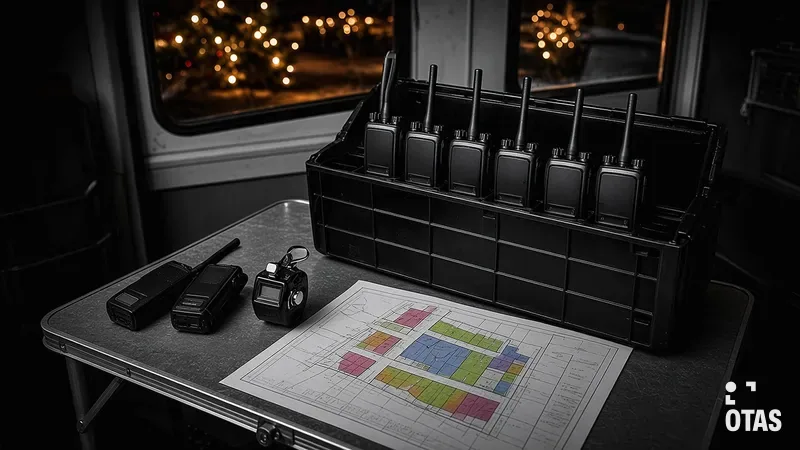
A method, not a set of figures. OTAS professional practice, drawing on HSE.
Five steps for each zone
- Measure Measure the usable area of the zone, after stalls, the stage, barriers and the medical lane are taken out.
- Find the narrowest point Find the narrowest point on the route into and out of the zone. That point limits the zone, not the area [5].
- Set a working figure Set a working capacity below the figure you calculate, and agree it with your council or Safety Advisory Group.
- Choose the count method Choose how you will count: a rough count over a small, identified area, or sampling flow rates in and out [6].
- Set the warning Set a warning point before full, so the control point hears it in time to act.
HSE says that “Where the number of people arriving may exceed the safe capacity of the venue”, you need arrangements for monitoring and estimating arrivals, and liaison with police and transport [7].
HSE also says to agree “how excess people could be redirected before reaching the venue”, and to consider “overflow space and additional routes” [7].
The “full” call: scripts and radio words
Write the call down before the night. OTAS professional practice unless a source is shown.
The model
- One council's plan says that once the event area reaches its agreed capacity, access will be via a second street [1].
Write down
- Who calls it One named person, with the authority to call “full” and to hold the show.
- The warning A warning call when a zone nears its working figure.
- The full call The exact radio words, for example “Zone 2 full, close the street mouth, send to the second route”.
- The barrier line Which barrier line moves, and who moves it.
- The message The “square is full” message for the PA and social channels.
HSE suggests screens can draw people to less crowded areas [8]. If you can, put an overflow screen on the second route.
Signs the square is filling
Signs 1, 2 and 4 draw on HSE guidance. Signs 3 and 5 are OTAS guidance.
Signs the square is filling
- 01Density rising in a marked area
HSE suggests “a rough count of people over a small, identified area” at street events [6].
- 02Flow into an area exceeds flow out
HSE suggests “sampling flow rates into and out of areas” where there are few boundaries [6].
- 03People stopping at street mouths
People pausing where a street meets the square, because they cannot see a way in.
- 04Bottlenecks forming
HSE lists entrances, exits and “potential bottlenecks/pinch-points” among the areas to monitor [6].
- 05No way through for a medic
If a steward could not walk a casualty route now, a medic could not either.
Plan the capacity, the count and the “full” call
Five stages, from planning to the exit. OTAS guidance unless a source is shown.
Five stages, from the plan to the exit
Plan the zones
Zone the space into arrival, viewing, stage front and exit areas [5]. Set a working capacity for each zone, limited by its narrowest point. Remove stalls from the viewing area [5].
Write the trigger
Write down the agreed capacity for each zone, who calls “full”, how it is radioed, and which barrier line moves. One council routes access to a second street once its event area is full [1].
Count from the start
Sample density in a marked area at fixed times [6]. Log readings every 10 to 15 minutes from 60 minutes before the switch-on.
Hold the lane
Keep a sterile lane from the medical point to the stage front, and mark it on the site plan. Keep it clear at the countdown.
The exit
Plan exits and transport for the 15 minutes after the switch-on. Keep stewards at the street mouths until the square is clear.
Medical access and accessibility
Decide medical access before the crowd forms.
The councillor's report said: “It would have been hard to reach someone in a medical emergency.” It also said wheelchair users were struggling [3].
OTAS professional practice
- Keep a sterile lane from the medical point to the stage front, and mark it on the site plan.
- Put a steward at each end of the lane, with the authority to keep it clear.
- Set an accessible viewing area away from the stage front, with its own route in and out.
- Tell people where the accessible viewing area is before the night.
Glass, alcohol and local orders
People carried glass from pubs into the crowd in the market town [3].
What the town is exploring
- A Public Spaces Protection Order covering glass and dogs [2].
OTAS professional practice
- A local order or an agreement with nearby bars about glass.
- Stewards briefed on what to do about glass, and who to tell.
- Litter and glass collection at the exit points after the switch-on.
Weather decisions
One city's 2024 switch-on was cancelled due to bad weather [4].
OTAS professional practice
- A fixed decision time and a named decision maker.
- A forecast check on the morning and again before the decision time.
- The message for a cancellation, ready to go on the PA and social channels.
- A fine evening can bring more people. Model the worst case if the weather is fine or schools are out.
Roles on switch-on night
Five roles, each with one named person. OTAS professional practice. Overall responsibility stays with the organiser [9].
| Role | What they own |
|---|---|
| Event lead | Overall responsibility for the event |
| Crowd manager | The authority to call “full” and to hold the show |
| Zone supervisors | One for each street mouth and the stage front |
| Medical lead | The medical point and the sterile lane |
| Messages lead | PA announcements and posts on social channels |
Table 4. Roles on switch-on night. OTAS professional practice.
HSE suggests a control point, which “For small venues ... could be a manager's office, a tent or a cabin” [8]. HSE also says to back up loud hailers in case the PA fails [8].
Action box
Operational
- Know your zone limit
- Report in agreed words
- Keep the lane clear
Know your zone and its limit. Report density and flow at the agreed times, in the agreed words. Keep the medical lane clear. If your street mouth is closed, send people to the named second route.
Tactical
- Hold and log the count
- Warn before full
- Move the barrier line
Hold the count for your zones and log it. Tell the control point before a zone is full, not after. Move the barrier line when “full” is called, and brief the PA message.
Strategic
- Set zone capacities
- Name who calls full
- Agree the second route
Set the capacity for each zone and the full trigger. Name the person who calls it. Agree the second route, the medical lane and the weather decision time with the council.
A checklist for switch-on night
OTAS professional practice unless a source is shown.
Before the night
- Council or Safety Advisory Group liaison, early [10].
- Zones and a working capacity for each, with the narrowest point marked.
- A written full trigger and a second route.
- Stalls kept out of the viewing area [5].
- A medical lane and an accessible viewing area on the site plan.
- A weather decision time and a named decision maker.
- A Martyn's Law check against the final SIA guidance when it is published [11].
On the night
- Stewarded entry points at each street mouth.
- Density samples in a marked area at fixed times [6], logged every 10 to 15 minutes from 60 minutes before the switch-on.
- A control point with a sightline or CCTV, and a back up loud hailer [8].
- A “square is full” message ready for the PA and social channels.
After the switch-on
- Exits and transport planned for the first 15 minutes.
- Stewards at the street mouths until the square is clear.
- A debrief, with the count log, for next year.
What we do not know yet
- What the final SIA guidance on Martyn's Law will say. It is due in autumn 2026 [11].
- The exact date the Act comes into force. The SIA says it is expected in spring 2027 [11].
- Whether the Scottish city's plan will change before the weekend. The council says it is “subject to final confirmation” [1].
- How many people attend switch-ons. None of the primary sources we read gives an attendance figure.
Coming up: dates for this season
The market town's switch-on is on Wednesday 18 November [2]. The Scottish city's event weekend runs from 20 to 22 November [1]. The English city's Christmas Fayre opens on 3 December [4]. The SIA expects to publish its final Martyn's Law guidance in autumn 2026 [11].
Frequently asked questions
Does a free, unticketed event need a capacity?
Yes. HSE says the same crowd management principles apply “even if the event is free or takes place on urban streets or open spaces” [5]. The Purple Guide says the same of free to enter and open access events [13].
How do you count a crowd with no gates?
HSE suggests “sampling flow rates into and out of areas” and “a rough count of people over a small, identified area” for street events with few boundaries [6]. Take readings at fixed times and log them.
Is a switch-on in scope of Martyn's Law?
The SIA test for events includes entry checks, such as “checking if attendees have a ticket, pass, or are members or guests”, and “800 or more people” present at the same time [11]. Our reading is that a free, unticketed switch-on with no entry checks may fall outside the qualifying event definition. That is not a regulator statement. Check the final guidance.
When does Martyn's Law come into force?
The Terrorism (Protection of Premises) Act 2025 received Royal Assent on 3 April 2025 [12]. The SIA says: “It is expected that the Act will come into force in spring 2027” [11].
We contract our stewards. Who is responsible?
HSE says: “While certain aspects of crowd safety can be allocated to contractors, for example stewarding, you retain overall responsibility” [9].
Can a licence limit numbers in Scotland?
Yes. Under section 41 of the Civic Government (Scotland) Act 1982, a licensing authority may attach conditions “limiting the number of persons to be admitted to the premises” [16].
Related OTAS Insights
These are links to other OTAS Insights pieces, not to any OTAS Live product or service.
- When a rumour moves faster than your stewards
- When a social post draws a crowd: pop-up events without a plan
Interest: OTAS Live Ltd, which publishes OTAS Insights, sells event operations services, handbooks and training related to this topic.
Law: this Insight summarises parts of UK law and guidance as published on legislation.gov.uk and GOV.UK. It is not legal advice. Ask your council what applies to your event, and take advice.
References
Web sources opened 2 November 2026 and labelled with their publisher.
- Perth and Kinross Council, Elected Member Briefing Note, Christmas Lights Switch-on Weekend, key event changes, 23 September 2026 pkc.gov.uk
- Keswick Reminder, scaled back and safer Christmas lights event decided for this year, 23 March 2026 keswickreminder.co.uk
- News and Star, Keswick Town Council discuss light switch future, 15 January 2026 newsandstar.co.uk
- BBC News, Worcester Christmas lights switch-on costs, 21 October 2026 bbc.co.uk
- HSE, crowd management, assess the risks hse.gov.uk
- HSE, crowd management, monitoring hse.gov.uk
- HSE, crowd management, controls hse.gov.uk
- HSE, crowd management, control inside the venue hse.gov.uk
- HSE, crowd management, roles and responsibilities hse.gov.uk
- HSE, crowd management, working with others hse.gov.uk
- Security Industry Authority, understanding Martyn's Law and the SIA's role as regulator, 17 July 2026 gov.uk
- GOV.UK, Terrorism (Protection of Premises) Act 2025 collection gov.uk
- The Purple Guide, crowd management chapter summary, 26 January 2026 thepurpleguide.co.uk
- The Purple Guide, about the Purple Guide thepurpleguide.co.uk
- Licensing Act 2003, section 4, legislation.gov.uk legislation.gov.uk
- Civic Government (Scotland) Act 1982, section 41, legislation.gov.uk legislation.gov.uk
If your square filled 20 minutes early, who would call “full”, and where would the next person go?
If you need support with zoning, capacity and stewarding plans for a switch-on or another open space event, reach out to us to see how we can support you.
OTAS Live Ltd · Correct as of
Download the PDFs
- The article: PDF, 21 pages, 3.5 MB
- The full report: PDF, 32 pages, 4.8 MB
- The slide deck: PDF, 24 pages, 1.3 MB
Corrections to published Insights articles are listed in our corrections log.