

Download the PDFs
- The article: PDF, 26 pages, 3.8 MB
- The full report: PDF, 35 pages, 4.6 MB
- The slide deck: PDF, 25 pages, 1.3 MB
days: the plan lead time in one licence [1]
days before, papers not ready [1]
objections, and none from authorities [7]
“It demonstrated a lack of overall control.”
A police alcohol licensing officer on case one, quoted by the Gazette and Herald [5]
By OTAS Insights · Published by OTAS Live Ltd
In the space of a month, two English licensing sub committees showed what they now expect from new festival organisers. In Wiltshire, a new festival was stopped by a prohibition notice after its safety papers were found incomplete at the event safety advisory group [1][2]. On a police review, the committee did not revoke the licence. It reset the event to “year one” at 5,000 people and wrote a timeline into the licence [1]. In south west London, a committee refused a new three day festival on a town green, even though no responsible authority had objected [7]. The common thread is simple. Committees are testing whether the organiser can deliver the event, not just whether the paperwork reads well.
In short: committees now test delivery. Appoint your event manager early, have your event management plan ready 180 days out and contract suppliers by 60 days out. Make sure your site plan, your sums and your marketing all tell the same story.
Case one: stopped, reviewed and reset
A new festival in Wiltshire was planned for 15 August 2026. The council's decision notice, minutes and appendices set out what happened [1][2][3][4].
Before the event
- The papers The police said the organisers failed to provide the event safety advisory group “with the necessary documentation 16 days before a planned Festival on 15 August 2026” [1].
- The drafts The plans “contained numerous ‘to be confirmed’ elements and were little more than skeletal drafts”. Contractors named in them had not been engaged [1].
- The deadlines The minutes record that not all the documents had been provided by the 60 and 30 day deadlines [4].
- The meeting The minutes record that responsible authorities at the meeting “had gasped when the papers were presented” [4].
The prohibition notice
- When A prohibition notice was served on 31 July 2026, with immediate effect [2].
- What it stopped The build, opening, admission, operation and de-rig of the event [2].
- The crowd Anticipated attendance was 2,500 to 3,000 [2].
- The issues Exit widths affected by fencing, missing security detail including SIA staff numbers and locations, inconsistent emergency code words, no medical provider appointed, and outstanding sign off evidence for temporary structures and electrics [2].
The review
- Who applied The police applied for a review. The committee modified the licence. It did not revoke it [1].
- The reset “2027 year shall be treated as year one with a maximum capacity of 5,000 and 2028 as the second year with a maximum capacity of 10,000” [1].
- The finding The committee found that documents “remained incomplete, inconsistent or absent less than two weeks before the event” [1].
- Next The next event is planned for August 2027. There is a 21 day right of appeal [1].
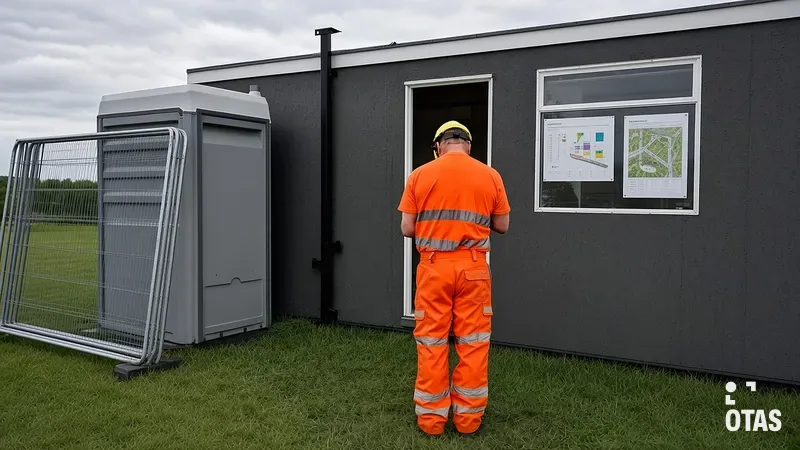
What else the committee heard in case one
The decision notice, the safety advisory group summary and the press set out more detail [1][3][5][6].
From the council papers
- Safeguarding The organisers were unfamiliar with work on violence against women and girls and with “Ask for Angela” [1].
- Fire The exit width sums were based on four final exits, where the site plan showed two from the main event area [1].
- The action list The safety advisory group asked for confirmed attendance, potable water, food trader registration, risk assessments, reviewed fire exit sums, consistent code words, a PA failure back up and wildfire measures [3].
From the press
- A police alcohol licensing officer said: “If this had gone ahead, it would have been dangerous” [5].
- The officer also said: “When asked what Ask for Angela is they didn't have a clue” [5].
- The Gazette and Herald reported that the organiser “admitted during a licensing hearing that he had never organised a festival before securing permission” [5].
- BBC News reported, citing the organiser, “only around 100 tickets having been sold” [6].
- Both reported that the original licence allowed the event to grow to nearly 15,000 people [5][6]. The decision now sets 5,000 for 2027 and 10,000 for 2028 [1].
Case two: refused on a town green
A new three day festival was planned for 25 to 27 June 2027 on a town green in south west London. The committee refused the application on 19 October 2026 [7].
The applicant's case [7]
- The footprint Just under 16,000 square metres, 38 per cent of the green.
- The capacity A daily capacity of 4,999, which the applicant said gave “over 2.5 square metres per person”.
- The offer 48 conditions offered, and clicker counts.
- The fence “The fence is about 2 metres high. The 4 emergency exits can be opened quickly and easily. They will be manned, but [the applicant] is unsure whether this would be at all times. They are 3 metres wide.”
The representations [7]
- There were “45 objections and 10 representations in support”.
- The committee “noted that there were no representations from any Responsible Authority”.
The reasons [7]
- The committee was “not satisfied that the number of people who could be present ... could be safely accommodated”. It pointed to “only one entrance and limited exit points which would also serve as the sole exit aside from emergencies”.
- The plan “did not take account of the proposed inner boundary to take into account the trees, such that the event space would be even smaller.”
- There was a “significant risk of people gaining unauthorised access ... by breaching the external perimeter fence”, which “could lead to the event capacity being breached”.
- The committee noted the “use by the Metropolitan Police of Section 35 Dispersal Orders due to ongoing concerns about antisocial behaviour” at the green.
- The event website “suggests that the event will be alcohol led”.
- In a highly residential area, “it would not be possible to impose conditions that could be sufficient to prevent significant public nuisance.”
The grounds were the prevention of crime and disorder, public safety and the prevention of public nuisance. The Legal Officer noted that the cumulative impact policy did not apply, as the site is just outside the zone. There is a right of appeal to the magistrates' court “within 21 days” [7].
What the two cases share
Two different outcomes, one review and one refusal. The same test sits under both. This is OTAS analysis of the two decisions.
The common thread
- Delivery Both committees asked whether the organiser could run the event safely, not only whether the forms were filled in [1][7].
- The site Both turned on exits. In case one the exit sums did not match the site plan [1]. In case two there was one entrance and limited exits [7].
- The detail In case one plans were incomplete [1]. In case two the plan missed the inner boundary for the trees [7].
- Authorities Case one began with the police and fire [1]. Case two was refused with no responsible authority objecting [7].
The law in brief: licences, reviews and notices
In brief, and not legal advice. The two cases are in England.
Licensing Act 2003
- A committee must promote the four licensing objectives: “the prevention of crime and disorder”, “public safety”, “the prevention of public nuisance” and “the protection of children from harm” [8].
- Section 18 sets out how an application is decided, including where relevant representations are made [9]. Committees must have regard to the licensing statement and the section 182 guidance [8].
- The police can apply for a review, and a committee can change conditions rather than revoke the licence [1].
- Appeals go to the magistrates' court, within 21 days [1][7][10].
Prohibition notices
- Under section 22 of the Health and Safety at Work etc. Act 1974, an inspector may serve a prohibition notice where activities “involve a risk of serious personal injury” [11].
- In case one, the notice took immediate effect and stopped the build, opening, admission, operation and de-rig [2].
Safety advisory groups
- HSE says organisers should “determine whether there is a safety advisory group (SAG) or a similar arrangement in the relevant area and, if appropriate, submit their event proposal for discussion and advice” [12].
- In case one, the Principal Licensing Officer said “the ESAG process existed to review plans, not to plan” events on behalf of organisers [1].
- HSE says: “you retain overall responsibility for ensuring the safety of the public” [13].
Scotland
- In Scotland, public entertainment licensing sits under section 41 of the Civic Government (Scotland) Act 1982, and licence conditions may limit numbers [15].
Book pre application meetings with your licensing team, police, fire and environmental health before you fix the date.

Conditions written into one licence
In case one, the committee modified the licence rather than revoke it. These are the main conditions [1].
| Condition | What it requires |
|---|---|
| Capacity | 5,000 in 2027 as year one, then 10,000 in 2028 [1] |
| Event manager | Experienced, appointed at least two weeks before the plan [1] |
| The plan | At least 180 days before the event [1] |
| Suppliers | Key suppliers contracted at least 60 days before [1] |
| Risk assessment | One document for build, live and de-rig [1] |
| Milestones | Dates for each area of the plan [1] |
| Sign offs | No build or admission without them [1] |
Table 2. The main conditions in the case one decision notice [1].
The milestones cover security and stewarding, medical and welfare, fire, traffic, water and sanitation, safeguarding, alcohol and drugs, emergency command and contractor interfaces. The plan must also set attendance assumptions with scalable resource triggers [1].
Martyn's Law on the horizon
A new regulator and new duties for larger events are coming.
What the SIA says [14]
- The guidance covers qualifying events, with entry checks and 800 or more people.
- The Act is expected to come into force in spring 2027.
What it may mean for a new festival (OTAS reading)
- A ticketed festival of 5,000 would have entry checks and more than 800 people. Check the SIA guidance when you plan year one.
- Build the public protection plan into the event management plan, not as a separate late document.
Why committees test delivery
The two decisions show what a committee looks for. The causes below come from the sources. The lessons are OTAS guidance.
The path from idea to opening
- Drafts are not plans. The plans in case one held “numerous ‘to be confirmed’ elements” [1]. A plan with gaps reads as a plan that is not ready.
- Names are not contracts. Contractors named in the plans had not been engaged [1]. A committee can ask who has signed.
- The sums must match the site. Fire and rescue said the exit width sums “appeared to be based on four available final exits, whereas the submitted site plan showed that only two exits were available from the main event area” [1].
- One set of words. Emergency code words were inconsistent across the plans [2]. In an emergency, two sets of words means two sets of actions.
- Support is not planning. The safety advisory group process exists “to review plans, not to plan” [1]. The organiser keeps overall responsibility [13].
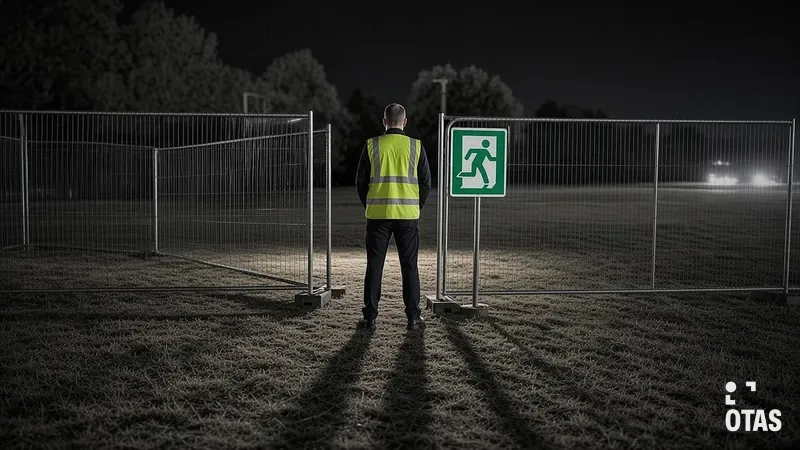
Seven questions your site plan must answer
Drawn from the reasons in case two [7]. The questions are OTAS guidance.
Ask these before a committee does
- Entrances How many entrances are there, and is the entrance also the everyday exit?
- Exits How many exits, how wide, and are they staffed at all times?
- Usable area Does the capacity sum use the real usable area, after trees, structures and buffers?
- The perimeter Can people outside without tickets breach the fence, and what is the plan if they do?
- The area What is the local antisocial behaviour picture, including police dispersal powers?
- Marketing Does your marketing match your application?
- Noise Can conditions really control noise in a highly residential setting?
Capacity and exit sums on open ground
A method, not a set of figures. OTAS professional practice.
Five steps
- Measure the usable area Start from the fenced area. Take out trees and their buffer, stages, bars, structures and welfare.
- Count the real exits Count only the exits drawn on the site plan you will submit. In case one the sums used four, and the plan showed two [1].
- Check what the fence does Check where the fence narrows a route. The prohibition notice letter in case one found exit widths affected by fencing [2].
- Staff every exit Say who staffs each exit, and when. In case two the applicant was unsure if the exits would be staffed at all times [7].
- One version Use one site plan and one set of sums across the fire plan, the security plan and the application.
Risk at the fence and beyond
A fence that people can breach is a capacity that can be breached [7].
OTAS professional practice
- Walk the perimeter at the time people will arrive, and mark the weak points.
- Plan stewarding and patrols on the outside of the fence, not just the inside.
- Ask the police about the local antisocial behaviour picture early. In case two, police dispersal orders at the green weighed in the decision [7].
- Write down what happens if the fence is breached, and who decides.
Signs your application is not ready
Signs 1 to 4 come from case one [1][2]. Sign 5 comes from case two [7]. The framing is OTAS guidance.
Signs your application is not ready
- 01“To be confirmed” in the plan
The plans in case one contained “numerous ‘to be confirmed’ elements” [1].
- 02Named contractors not engaged
Contractors named in the plans had not been engaged [1].
- 03Exit sums that do not match the plan
Sums based on four exits, on a site plan that showed two [1].
- 04No medical provider appointed
The prohibition notice letter listed no medical provider appointed [2].
- 05Marketing that tells a different story
A committee found a website “suggests that the event will be alcohol led” [7].
Work back from the event date
The timeline one committee wrote into a licence [1], with an OTAS planning step at the end. Use it as a benchmark.
Five steps, working back from the event
Appoint the event manager
An experienced event manager, appointed “at least two weeks before the submission of the initial Event Management” plan [1]. That is at least 194 days before the event.
Submit the plan
The event management plan, “at least 180 days before the event” [1].
Contract the suppliers
“The contracting of relevant key suppliers to be in place at least 60 days” before the event [1].
Get the sign offs
No build and no public admission unless the specified safety critical sign offs are in place [1].
Plan for the hearing
Plan back from the hearing date too. A refusal or a review needs the 21 day appeal window and time to reapply. That is OTAS guidance.
The evidence pack
What the committee and the safety advisory group asked for in case one [1][2][3]. Have it ready before you apply.
The plans
- A consolidated risk assessment for build, live and de-rig [1].
- A security and stewarding plan, with SIA staff numbers and locations [2].
- A fire plan, with exit widths calculated on the actual site plan [1][3].
- A traffic and transport plan [1].
- Water and sanitation, including potable water [1][3].
- Safeguarding, including work on violence against women and girls and “Ask for Angela” [1].
- An alcohol and drugs policy [1].
The proof
- A medical and welfare provider, appointed and named in the plans [2].
- An emergency command structure, with one set of code words [2][3].
- A PA failure back up [3].
- A contractor interface plan, with contractors actually engaged [1].
- Attendance assumptions with scalable resource triggers [1].
- Sign off evidence for temporary structures and electrics [2].
- Wildfire measures, where relevant [3].
Preparing for the hearing
OTAS professional practice.
Decision points
- Go or no go Do not apply until the event manager and core suppliers are in place.
- Talk early Hold pre application meetings with the police, fire, environmental health and licensing.
- Rehearse Decide who answers on capacity, exits, security and noise, and rehearse it.
- Year one Consider proposing a smaller first year yourself, rather than having one imposed.
At the hearing
- Bring the site plan and the sums, and make sure they match.
- Answer with what is signed, not what is planned.
- Check your website and posts say the same as your application [7].
Roles before the hearing
Five roles, each with one named person. OTAS professional practice. Overall responsibility stays with the organiser [13].
| Role | What they own |
|---|---|
| Licence holder | Accountable, and attends hearings |
| Event manager | The plan and the timeline |
| Safety officer | Risk assessment, exits and capacity sums |
| Security lead | The SIA deployment plan |
| Adviser | Licensing conditions and representations |
Table 4. Roles before the hearing. OTAS professional practice.
Action box
Operational
- Know the site plan
- Learn one set of codes
- Report blocked exits
Know the site plan you will work to. Check that the exits you staff are the exits on the plan. Learn the one set of code words. Report any exit that is blocked or not staffed.
Tactical
- Own one plan section
- Remove “to be confirmed”
- Match figures to the site
Own a section of the plan, such as security, medical, fire or traffic, and remove every “to be confirmed” from it. Check that your figures match the site plan and the contracts that are signed.
Strategic
- Appoint the manager early
- Sign suppliers first
- Propose a smaller year one
Appoint an experienced event manager before the plan is written. Do not apply until core suppliers are in place. Consider proposing a smaller first year yourself, rather than having it imposed.
A checklist for your application
OTAS professional practice unless a source is shown.
Before you apply
- An experienced event manager appointed [1].
- Core suppliers in place, with contracts signed.
- Pre application meetings with police, fire, environmental health and licensing.
- The seven site questions answered in writing.
- Marketing checked against the application [7].
Before the safety advisory group
- The event management plan 180 days out [1].
- No “to be confirmed” left in the plan [1].
- Exit sums that match the site plan [1].
- One set of code words [2].
- A medical provider named [2].
Before the build
- Key suppliers contracted 60 days out [1].
- Safety critical sign offs in place [1].
- A debrief date booked for after the event.
What we do not know yet
- How the year one conditions will work in practice. The next event in case one is planned for August 2027 [1].
- Whether other committees will set the same 180 day benchmark. We found it in one decision [1].
- When Martyn's Law comes into force. The SIA says it is expected in spring 2027 [14].
Coming up: dates to plan around
The festival in case one plans its next event for August 2027, as year one at 5,000 [1]. Working back, 180 days before an August event falls in February or early March. The event refused in case two had been planned for 25 to 27 June 2027 [7]. Martyn's Law is expected to come into force in spring 2027 [14].
Frequently asked questions
Can a committee refuse a licence when no authority objects?
Yes. In case two the committee “noted that there were no representations from any Responsible Authority”, and still refused, on grounds of crime and disorder, public safety and public nuisance [7].
What is a review, and does it mean the licence is revoked?
The police can apply for a review. In case one the committee modified the licence rather than revoke it, and reset the event to year one at 5,000 [1].
Who can stop an event close to the date?
An inspector may serve a prohibition notice under section 22 of the Health and Safety at Work etc. Act 1974 where activities “involve a risk of serious personal injury” [11]. In case one the notice stopped the build, opening, admission, operation and de-rig [2].
Will the safety advisory group help write our plan?
No. In case one the Principal Licensing Officer said the process “existed to review plans, not to plan” [1]. HSE says you retain overall responsibility for the safety of the public [13].
How long is there to appeal?
21 days, to the magistrates' court [1][7][10].
Does this apply in Scotland?
The two cases are English, under the Licensing Act 2003. In Scotland, public entertainment licensing sits under section 41 of the Civic Government (Scotland) Act 1982 [15]. The lessons on planning and evidence still apply.
Related OTAS Insights
These are links to other OTAS Insights pieces, not to any OTAS Live product or service.
- When a social post draws a crowd: pop-up events without a plan
- Signed off yesterday, failed today: temporary seating on show day
Interest: OTAS Live Ltd, which publishes OTAS Insights, sells event operations services, handbooks and training related to this topic.
Law: this Insight summarises parts of UK law and guidance as published on legislation.gov.uk and GOV.UK. It is not legal advice. Ask your council what applies to your event, and take advice.
References
Web sources opened 2 November 2026 and labelled with their publisher.
- Wiltshire Council, Northern Area Licensing Sub Committee, decision notice, 30 September 2026 cms.wiltshire.gov.uk
- Wiltshire Council, Appendix 14, prohibition notice cover letter, redacted, 31 July 2026 cms.wiltshire.gov.uk
- Wiltshire Council, Appendix 12, event safety advisory group summary, 31 July 2026 cms.wiltshire.gov.uk
- Wiltshire Council, Northern Area Licensing Sub Committee, printed minutes, 30 September 2026 cms.wiltshire.gov.uk
- Gazette and Herald, festival can go ahead despite failings, 9 October 2026 gazetteandherald.co.uk
- BBC News, festival licence review, 10 October 2026 bbc.co.uk
- London Borough of Richmond upon Thames, Licensing Sub Committee, public minutes and decision notice, hearing 19 October 2026 cabnet.richmond.gov.uk
- Licensing Act 2003, section 4, legislation.gov.uk legislation.gov.uk
- Licensing Act 2003, section 18, legislation.gov.uk legislation.gov.uk
- Licensing Act 2003, appeals, Schedule 5, legislation.gov.uk legislation.gov.uk
- Health and Safety at Work etc. Act 1974, section 22, legislation.gov.uk legislation.gov.uk
- HSE, crowd management, working with others hse.gov.uk
- HSE, crowd management, roles and responsibilities hse.gov.uk
- Security Industry Authority, understanding Martyn's Law and the SIA's role as regulator, 17 July 2026 gov.uk
- Civic Government (Scotland) Act 1982, section 41, legislation.gov.uk legislation.gov.uk
If your hearing were next week, who would answer on capacity, exits, security and noise?
If you need support with an event management plan or a licensing hearing for a new festival, reach out to us to see how we can support you.
OTAS Live Ltd · Correct as of
Download the PDFs
- The article: PDF, 26 pages, 3.8 MB
- The full report: PDF, 35 pages, 4.6 MB
- The slide deck: PDF, 25 pages, 1.3 MB
Work with OTAS
Applying for a new festival licence?
Corrections to published Insights articles are listed in our corrections log.