
Download the PDFs
- The article: PDF, 21 pages, 3.9 MB
- The full report: PDF, 31 pages, 5.5 MB
- The slide deck: PDF, 23 pages, 1.3 MB
firework displays lost in fog [1]
visibility in the next night's fog [3]
storm gusts possible on coasts [4]
“…do not continue if the operator advises cancelling or stopping the display.”
Explosives Industry Group, Working Together on Firework Displays, printed page 36, on stopping or cancelling in adverse wind [20]
By OTAS Insights · Published by OTAS Live Ltd
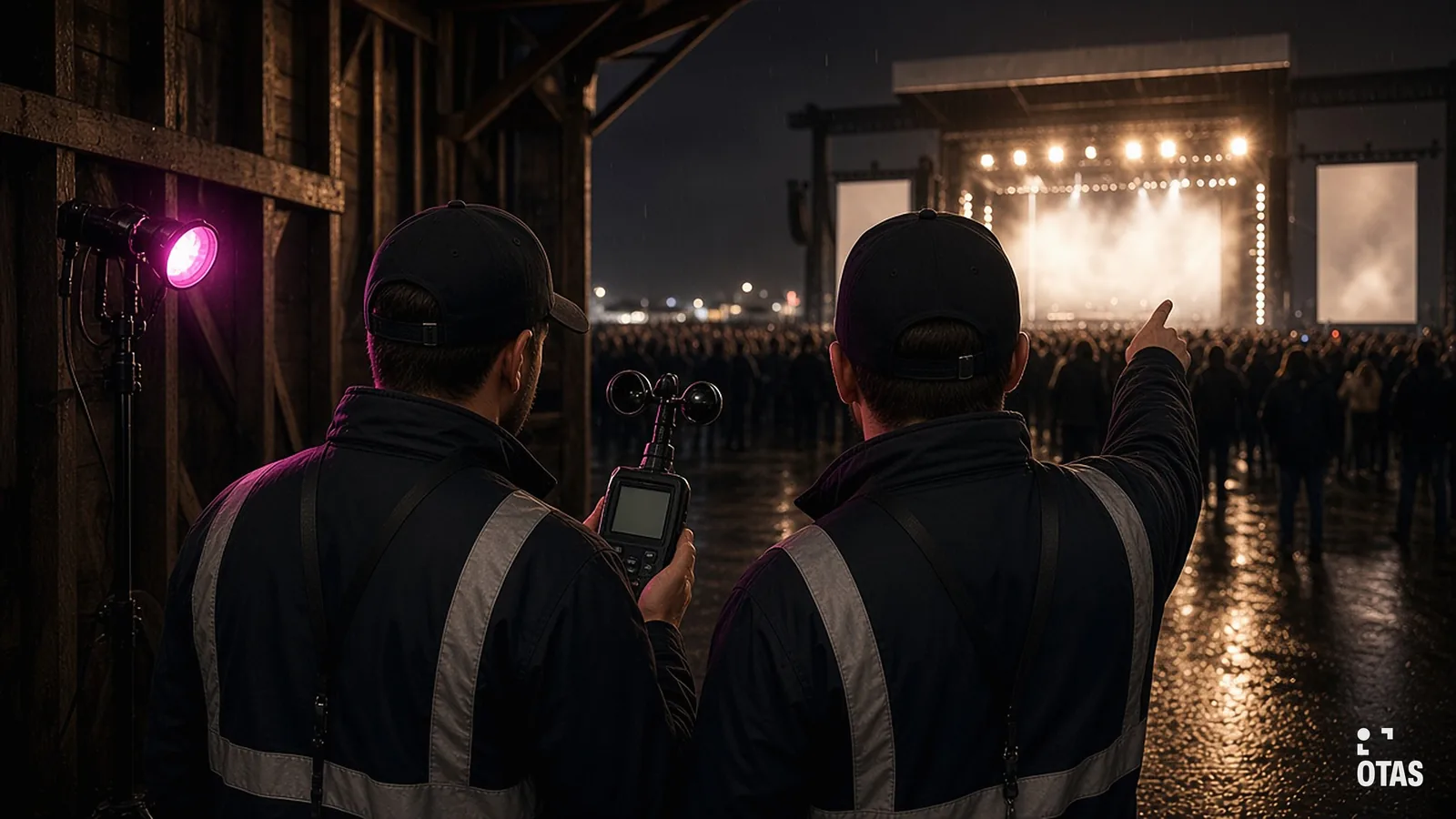
On the evening of Saturday 7 November, thick fog settled over Greater Manchester. Flights into the city's airport were diverted, and two firework displays were barely visible. Some people left part way through [1]. At a televised FA Cup tie the same evening, the commentator could not tell which team had the ball from about the hour mark, and players could not see both goals from the centre circle. The game was played to the end, through extra time and penalties. BBC Sport reported it came very close to being called off [2]. The next night the Met Office had fog warnings over much of England, with visibility in places below 100 metres [3]. Two weeks earlier, a named storm brought an amber wind warning and gusts up to 80 mph on exposed coasts. A light trail in Liverpool was cancelled two nights running and a Diwali celebration in central London was called off [4][5]. This Insight is not about who made the right call. It is about making sure your call is made on numbers you agreed before the weather arrived.
In short: weather rarely forces a stop on its own. People do, late, when nobody agreed the numbers. Before an outdoor event, set the wind, visibility and lightning triggers for each level of response. Name one person who calls delay, pause or stop, and write the words the team and the crowd will hear.
What was reported
Two weather events, as reported [1] to [6]. We describe events and venues rather than naming them in the text. Some source links carry names. We do not judge any decision.
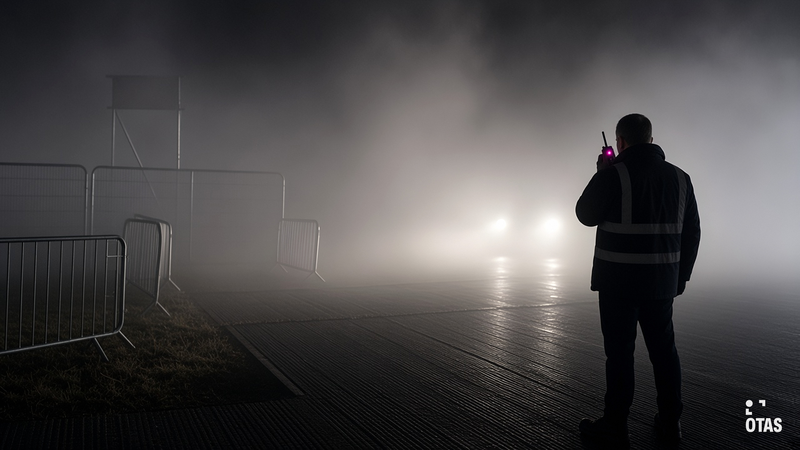
Fog, 7 and 8 November
- Where Greater Manchester on the Saturday evening, then much of England, eastern Wales and Northern Ireland on the Sunday night and Monday morning [1][3].
- Displays Two firework displays were barely visible in the fog. Some people left part way through. One club said it was disappointed but the community still enjoyed the night [1].
- A cup tie Visibility at a televised FA Cup tie was described as down to a few yards. Players could not see both goals or the corner flags from the centre circle. The match went to penalties [1][2].
- Warnings Yellow fog warnings ran to 11:00 on Monday 9 November. Visibility could fall below 100 m. Crashes on the M20 and the A303 were reported in fog [3].
Storm, 24 and 25 October
- The warning An amber wind warning ran from 21:00 on Saturday 24 October to 21:00 on Sunday, with gusts of 60 to 70 mph and up to 80 mph on exposed coasts [4]. The storm was named on 22 October [7].
- Cancelled A free light trail in Liverpool was cancelled for a second night [5]. A Diwali celebration in central London was cancelled on the advice of independent health and safety experts [4].
- Closed A floodlit event at a North Yorkshire estate and a castle in Edinburgh closed. Markets and grass pitch fixtures were called off [4][5].
- Afterwards The Met Office recorded gusts over 70 knots, about 81 mph, on the west coast. Two men died after trees fell [6].
What the guidance says about weather and events
In brief, from the Met Office, HSE and industry guidance [7] to [25]. Not legal advice.
Warnings and forecasts
- The colour of a Met Office warning is set by a combination of the impact the weather may have and how likely it is, so read each warning [8].
- Warnings are issued up to seven days ahead, for rain, thunderstorms, wind, snow, lightning, ice, extreme heat and fog [8].
- Fog means visibility below 1,000 m. Dense fog, which affects driving, means visibility below 100 m [9].
- A storm is named when it could lead to an amber or red warning [7].
- If you can hear thunder you are within range of lightning, which can strike up to 10 miles from the centre of a storm [10].
- The core season for UKHSA Cold Health Alerts runs from 1 November to 31 March. Alerts can also be issued outside it [21].
Temporary structures and wind
- Industry guidance on temporary demountable structures includes wind management plans. HSE lists it on its event safety pages [13][15].
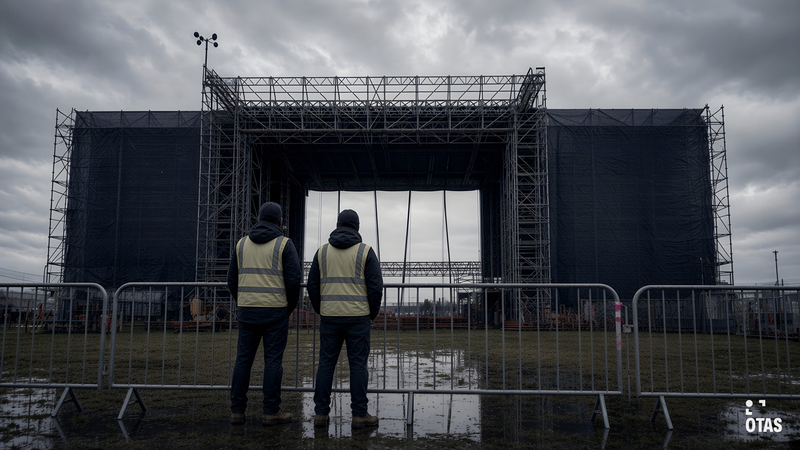
- A published wind management plan sets levels against the operational maximum gust, measured as a 3 second gust at 10 m. At 75 percent with a rising trend, staff go on alert. At 90 percent, the plan is put into action, the site is secured against public access and all but safety critical staff leave [14].
- HSE says monitor and measure the local weather where a structure is susceptible to it. If wind arrangements are not in place, HSE says it may be prudent to keep an exclusion zone of about 1.5 times the tower height around the tower. Ballast must stay in place while the structure is in use [15].
- HSE says consider prevailing wind, flooding and ground conditions in site design [17], and include weather news in site inductions [18].
Fireworks, lightning and the stop
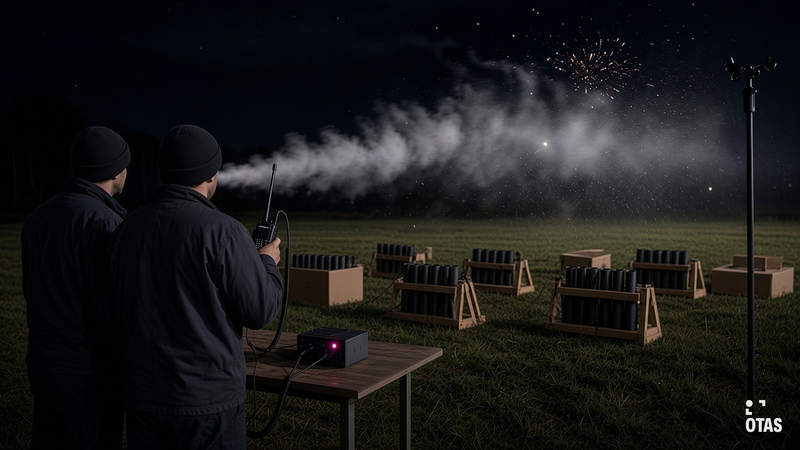
- Industry firework guidance says high winds may mean changing the display or, in extreme conditions, cancelling it or finishing early. Involve the display operator, and do not continue if the operator advises stopping [20].
- HSE says plan for the prevailing wind and what happens if it changes, and recheck weather and wind on the day [19].
- RoSPA advises event organisers to monitor lightning risk from the day before to dispersal, list safe structures, and set criteria to suspend and resume, such as the 30/30 rule [11].
- HSE says plan for sudden bad weather, agree public address wording in advance, and restart only after consultation [16].
- Employers, and self employed people whose work is of a prescribed kind, have a duty to people who are not their employees, such as the public [23]. They must run their work so that, so far as is reasonably practicable, those people are not exposed to risks to their health or safety [23].
- Northern Ireland has the same kind of duty under the Health and Safety at Work (Northern Ireland) Order 1978, article 5 [25].
The Purple Guide weather chapter asks organisers to monitor forecasts, plan for weather scenarios, and plan how people will be told if an event is cancelled [12]. A BBC report on a national inspection of event safety oversight said safety advisory groups are not statutory and have no basis in law [24]. They give advice. The legal duties stay with those who run the event [23]. In OTAS guidance, that means the organiser still owns the weather call.
Wind, fog and lightning in numbers
The numbers the guidance uses. They are background for your own triggers, not limits for your site.
Wind
- A published wind management plan measures the 3 second gust at 10 m and sets action levels at 75 and 90 percent of the operational maximum gust [14].
- To turn knots into mph, multiply by about 1.15 [22]. The storm on 24 October gusted over 70 knots, about 81 mph, on the west coast [6].
- If wind arrangements are not in place, HSE says it may be prudent to keep an exclusion zone of about 1.5 times the tower height around the tower [15].
Fog
- Fog is visibility below 1,000 m. Below 100 m is dense fog. Public forecasts use 180 m [9].
- Mist is visibility above 1 km [3][9].
Lightning
- Lightning can strike up to 10 miles from the centre of a storm [10].
- The 30/30 rule: suspend at 30 seconds or less from flash to thunder. Restart 30 minutes after the last thunder [11].
Why weather calls come late
Each reason is about people and plans, not the weather. OTAS guidance.
Decide on the number, not the mood
- A warning is not a trigger. A yellow warning covers a wide area. It does not tell you what to do at your site, so teams wait to see what happens.
- No number agreed. If nobody has written the gust, visibility or lightning numbers, every decision becomes a debate on the night.
- Everyone waits for someone else. The display operator, the structure supplier, the venue and the safety advisory group each expect another to call it. Safety advisory groups give advice and are not statutory [24]. In OTAS guidance, the organiser decides.
- The crowd is already in. Once people have travelled and paid, stopping feels harder. That pressure is strongest at the moment the call matters most.
- Fog hides the problem. In fog, stewards cannot see the next post, CCTV loses the far end and the display operator may not see the fall out area. The risk grows while it is harder to see.
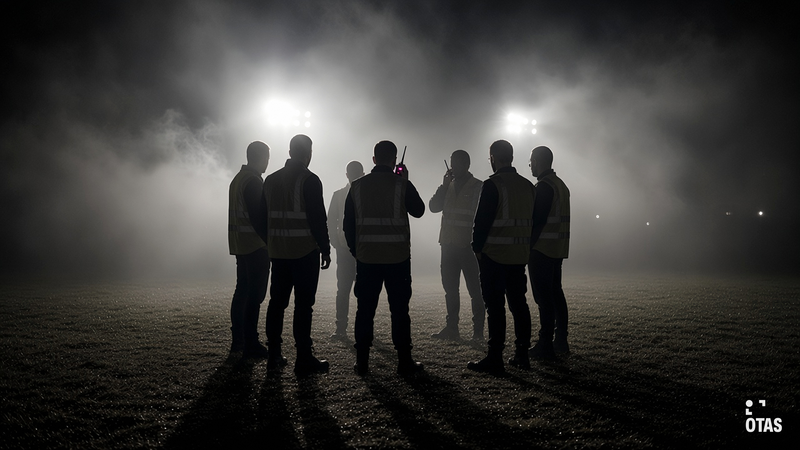
Six things to agree before the event
These are the six things to agree first. OTAS guidance unless a source is shown.
Before the event
- The limits The weather limit for every structure, display and activity, from the person who sets it [13][14].
- The triggers Watch, act and stop for wind, fog, lightning, rain and cold.
- The owner One named person who calls delay, pause or stop, with a deputy.
- The operator The display operator can stop the display, and you will not overrule that [20].
- The words Public address and radio words for delay, pause, stop and restart [16].
- The message out How you will tell people who are not yet on site, by web and social media [12][16].
Signs your weather plan will not hold
Each of these is OTAS guidance, drawn from HSE, Met Office and industry guidance.
Signs your weather plan will not hold
- 01No numbers
The plan says monitor the weather but sets no wind, visibility or lightning number [16].
- 02Wind from a phone
Gusts are read from an app, not where and how the designer or supplier specifies [14][15].
- 03No fog plan
Nobody has asked what stewards, CCTV and the display operator need to see [9].
- 04Nobody owns the call
The event manager, display operator and supplier each think another decides [20].
- 05No words written
There is no public address wording for delay, pause or stop [16].
Plan the weather call, from the first meeting to the night
Five stages. OTAS guidance unless a source is shown.
Five stages, from the limits to the night
Limits
Collect the weather limit for every temporary structure, display and activity from the person who designed or supplies it [13][14]. Record where each limit is measured, and who reads it.
Triggers
Turn each limit into three levels: watch, act and stop. Add visibility and lightning triggers [9][11]. Agree them with your display operator, structure suppliers and safety advisory group.
Owner
Name one person who calls delay, pause or stop, and a deputy. Make clear that the display operator can stop the display, and that you will not overrule that [20].
Words
Write the public address and radio words for delay, pause, stop and restart, and how you will tell people who are not yet on site [12][16]. Test them at a table top exercise [16].
On the night
Check the forecast from the day before to dispersal [11]. Read the wind where and how the designer or supplier specifies, and the visibility, at set times. Log every reading and every decision, and call it when the number is reached.
Public address scripts
Agree the words before the event, as HSE advises [16]. Keep them short, calm and the same every time. OTAS guidance.
Delay, before doors or the display
- "We are delaying the start because of the weather. Please stay where you are. We will update you in ten minutes."
Pause, during the event
- "We are pausing the show because of the weather. Please stay where you are and follow the stewards. We will update you shortly."
Stop and leave
- "Because of the weather, tonight's event is ending now. Please leave calmly by the nearest exit, following the stewards. Thank you."
Restart
- "Thank you for your patience. The weather has improved and we are ready to restart."
Action box
Operational
- Know the words
- Report what you see
- Follow the call
Know the words for delay, pause and stop. Report what you see, such as gusts, fog at your post or thunder, straight away. Follow the call when it comes.
Tactical
- Read and log
- Report the trigger
- Brief the words
Read the wind and visibility at set times and log them. Tell the decision owner the moment a trigger is reached. Brief the words at the start of each shift.
Strategic
- Set the triggers
- Name the owner
- Tell people early
Collect the limits, set the triggers and name the person who calls it. Agree them with the display operator and suppliers, and plan how you will tell people who are not yet on site.
Weather call checklist
OTAS guidance unless a source is shown.
Before the day
- Limits collected from every designer and supplier [13][14].
- Triggers agreed for wind, fog, lightning, rain and cold.
- One named person who calls it, and a deputy.
- Public address words written and recorded [16].
On the day
- Forecast checked from the day before to dispersal [11].
- Wind read where and how the designer or supplier specifies, and visibility at the posts, at set times [15].
When a trigger is reached
- Call it. Tell the team, then the crowd.
- Log the reading and the decision.
- Restart only when the risk is back to a tolerable level, staff are in position and the owner has consulted the other key agencies on site, such as the emergency services [16]. Do not restart a display unless the display operator agrees. OTAS guidance.
What we do not know yet
- What triggers, if any, the displays and the cup tie in the fog had agreed in advance. This is not public.
- What visibility was measured at each site. The reports describe it, but do not give a figure [1][2].
- How the cancelled storm events reached their decisions, beyond what was reported [4][5].
- Whether any review of the fog evening is planned. None had been announced as of 9 November.
Coming up: winter events and the next named storm
Christmas markets, light trails, switch ons and New Year events run outdoors through the darkest, foggiest and windiest weeks of the year. The core season for Cold Health Alerts runs until 31 March [21], and the Met Office names storms through the winter [7]. The plan that works is the one agreed before the forecast turns.
Frequently asked questions
Should we stop when a yellow warning is issued?
Not by itself. A warning tells you what impact the weather could have across an area [8]. Your triggers tell you what to do at your site. Use the warning to start watching and measuring.
What wind speed should we stop at?
The one your structure designer or supplier set for each structure, measured as they say. A published plan used 75 and 90 percent of the operational maximum gust as its alert and action levels [14]. Do not invent one.
Is there a legal visibility limit for events?
No single figure applies to every event. The Met Office calls visibility below 100 m dense fog [9]. Set your trigger by what your stewards, CCTV and display operator need to see.
Who can stop a firework display?
The display operator. Industry guidance says do not continue if the operator advises cancelling or stopping [20]. The organiser can also decide to stop it. This is OTAS guidance.
What is the 30/30 rule?
If the gap between a lightning flash and its thunder is 30 seconds or less, suspend outdoor activity. Wait 30 minutes after the last thunder before restarting [11].
Did the cup tie and the displays in the fog do the wrong thing?
We do not know, and we do not judge it. The reports describe the conditions, not the plans or numbers each team had agreed [1][2].
Related OTAS Insights
These are links to other OTAS Insights pieces, not to any OTAS Live product or service.
Interest: OTAS Live Ltd, which publishes OTAS Insights, sells event operations services, handbooks and training related to this topic.
Law: this Insight summarises Met Office, UKHSA, HSE and industry guidance and health and safety law in Great Britain as published on 9 November 2026. Northern Ireland has its own health and safety law. It is not legal or meteorological advice. Ask your structure designers and suppliers, your display operator and your safety advisory group what applies to your event.
References
Web sources opened 9 November 2026 and labelled by source type. Links are for checking only. Listing a source does not mean it endorses OTAS or has worked with OTAS.
- Regional newspaper report on thick fog, flight diversions and firework displays in Greater Manchester, 8 November 2026 manchestereveningnews.co.uk
- BBC Sport report on an FA Cup tie played in thick fog, 8 November 2026 bbc.co.uk
- BBC Weather report on fog warnings across England, Wales and Northern Ireland, 8 November 2026 bbc.com
- National newspaper and PA report on a named storm, travel disruption and cancelled events, 24 October 2026 theguardian.com
- BBC News report on events and attractions closed by a named storm, 24 October 2026 bbc.co.uk
- Met Office, storm summary for two named storms, October 2026 metoffice.gov.uk
- Met Office, UK Storm Centre weather.metoffice.gov.uk
- Met Office, weather warnings guide metoffice.gov.uk
- Met Office, fog metoffice.gov.uk
- Met Office, stay safe in thunder and lightning weather.metoffice.gov.uk
- RoSPA, lightning safety rospa.com
- The Purple Guide, weather chapter, January 2026 (subscription) thepurpleguide.co.uk
- Institution of Structural Engineers, Temporary demountable structures: Guidance on procurement, design and use, fourth edition, 2017 istructe.org
- Published wind management plan for a temporary structure, filed with a planning application, 2022 docs.planning.org.uk
- HSE, event safety, outdoor equipment hse.gov.uk
- HSE, event safety, incidents and emergencies hse.gov.uk
- HSE, event safety, venue and site design hse.gov.uk
- HSE, event safety, managing an event hse.gov.uk
- HSE, organising firework displays hse.gov.uk
- Explosives Industry Group, Working Together on Firework Displays, 2023 eig2.org.uk
- UKHSA, Weather Health Alerting System gov.uk
- Met Office, Beaufort wind force scale metoffice.gov.uk
- Health and Safety at Work etc. Act 1974, section 3 legislation.gov.uk
- BBC News report on a national inspection of event safety oversight, 4 September 2026 bbc.co.uk
- Health and Safety at Work (Northern Ireland) Order 1978, article 5 legislation.gov.uk
If fog came down over your event tonight, who would make the call, and on what number?
If you need support setting weather triggers and stop decisions for your event, reach out to us to see how we can support you.
Events industry since 2008, internationally since 2015. OTAS Live Ltd. By OTAS Insights. Edited by Kris Dailly.
Download the PDFs
- The article: PDF, 21 pages, 3.9 MB
- The full report: PDF, 31 pages, 5.5 MB
- The slide deck: PDF, 23 pages, 1.3 MB
Work with OTAS
Planning an outdoor event this winter?
Corrections to published Insights articles are listed in our corrections log.