
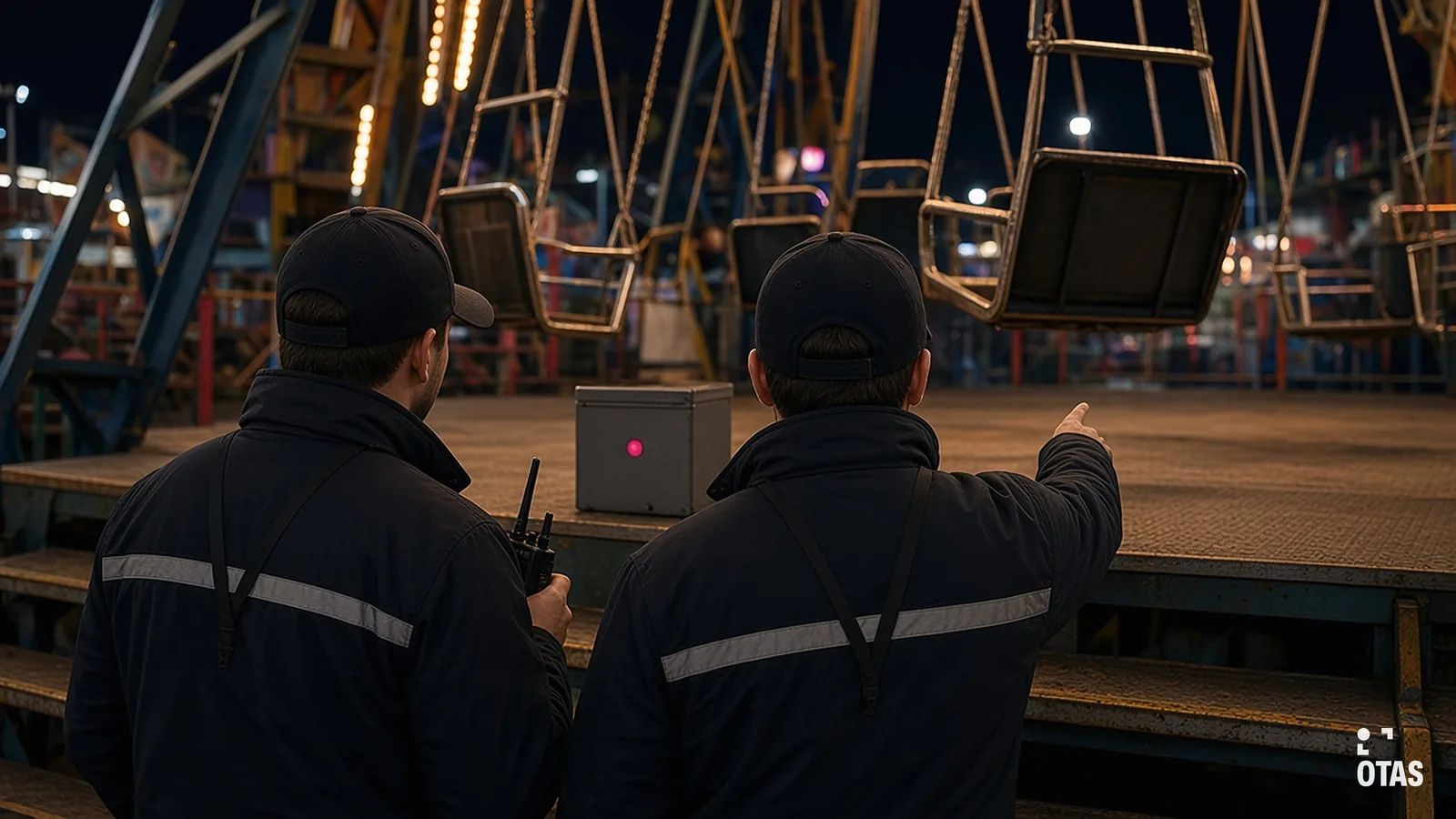
Download the PDFs
- The article: PDF, 21 pages, 4.6 MB
- The full report: PDF, 35 pages, 7.4 MB
- The slide deck: PDF, 24 pages, 1.5 MB
hurt when swings collided [1]
to hospital from a Rotherham fair [3]
swing out height to enclose [9]
“Do not start the device unless you have positive confirmation that it is safe to do so.”
HSE, HSG175, paragraph 320 [9]
By OTAS Insights · Published by OTAS Live Ltd
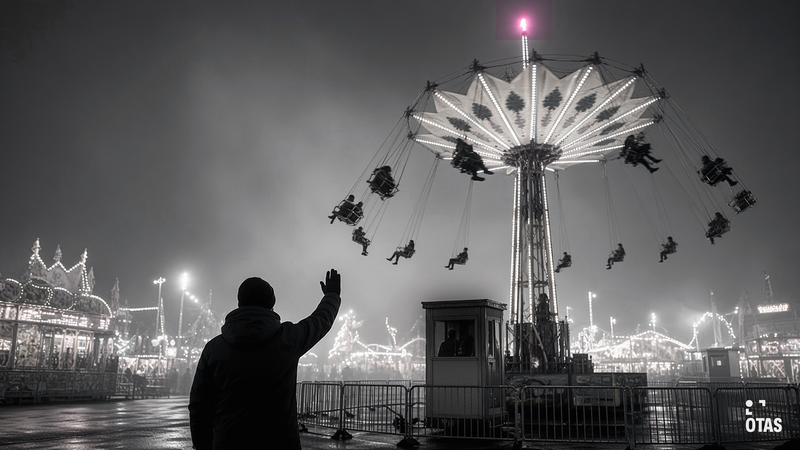
On Saturday 7 November a chair swing ride at a county fair in Georgia, USA, became unstable as it slowed and the swings collided [1]. The sheriff's office said two 13 year olds had held on to each other's seats after staff told them not to [1][2]. A woman left by ambulance and two children were treated for minor injuries [1]. A parent said other parents ran to the control panel to help slow the ride [1]. The two teenagers were charged and released to their parents [2]. In September three people, aged 11, 13 and 21, were taken to hospital from a fair in Rotherham, South Yorkshire, and the fair closed early [3]. The cause has not been made public [3][4]. This Insight is for organisers who bring rides into a winter event. It covers what UK guidance expects, how to brief riders and staff, when to stop a ride, and what to do in the first ten minutes after something goes wrong.
In short: rider conduct is a risk you can plan for. Check each ride before it arrives, and give riders the rules in the queue and at the gate. Make sure the operator can see the whole ride and is expected to stop it, and agree who takes charge after an incident.
What was reported
Three reports, from Georgia, Rotherham and Louisiana [1][3][6]. Children were involved in all three. We do not name them. We describe events and ride operators rather than naming them in the text. Some source links carry names. Where a cause is claimed, we say who claimed it.
Georgia, USA, 7 November
- Where A chair swing ride at a county fall fair in Grovetown, Georgia, on a Saturday [1]. The fair runs until 15 November [1].
- What deputies said The sheriff's office said two 13 year olds held on to each other's seats while the ride was moving, after staff had warned them not to [1][2]. Video shared online shows the ride becoming unstable as it slowed, and the swings colliding [1].
- Injuries A woman was taken away by ambulance and two children were treated for minor injuries, according to a local station [1]. CBS reported three people with minor injuries [2].
- At the controls A parent told a local station that other parents rushed to the control panel to help her husband slow the ride [1]. She said she did not see much urgency from law enforcement or EMS [1].
- Afterwards The two teenagers were charged with being unruly and released to their parents [2]. The reports do not mention any check of the ride afterwards [1][2].
Rotherham, 11 September
- Where A fair in Maltby, Rotherham, South Yorkshire, on a Friday evening [3].
- What happened The ambulance service was called at about 18:50 and sent two ambulances and three rapid response vehicles. Three people, aged 11, 13 and 21, were taken to hospital [3].
- On the night The fair closed early. A nearby road was closed so that people could leave the site safely [3][4].
- Afterwards The next day the two children were stable in hospital and the woman had minor injuries [3]. The authorities said they were investigating, and that checks would be made across the fair's equipment [4]. The cause has not been made public.
Louisiana, USA, 1 November 2025
- Where A Ferris wheel at a harvest festival in New Roads, Louisiana [5].
- What investigators said Two girls fell from a wheel tub [5]. The state fire marshal said the tub door was open while the wheel turned, caught on part of the structure and tipped the tub [6]. The wheel had passed its yearly inspection [6].
- The question of who opened the door Documents released later show the ride company believed the riders opened the door. Investigators could not prove that [7]. Reports differ on how many girls fell, and from what height [5][8].
- Afterwards Both girls went home to recover [5]. The fire marshal stopped three wheels from operating in the state and set out changes to how rides are inspected [6]. Louisiana lawmakers are now considering tougher inspection rules, and lawsuits are under way [8].
What these cases do and do not show
Facts and judgement are kept apart here. The facts carry source numbers. The rest is OTAS guidance.
| Incident | What is reported | What is not known |
|---|---|---|
| Georgia | Deputies said riders held each other's seats after warnings [1][2] | Whether the ride was checked afterwards, and why it was not stopped sooner [1][2] |
| Rotherham | Three people went to hospital, the fair closed early [3] | The cause, and what the checks found [4] |
| Louisiana | A tub door was open while the wheel turned [6] | How the door opened. The rider claim was not proved [7] |
Table 3. Facts and open questions in the three cases. Facts from [1][2][3][4][6][7].
The lesson for organisers does not depend on the cause. In each case people were hurt on a ride at a public event, and the people around the ride had to act in the first minutes. Planning for rider conduct, for a fault and for the response is the same job.
What UK guidance says about rides at events
In brief, from HSE guidance HSG175, Fairgrounds and amusement parks: Guidance on safe practice, third edition, 2017 [9][10], and HSE web guidance [11][12][15]. Not legal advice. Paragraph numbers are from HSG175.
Who holds the duty
- Where a fair is part of a larger event, the overall event promoter keeps the legal duty to make sure the whole site is safe, but may engage a separate organiser for the fair. Ride controllers must cooperate with the organiser (para 173) [9].
- Each controller is responsible for running their own ride safely. The organiser must have the authority to act to keep the public safe if a controller is not doing so (para 174) [9].
- If you contract a fair organiser, HSE says to check they are competent and resourced for the job, as with any contractor [15].
Before the fair opens
- Check that every controller has current insurance and, for each ride, a current Declaration of Operational Compliance, known as a DOC, from a registered inspection body (para 187) [9].
- Plan the layout so there are no pinch points, with extra space round popular rides and room for emergency vehicles while people are leaving (para 182) [9].
- Have a written emergency plan, with named roles. Stewards should not be involved in operating rides (para 181) [9].
- Carry out safety checks each day before the public are let in (para 190) [9].
While the ride runs
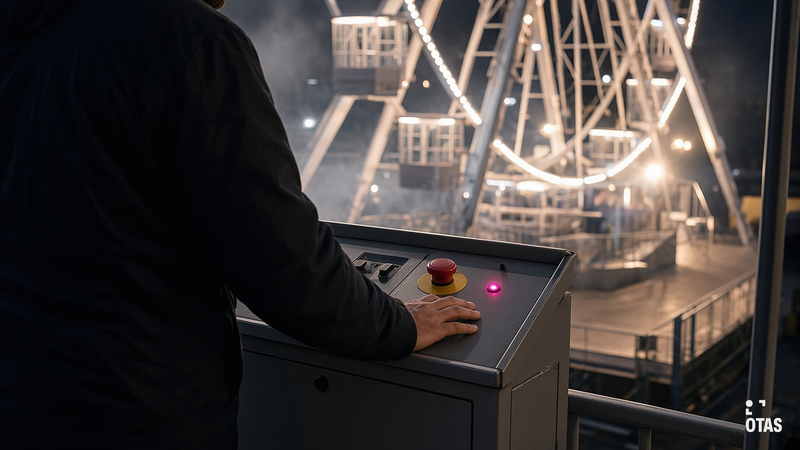
- Each ride must be in the immediate charge of an operator, who is in control throughout the cycle and runs only one ride. Nobody else may interfere with it, except to use an emergency stop (para 273) [9].
- Provide enough attendants for the access points and the queue. The number depends on the size of the crowd (para 274) [9].
- The operator should have a clear view of the whole ride, especially loading. If not, use agreed signals. Do not start without positive confirmation it is safe (paras 275 and 320) [9].
- Barriers should keep people out of the ride's safety envelope, with an attendant or a closed gate at each access point while the ride moves (paras 241 and 242) [9].
When riders do not follow the rules
- HSE lists passengers deliberately failing to follow safety instructions as reasonably foreseeable misuse (para 31) [9].
- HSE's guidance also sets a limit. Foreseeable misuse is unlikely to include deliberate or outrageously reckless actions, such as passengers deliberately attempting to defeat restraint systems (para 30). People climbing over or otherwise defeating a properly installed and effective safety device or perimeter safety fencing, and passengers changing seats while the ride is in motion, are not reasonably foreseeable misuse (para 32) [9].
- Use clear notices and the PA to back up the rules, and have attendants give clear instructions and check restraints before the start (para 285) [9].
- Train operators and attendants to stop the ride if needed, to prevent riders misusing safety equipment, behaving recklessly or ignoring instructions (para 286) [9].
- Operators should watch riders and attendants closely, and stop the ride if anyone behaves unsafely or does not follow instructions (para 321) [9].
HSE says the vast majority of accidents on fairground rides come from poor maintenance or poor operation [12]. Rider conduct is part of operation: the controller plans for it, and the operator acts on it.
The paperwork to collect before build up
Collect these for every ride before it arrives on site. Sources shown. A DOC is the Declaration of Operational Compliance from a registered inspection body.
| Document | What to check |
|---|---|
| DOC | Current, for this ride, checked online by its ADIPS number. Paper is not proof. Normally valid for 12 months [17][18] |
| Insurance | Public liability insurance for the controller. One council asks for at least £5 million [21] |
| Risk assessment | For this ride on your site, including rider conduct and bad weather [9][21] |
| Rider rules | Height, age and conduct rules, and the signs and PA words that give them [9] |
| Emergency arrangements | How riders are got off the ride if it stops, including at height (paras 302 and 303) [9] |
| Named controller | Who is in charge of the ride on site, and how to reach them [9] |
Table 4. Paperwork for each ride. Sources shown. Not a full list. Ask your council what it needs.
Ride inspectors who work under ADIPS are registered with it, and NAFLIC is a trade association for them [17][22]. Trade bodies such as the Showmen's Guild set safety rules for their members [19]. The Purple Guide recommends using ride operators who are experienced, insured and trained [20].
Who owns what on a mixed site
At a winter event, a market, a stage and a fair often share one site. Five roles, each with one named person. Drawn from HSG175 paras 173, 174, 181 and 273 [9].
| Role | What they own |
|---|---|
| Event organiser | The safety of the whole site, including the rides. The authority to close a ride (paras 173 and 174) [9] |
| Fair organiser or deputy | The fair area, the layout, daily checks and the emergency plan for the rides, where one is engaged [9][11] |
| Ride controller | The safe running of their ride, the staff, the rider rules and reporting (paras 174 and 307) [9] |
| Ride operator | The ride itself, throughout each cycle, and the decision to stop it (paras 273 and 321) [9] |
| Steward | The public around the rides, queues and access lanes. Not the ride controls (para 181) [9] |
Table 5. Roles on a site with rides. Drawn from HSG175 [9] and HSE [11].
Why winter events raise the stakes
In Georgia, parents reached the control panel [1]. In Rotherham, a road was closed to let people leave [3]. The rest of this section is OTAS guidance, drawing on HSE.
From a rule to a stopped ride
- Groups of teenagers. Winter events draw groups of young people after school and at weekends. Showing off on a ride is more likely in a group, and one warning may not be enough.
- Busy queues, short cycles. A long queue puts pressure on staff to load quickly. The rules get shortened or skipped, and restraints are checked in a hurry.
- Dark, cold and wet. Short days mean most rides run in the dark. Rain makes platforms and steps slippery, and HSE lists heavy rain and strong winds as reasons to stop a ride (para 318) [9].
- Spectators close to the ride. Parents and friends stand at the barrier. HSE notes that spectators may be relatives of riders, and distressed (para 301) [9]. If staff do not act fast, others will try to.
- Small sites, tight access. Winter markets and lights events often sit in town squares and parks. Rides are packed close to stalls, which leaves little room for an ambulance or for people to move away.
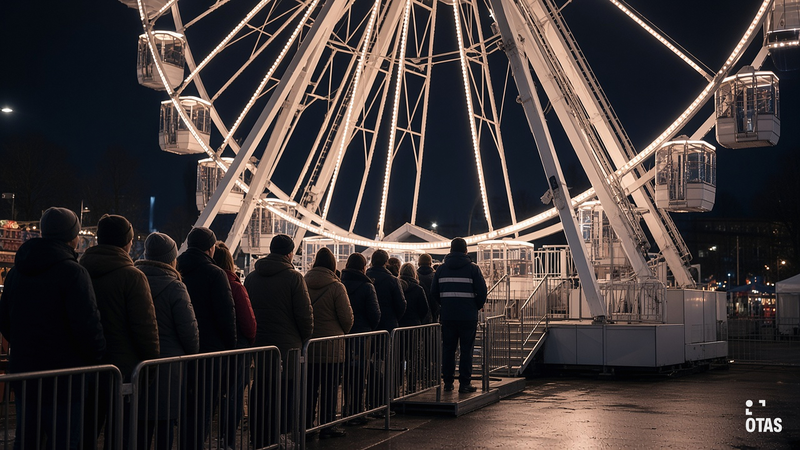
Tool: ride zone layout and queue checks
Use this at the site walk before opening, and again at each busy period. OTAS guidance, drawing on HSG175 [9] and HSE crowd guidance [16].
Layout, before opening
- Each ride has space round it, with extra space for the busiest rides (para 182) [9].
- A lane for emergency vehicles reaches every ride, and stays clear while people are leaving (para 182) [9].
- Barriers keep the public outside each ride's safety envelope, with no gaps a child could get through (paras 239 and 242) [9].
- Access points are as few as the ride needs, normally no more than four (para 240) [9].
- The operator can see the whole ride and loading area from the controls (para 275) [9].
Queue, each busy period
- The queue does not block an access route or another ride's exit [16].
- There is a way out of the queue without pushing against people [16].
- Enough attendants are on the gate and the queue for the crowd (para 274) [9].
- Nobody stands at the control panel except the operator.
- Rider rules are on a sign at the queue start, and on the PA.
Signs a ride is running beyond its controls
Each of these is OTAS guidance, drawn from the reports and HSG175.
Signs a ride is running beyond its controls
- 01Rules only on a sign
Nobody says the rules in the queue, at the gate or on the PA (para 285) [9].
- 02Warnings without a stop
Riders are told off, but the ride keeps running (para 286) [9].
- 03Operator cannot see it all
The controls have a blind side, or the operator watches the queue (para 275) [9].
- 04Crowd at the controls
Spectators stand at the control panel or lean on the gate (para 273) [9].
- 05No plan after a stop
Nobody knows who calls 999 or who keeps the ride closed.
Tool: stop the ride triggers
When a ride should be stopped, and who acts. Agree these with each controller before opening. Drawn from HSG175 [9].
A warning that is ignored is a reason to stop, not to warn again. Agree a simple signal from the attendant to the operator, such as a raised arm, and make sure every attendant knows it (para 320) [9].
| Trigger | Who stops it | What happens next |
|---|---|---|
| A rider ignores an instruction while moving | Operator, on sight or signal | Stop, remove the rider, record it |
| Riders interfere with seats, bars or restraints | Operator | Stop, check every restraint |
| Noise, vibration or a change in how it runs | Operator | Stop. Controller checks it first |
| Strong wind, heavy rain or lightning | Operator, on the controller's call | Stop and close until safe |
| Crowding at the gate or platform | Operator | Stop loading, clear the area |
| Anyone hurt or in distress | Operator, as soon as it is safe | Stop, call controller and first aid |
Table 6. Stop the ride triggers. Drawn from HSG175 paras 285, 286, 309, 318, 321 and 323 [9]. Who acts is OTAS guidance.
Plan the rides from booking to the last ride
Five stages, from the booking to the incident. OTAS guidance unless a source is shown.
Five stages, from the booking to the incident
Book
Ask each controller for the ride's DOC number, insurance, risk assessment and rider rules before you agree the booking (para 187) [9][21]. Check the DOC online, not from a paper copy [17].
Lay out
Place rides with space round each one, a queue that does not block an access route, and a clear lane for emergency vehicles (para 182) [9][16].
Brief
Before opening each day, brief stewards on where they stand and what they do. Agree with each controller how operators and attendants deal with riders who ignore the rules (para 286) [9].
Watch
During opening, the organiser or deputy walks the rides, checks queues and barriers, and watches how the rules are given (paras 190 and 191) [9].
Respond
If something goes wrong, the operator stops the ride, the controller takes charge of it and stewards keep the area clear (para 309) [9]. The organiser makes sure the ride stays closed until it is safe (para 309) [9].
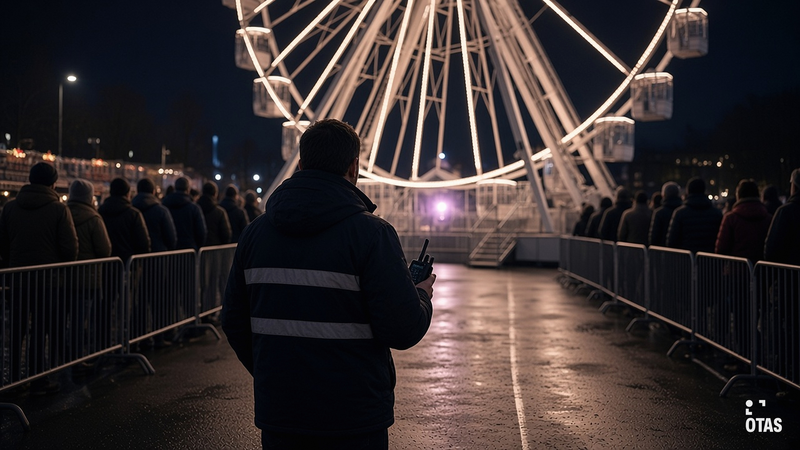
Tool: operator and attendant brief
The controller briefs their own staff. As organiser, agree what the brief covers and that it happens every day. OTAS guidance, drawing on HSG175 [9].
Operator
- You are in charge of this ride throughout each cycle. Only you use the controls (para 273) [9].
- Keep the whole ride in view. If you cannot see part of it, use the agreed signal with the attendant (paras 275 and 320) [9].
- If a rider ignores an instruction, stop the ride. Do not wait for the cycle to end (paras 286 and 321) [9].
- Do not start until the attendant confirms it is safe (para 320) [9].
Attendant
- Give the rules at the gate in plain words, every cycle.
- Check every restraint by hand before the start (para 285) [9].
- Watch the riders, not the queue, while the ride moves.
- If a rider ignores you, signal the operator to stop.
- Keep spectators away from the gate and the controls.
Steward
- Keep queues tidy and the access lane clear.
- You do not operate rides (para 181) [9].
- If something goes wrong, keep the public back and wait for the controller.
Tool: rider conduct signage and PA script
Short words, said often. Agree them with each controller so they match the ride's own rules. OTAS guidance, drawing on HSG175 para 285 [9] and HSE advice for the public [13][14].
Sign at the queue start
- Stay seated. Hold on. Keep your hands to yourself.
- No standing, kneeling, swapping seats or holding other seats.
- Follow the attendant. If you do not, the ride will stop and you will be asked to leave.
PA, every few minutes
- "Welcome to the fair. On every ride, stay seated, hold on and follow the attendant."
- "For everyone's safety, the operator will stop any ride if riders do not follow the rules."
- "Parents and carers, please stay behind the barriers and leave the controls to the ride staff."
From the attendant at the gate
- "Sit back, hold on, hands on your own seat."
- "If you hold another seat or stand up, I will stop the ride."
HSE advises parents to tell children to sit still, because turning, kneeling and standing take riders out of the safe position in the seat [14]. Use that in your PA and on your website before the event.
The first ten minutes after a ride incident
OTAS guidance, drawing on HSG175 paras 299 to 309 [9]. Agree it with each controller, and brief it to every steward.
First minute
- The operator stops the ride as soon as it is safe (para 323) [9].
- The attendant keeps riders seated unless there is danger, and calls the controller.
- Stewards move spectators back from the barrier and away from the controls.
Next five minutes
- First aid reaches the casualty. Event control calls 999 if needed, and sends a steward to meet the ambulance.
- The access lane is kept clear for the ambulance [9].
- The controller decides how riders are got off, using the ride's own procedure (paras 302 and 303) [9].
Up to ten minutes
- The ride stays closed. If a defect could be the cause, it is not used until the cause is found and put right (para 309) [9].
- The organiser checks whether similar rides should stop too (para 309) [9].
- Someone looks after distressed relatives and friends (para 301) [9].
- The controller notes times, witnesses and what was seen. They are usually the person who reports under RIDDOR (paras 306 and 307) [9].
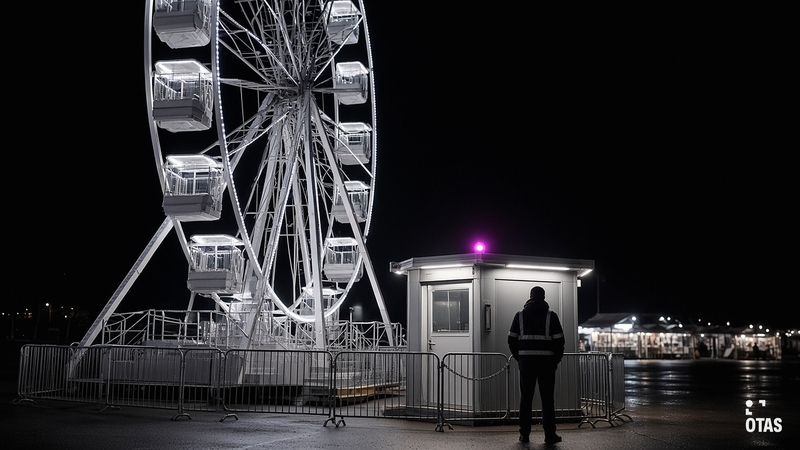
Action box
Operational
- Rules at the gate
- Tell the operator
- Keep the controls clear
Give the rules at the gate in plain words. If a rider ignores them once the ride is moving, tell the operator straight away so they can stop the ride. Keep spectators away from the controls. After an incident, keep the area clear and wait for the controller.
Tactical
- Agree the stop
- Walk the rides
- Brief the first ten minutes
Agree with each controller how their staff give the rules and when they stop the ride. Walk the rides during opening. Watch queues, barriers and the operator's view. Make sure every steward knows the plan for the first ten minutes.
Strategic
- Check every ride
- Plan the access lane
- Name who decides
Check every ride before it is booked: DOC, insurance, risk assessment and rider rules. Plan the layout with an access lane. Write who takes charge, who reports and who decides when a ride reopens.
Readiness checklist
OTAS guidance unless a source is shown.
Before booking
- DOC checked online for every ride [17].
- Insurance and risk assessment for every ride [21].
- Rider rules for every ride.
Before opening
- Layout walked, with an access lane for emergency vehicles [9].
- Stop signal agreed and tested.
- Brief given to operators, attendants and stewards.
- PA lines in the running order.
During opening
- Organiser or deputy walks the rides [9].
- Queues checked at the busiest hour.
- Weather watched for wind and rain [9].
After
- Incidents logged and reported.
- A short debrief with each controller.
What we do not know yet
- What caused the incident at the Rotherham fair, and what the equipment checks found.
- Whether any engineering assessment has been made of the Georgia swing ride, and what it found.
- How the Louisiana tub door came to be open, which investigators have not proved.
- What the organisers of each event knew about the rides' rider rules before they opened.
Coming up: Christmas fairs
Christmas markets, light trails and winter wonderlands open across the UK from mid November, many with a wheel, swings and children's rides. Most run in the dark, in busy town centres, with groups of young people after school. The rider rules and the stop need to be agreed before the first night [9].
Frequently asked questions
Is a rider ignoring the rules really our problem?
Yes. HSE lists passengers deliberately failing to follow safety instructions as reasonably foreseeable misuse (para 31) [9]. HSE's guidance says it is unlikely to include deliberate or outrageously reckless actions, such as trying to defeat a restraint (para 30). Changing seats while the ride is in motion, or getting past a properly installed and effective safety device or fence, is not foreseeable misuse (para 32) [9]. The controller must plan for riders ignoring instructions, and as organiser you should check they have.
Who should stop the ride?
The operator, who is in charge of the ride throughout the cycle (para 273) [9]. Stewards and spectators should not touch the controls. Agree how an attendant or steward tells the operator to stop.
Can a steward also work the ride?
HSE says stewards should not be involved in operating rides (para 181) [9]. Keep the two jobs apart.
How do we check a ride is safe to book?
Ask for the DOC number and check it on the ADIPS website, because a paper copy is not proof [17]. A DOC is normally valid for 12 months [18]. Ask for insurance and the risk assessment too [21].
Do incidents with riders need reporting?
If a member of the public is taken from the ride straight to hospital for treatment, it is likely to be reportable under RIDDOR. The ride controller is usually the responsible person (paras 306 and 307) [9].
What about events in Scotland?
You may need a public entertainment licence from the council under the Civic Government (Scotland) Act 1982 [23]. Ask the council early, and plan to share ride details with them.
Related OTAS Insights
These are links to other OTAS Insights pieces, not to any OTAS Live product or service.
Interest: OTAS Live Ltd, which publishes OTAS Insights, sells event operations services, handbooks and training related to this topic.
Law: this Insight summarises HSE guidance as published on hse.gov.uk, including HSG175, with ADIPS, trade body and council guidance and Scottish licensing law. It is not legal advice. Ask your council, your safety advisory group and each ride controller what applies to your event.
References
Web sources opened 9 November 2026 and labelled with their publisher.
- WRDW News 12, teens forced Columbia County fair ride swing out of control, 7 November 2026 wrdw.com
- CBS Newspath via Local 12, Georgia fair swing ride disrupted, teens charged, 8 November 2026 local12.com
- BBC News, children and woman injured on fairground ride, Maltby, 12 September 2026 bbc.com
- Greatest Hits Radio South Yorkshire, officers respond to injuries at Maltby Crags Fair, September 2026 hellorayo.co.uk
- WBRZ, both girls thrown from Ferris wheel in New Roads recovering at home, November 2025 wbrz.com
- WBRZ, state fire marshal to change inspection protocol after New Roads Ferris wheel accident, 12 November 2025 wbrz.com
- WAFB, documents outline potential reason for New Roads Ferris wheel incident, 4 May 2026 wafb.com
- WAFB, New Roads Ferris wheel incident drives Louisiana carnival ride safety reform, 8 April 2026 wafb.com
- HSE, HSG175 Fairgrounds and amusement parks: Guidance on safe practice, third edition, 2017 hse.gov.uk
- HSE, HSG175 publication page hse.gov.uk
- HSE, fair organisers hse.gov.uk
- HSE, employers of fairground ride controllers hse.gov.uk
- HSE, safety of members of the public on fairground rides hse.gov.uk
- HSE, keeping children safe at fairgrounds hse.gov.uk
- HSE, event safety, amusements and attractions hse.gov.uk
- HSE, event safety, put crowd controls in place hse.gov.uk
- ADIPS, check a DOC adips.co.uk
- ADIPS, frequently asked questions adips.co.uk
- The Showmen's Guild of Great Britain, fairground safety showmensguild.co.uk
- The Purple Guide, amusements, attractions and promotional displays thepurpleguide.co.uk
- Dover District Council, event planning, fairground and amusement rides dover.gov.uk
- NAFLIC, National Association for Leisure Industry Certification naflic.co.uk
- Civic Government (Scotland) Act 1982, section 41, public entertainment licences legislation.gov.uk
If a rider ignored your attendant tonight, would your operator stop the ride, or wait for the cycle to end?
If you need support with planning rides and attractions at your winter event, reach out to us to see how we can support you.
Events industry since 2008, internationally since 2015. OTAS Live Ltd. By OTAS Insights. Edited by Kris Dailly.
Download the PDFs
- The article: PDF, 21 pages, 4.6 MB
- The full report: PDF, 35 pages, 7.4 MB
- The slide deck: PDF, 24 pages, 1.5 MB
Work with OTAS
Bringing rides into a winter event?
Corrections to published Insights articles are listed in our corrections log.