
Download the PDFs
- The article: PDF, 20 pages, 4.2 MB
- The full report: PDF, 36 pages, 6.0 MB
- The slide deck: PDF, 24 pages, 1.3 MB
officers hurt in Glasgow [1]
arrests in Kilkenny [19]
to hospital, Kilkenny [18]
“An ambulance, crewed by trained paramedics, shall be on site throughout the Promotion.”
British Boxing Board of Control, rule 8.6.4 [4]
By OTAS Insights · Published by OTAS Live Ltd
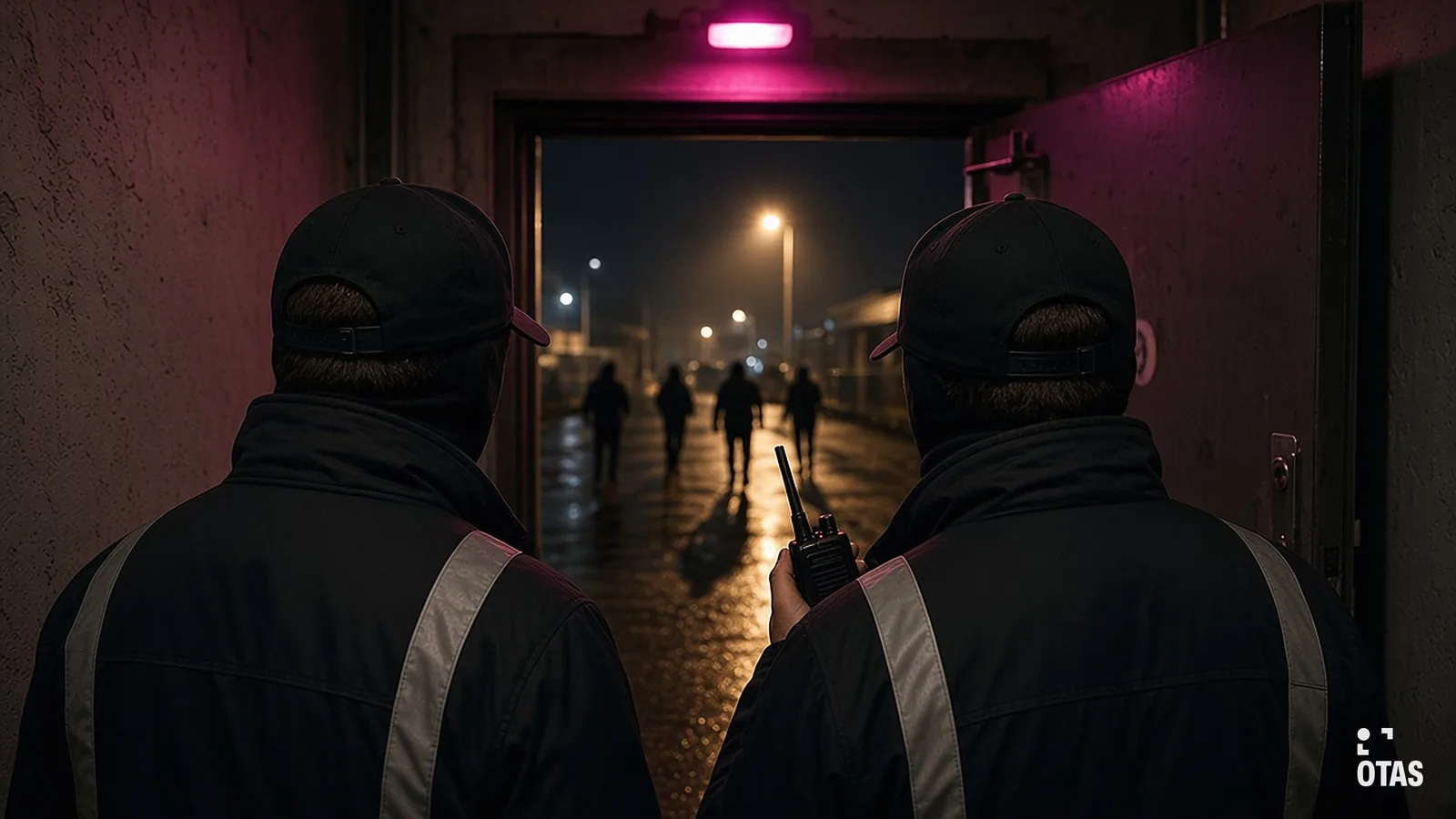
On Saturday 7 November two fight nights ended with the police in attendance. In Glasgow, police received reports of a large disturbance outside an indoor combat sports event at about 23:10. Three officers were hurt, two of them needing medical treatment, and two men were charged [1][17]. In Kilkenny, gardaí arrived at a boxing event at about 21:00. Violence broke out at ringside, in the ring and then among the spectators. A man in his 30s was assaulted and taken to hospital, two arrests were reported, and the event was abandoned before the headline bout [18][19]. The two nights raise different questions. Glasgow is about the street after the show. Kilkenny is about the ring, the audience and the authority to stop. This Insight is for organisers, promoters and safety leads who run combat sports events. It covers what the rules and guidance say, how to plan the ring, the clinical route and the street, and the tools to test it.
In short: plan the ring, the room and the route out as one operation. Name who can hold the show and who can restart it, and keep a clinical route clear when the audience moves. Plan spectator care apart from boxer care, and give the street after the show an owner.
What was reported
Two reports from the same night, 7 November 2026 [1][17][18][19]. We describe the events rather than naming the venues, the promoters or the people involved. Arrests and charges are not findings of guilt. Reports from Kilkenny differ in some details, and we say where.
Glasgow, 7 November
- Where Outside an indoor arena in Glasgow, after a bare knuckle fighting event on a Saturday evening [1][17].
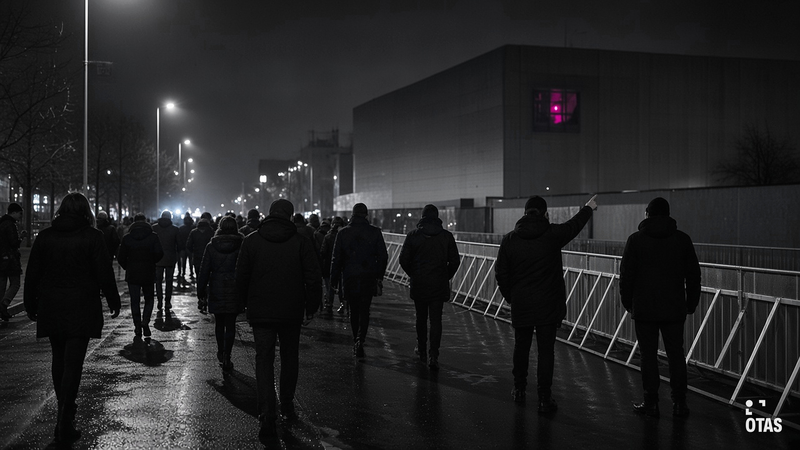
- What police said At about 23:10, police received reports of a large disturbance in the street outside the venue [1]. Footage shared online shows a group of men fighting in the street [1].
- The response More than 20 police vehicles and a police helicopter went to the area [1]. Three officers were hurt, two of them needing medical treatment [1][17].
- Afterwards Two men, aged 32 and 27, were arrested and charged, and will be reported to prosecutors. Three other men were arrested and given recorded police warnings. Police said inquiries were continuing [1][17].
Kilkenny, 7 November
- Where A celebrity boxing event at an indoor venue in Kilkenny city, on the same Saturday night [18][19].
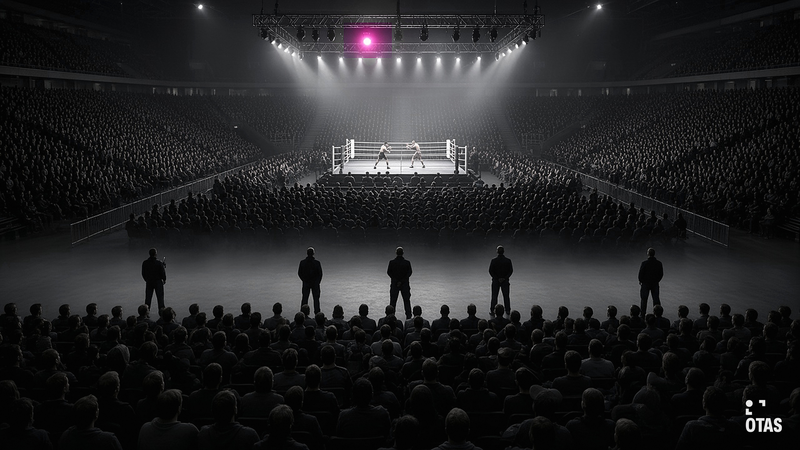
- What was reported Videos show security staff trying to step in during an altercation in the ring. Violence escalated, with reports of chairs and glass thrown across the room [18]. It broke out at ringside, in the ring and then through the spectators [19].
- The response Gardaí arrived at about 21:00 [18][19]. A man in his 30s was assaulted. He was treated at the scene by paramedics and taken to hospital by ambulance [18][19].
- Afterwards The event was abandoned before the headline bout and people were escorted out [18][19]. Two arrests were reported [19]. RTÉ also reported that a teenager was arrested and charged [18]. Reports differ in the detail of who was arrested.
What these reports do and do not show
Facts and judgement are kept apart here. The facts carry source numbers. The rest is OTAS guidance.
| Event | What is reported | What is not known |
|---|---|---|
| Glasgow | Disorder in the street outside after the event, three officers hurt, two men charged [1][17] | The steward plan outside, where the event's responsibility ended, the handover to police |
| Kilkenny | Violence at ringside, in the ring and in the crowd, one man to hospital, the event abandoned [18][19] | The security and medical plan, who called the stop, what cover remained |
| Both | Police or gardaí attended, arrests were made [1][19] | The outcome of any charges. Arrests are not findings of guilt |
Table 3. Facts and open questions on the two nights. Facts from [1][17][18][19].
The lesson for organisers does not depend on who was to blame. On both nights the event plan met something it had to manage at speed: a crowd in the street, or a fight that left the ring. Planning the ring, the room and the route out together is the same job on any fight night.
Scope of this Insight
What this Insight covers, and what it does not.
It covers
- Combat sports events with a ring and a seated or standing audience.
- The ring and audience boundary, the clinical route, the hold and the restart.
- Dispersal into the street and the handover to the police.
- Licensing and security questions in Scotland and Ireland.
It does not cover
- Who was at fault on either night, or anyone's guilt.
- Clinical protocols. Those belong to your clinical lead and the sanctioning body [4][12].
- Fighter safety and anti doping rules beyond the event plan [15].
- Legal advice for your event.
What the rules and guidance say
In brief, from the sport's rules, licensing law, the security regulators and HSE crowd guidance [4][6][9][13][20][21][23]. Not legal advice. Which rules apply depends on the sport, the sanctioning body and where the event is held.
The sport's own rules
- For promotions under the British Boxing Board of Control, the promoter must keep a phone link from the venue to the local hospital (rule 8.6.2) [4]. This is so the hospital can be told at once of an emergency (rule 8.6.2) [4].
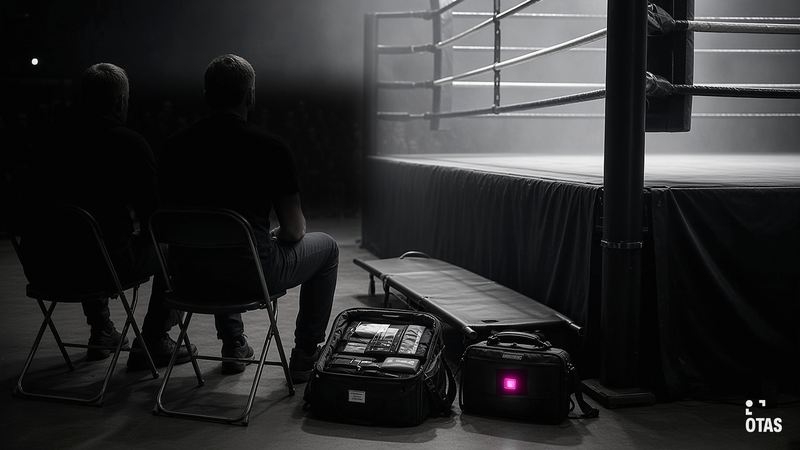
- Full resuscitation equipment must be at ringside, and no contest takes place unless trained staff who can use it are present (rule 8.6.3). An ambulance crewed by paramedics must be on site throughout, for the sole use of injured boxers (rule 8.6.4) [4].
- The promoter must have enough security in place for medical help to reach boxers in the ring without hindrance (rule 8.6.5) [4].
- A ringside physicians' consensus says a bout should be stopped if a fighter shows signs of concussion [12].
Not every format is under those rules
- The Board oversees gloved professional boxing. A BBC feature noted it is not involved in bare knuckle events, which another body regulates [2].
- England Boxing says white collar boxing is often run by private promoters, outside the governance of the sport [3]. Boxing Scotland says it does not recognise unofficial, unlicensed or white collar organisations [5].
- A study of 141 sanctioned professional bare knuckle bouts in the US found more than a third of fighters were injured, mostly with cuts, and five needed transfer to hospital [11].
- So the medical and security rules for your event depend on who sanctions it. If nobody does, you set them yourself, with a competent clinical lead.
Permission is local
- In Scotland, councils licence public entertainment under section 41 of the Civic Government (Scotland) Act 1982, and indoor sports entertainment under section 41A [6][7].
- Glasgow City Council lists boxing or wrestling entertainment as a sporting event that needs a public entertainment licence, unless another licence covers it [8].
- Glasgow asks for temporary applications at least 12 weeks before the event, and six months for events over 5,000 spectators, with an event management plan [9][10]. Police Scotland and the fire service are consulted [10].
Crowd duty and security staff
- HSE says the organiser keeps overall responsibility for crowd safety, and roles must cover normal and emergency situations [21]. Plan for dispersal as well as arrival [20][22].
- In the UK, door supervision at events may need an SIA licence, depending on the work and the contract [13].
- In Ireland, since 1 November 2022 everyone providing security at an event must hold a Private Security Authority licence. It is an offence for an organiser or promoter to engage an unlicensed contractor or employee [23][24].
The sport's rules protect the boxers. HSE crowd guidance protects everyone else [4][21]. A fight night needs both, planned by people who talk to each other.
Permission is local, not a label
Calling an event a fight night, a boxing show or a celebrity bout does not answer what permission it needs. Sources shown.
| Question | Where to find the answer |
|---|---|
| Who sanctions the event? | The sanctioning body, if any. The Board oversees gloved professional boxing [2][4] |
| Which medical rules apply? | The sanctioning body's rules. If there are none, your clinical lead sets them [4][12] |
| What licence does the venue or event need? | The council. In Glasgow, a public entertainment licence for boxing or wrestling entertainment [8][9] |
| How far ahead must we apply? | In Glasgow, at least 12 weeks, or six months over 5,000 spectators [9] |
| Who can work as security? | The regulator. The SIA in the UK [13]. The Private Security Authority in Ireland [23] |
| Does anyone work with children? | In Scotland, check if the role needs PVG membership [14] |
Table 4. Questions to answer for the actual format and place. Sources shown. Not legal advice.
Do not carry Scottish licensing assumptions into an Irish event, or the other way round. Ask the council, the sanctioning body and the security provider, and keep their answers in writing. Martyn's Law is expected to come into force in spring 2027 and will apply to events where 800 or more people are expected at once, with checks on entry [16].
Who owns what on a fight night
Seven roles, each with one named person. One person may hold two roles, but test that they can do both at once. Drawn from HSE crowd guidance [21] and Board rules [4].
| Role | What they own |
|---|---|
| Event organiser or promoter | Overall crowd safety, the plan and the people in it [21]. Enough security for medical help to reach the ring (rule 8.6.5) [4] |
| Show lead | The running order, and the only person who can restart the show after a hold |
| Clinical lead | Medical cover for the boxers and the crowd, and whether the cover is enough to go on [4][12] |
| Ring supervisor | The ring, the apron and the clinical route beside it |
| Security lead | Licensed staff on the doors, in the room and round the ring [13][23] |
| Dispersal lead | The routes outside, until the agreed handover [20][22] |
| Police liaison | One line to the police or gardaí, before, during and after the show |
Table 5. Roles on a fight night. OTAS guidance, drawing on HSE [21] and Board rule 8.6.5 [4].
Why fight nights stretch the plan
In Glasgow, the disorder was in the street after the show [1]. In Kilkenny, it moved from the ring into the crowd [19]. The rest of this section is OTAS guidance.
From trouble at ringside to a decision
- The ring and the room are one space. When trouble starts at ringside, the people who protect the ring and the people who care for the crowd need the same space at the same time.
- Boxer care is not crowd care. Under Board rules the ringside ambulance is for injured boxers only (rule 8.6.4) [4]. A spectator who is hurt needs separate first aid and transport.
- The show clock pushes for a restart. A late running card and a full house create pressure to start the next bout before cover, access and calm have been checked.
- The crowd leaves together, late. A fight night often ends late, with a large crowd leaving at once into a city centre. Groups who were in the room meet again outside, beyond the event's own staff [1][22].
- New formats, new audiences. Bare knuckle, white collar and celebrity events can sit outside the usual governance of the sport [2][3][5]. The audience may not know the conventions of a fight night.
Tool: ringside zone and clinical route checks
Use this at the walk round before doors open, and again before the main event. OTAS guidance, drawing on Board rules 8.6.2 to 8.6.5 [4].
The ring and the apron
- Only named people go up to the apron and into the ring.
- Staff stand between the front row and the ring, facing the crowd.
- Nothing that can be thrown sits within reach of the front rows, such as loose chairs or glass.
- The ring supervisor can see all four sides.
The clinical route
- A route from the ring to the ambulance point that the crowd does not use.
- Resuscitation equipment at ringside, with trained staff present (rule 8.6.3) [4].
- A phone link to the local hospital is working (rule 8.6.2) [4].
- Separate first aid and transport for spectators (rule 8.6.4) [4].
The room
- Exits clear and staffed, with no pinch point at the bar [20].
- A way to stop the music and speak to the room from event control.
- Security can reach the ring without crossing the crowd.
Signs your fight night plan stops at the door
Each of these is OTAS guidance, drawn from the reports and the rules.
Signs your fight night plan stops at the door
- 01Nobody owns the street
The plan ends at the exit doors, with no named lead for dispersal [21][22].
- 02One route, two jobs
The route to the ring is also the crowd's way to the bar or the exit.
- 03No named hold
Nobody can say who stops the show, or how the call reaches the referee.
- 04Ambulance counted twice
The boxers' ambulance is also the crowd's ambulance (rule 8.6.4) [4].
- 05Security not briefed for the ring
Staff are posted on the doors but not round the ring [4][23].
Tool: hold and restart triggers
When to hold the next bout, and who acts. A hold is a pause, not the end of the show. Agree these with the show lead, the referee and the clinical lead before doors open.
| Trigger | Who calls the hold | What has to happen next |
|---|---|---|
| Fighting at ringside or in the crowd | Security lead or show lead | Hold, clear the route, restore order |
| Something thrown towards the ring | Security lead | Hold, clear the area, check the injured |
| Ambulance leaves with a casualty | Clinical lead | Hold until cover is confirmed |
| Medical help cannot reach the ring | Clinical lead or ring supervisor | Hold, open the route [4] |
| Signs of concussion in a bout | Referee, on medical advice | Stop the bout [12] |
| A crowd building at the exits | Dispersal lead | Hold, open the exits, tell control |
Table 6. Hold and restart triggers. Drawn from Board rules 8.6.3 to 8.6.5 [4] and the consensus [12]. Who acts is OTAS guidance.
Only the show lead restarts, and only after the clinical lead confirms the cover, the security lead confirms the room, and the ring supervisor confirms the route.
Plan the night from the ring walk to the last street
Five stages, from permission to the street. OTAS guidance unless a source is shown.
Five stages, from permission to the street
Permit
Confirm who sanctions the event, which rules apply and what the council needs. In Glasgow, apply at least 12 weeks ahead [4][9]. In Ireland, check the security contractor's licence on the register [23].
Brief
Brief security, stewards, officials, production and the medical team together on the hold call, the clinical route and who can restart [4][21].
Hold
If cover or crowd control is lost, hold the next bout. Keep the clinical route clear and record who called the hold [4][12].
Transfer
If anyone goes to hospital, check what cover remains against the agreed minimum before the show restarts [4].
Disperse
Keep staff on the routes outside until the agreed handover point. Pass on what you see to the police through one named liaison [20][22].
Tool: ringside and security brief
Read this to security, stewards and officials together before doors open. OTAS guidance, drawing on Board rule 8.6.5 [4] and HSE [21].
Ring team
- You keep the apron and the clinical route clear. Nobody else goes up.
- Face the crowd, not the fight.
- If anything is thrown or anyone climbs towards the ring, call the hold on the radio.
Room team
- Watch the rows nearest the ring and the bar.
- If a fight starts, call it in, then move people away from it. Do not go in alone.
- Keep the exits clear.
Everyone
- The hold call word is: ________.
- On a hold, stop, hold your position and listen for instructions.
- Only the show lead restarts. Wait for the restart call.
Tool: dispersal brief
For the team who work the routes outside after the show. OTAS guidance, drawing on HSE crowd guidance [20][21][22].
Before the last bout
- Staff to their posts outside before the main event ends.
- The dispersal lead confirms the routes to transport and the taxi rank [20].
- The police liaison tells the police when the crowd will leave.
As the crowd leaves
- Keep people walking and away from the traffic [22].
- Watch for groups meeting again outside, and call it in.
- Keep a route clear for police and ambulance.
- Do not follow anyone or go into a fight. Report it and stay with your team.
The handover
- Stay on your post until the dispersal lead says the handover is done.
- The dispersal lead records the time and who took over.
An empty room is not the end of the job. The dispersal task ends at the agreed handover point, not when the doors close.
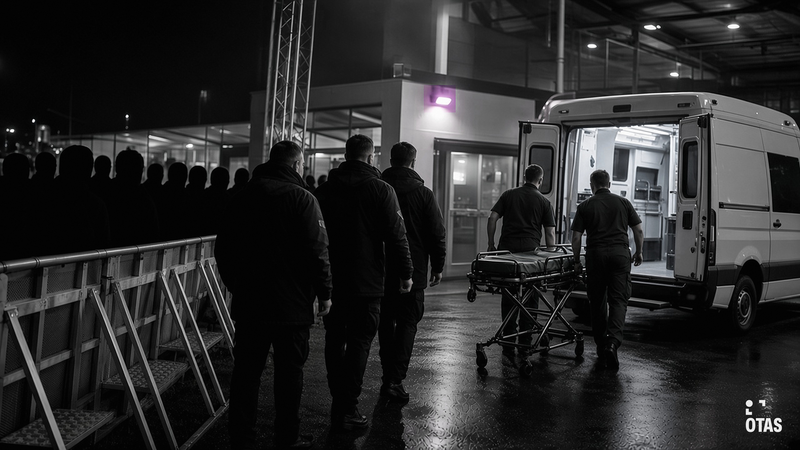
Exercises: the street and the ring
Two table top exercises of about 20 minutes each. Run them with every lead before the event. OTAS guidance.
Exercise one: the room empties into the street
- The last bout ends and 3,000 people leave together. A group starts fighting on the main route to the station.
- Who sees it, and who do they call? What does the dispersal lead do with the staff outside?
- The police ask for a route for their vans against the flow of the crowd. How do you keep it open?
- When is the dispersal task finished, and who says so?
Exercise two: a ringside incident and a transfer
- Mid card, a fight breaks out in the front row and a chair is thrown towards the ring.
- Who calls the hold, and how do the referee and production hear it?
- A spectator is hurt and leaves by ambulance. What cover is left, and who checks it?
- The card is running late. What has to be confirmed before the show lead can restart?
Record what went well, what was missing and who will fix it. Test the fixed plan again before opening.
Tool: hold and release record
A simple record for event control. Keep clinical details in the clinical team's own notes, not here. OTAS guidance.
| Field | What to write |
|---|---|
| Hold called | Time, by whom, and why |
| Who was told | Referee, production, security, clinical, dispersal, police liaison |
| Clinical route | Clear, and confirmed by whom |
| Cover | What remains, and confirmed by the clinical lead |
| The room | Calm, and confirmed by the security lead |
| Decision | Restart or stop, the time, and the show lead's name |
Table 7. Hold and release record. OTAS guidance. Adapt it to your event control log.
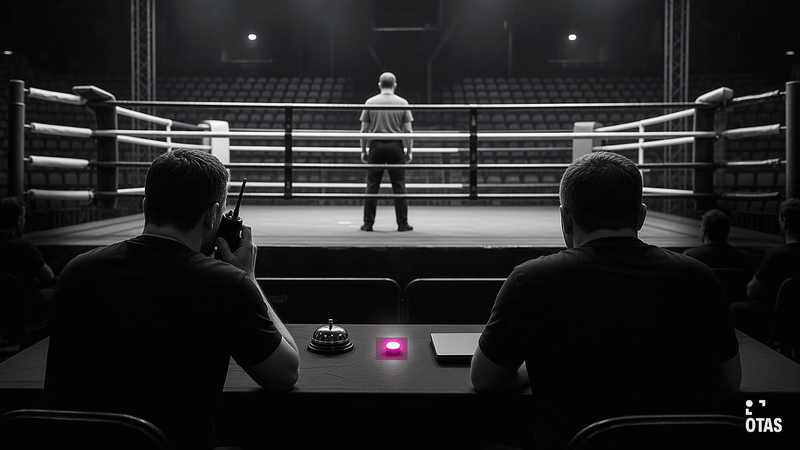
The first ten minutes after trouble at ringside
OTAS guidance, drawing on Board rules [4] and HSE crowd guidance [21]. Brief it to every lead.
First minute
- The hold is called and the next bout waits.
- Security moves between the trouble and the ring, and the ring team keeps the route clear.
- Event control stops the music and gets ready to speak to the room.
Next five minutes
- The clinical lead reaches anyone hurt. Event control calls 999 if needed.
- The police liaison tells the police what is happening.
- Staff move people away from the trouble and keep the exits open.
Up to ten minutes
- The clinical lead confirms what cover remains.
- The show lead decides, with the leads, whether to restart or to stop.
- If the show stops, the dispersal team goes to the routes outside first, then the room is cleared.
Action box
Operational
- Pass on the hold
- Keep the route clear
- Stay to the handover
Know the hold call and pass it on at once. Keep the clinical route clear, even if the crowd pushes towards the ring. Stay on your post outside until you are told the handover is done.
Tactical
- One brief for all
- Staff for two jobs
- One police liaison
Brief every team together on the hold, the clinical route and the restart. Keep enough staff to handle an incident and the exit at the same time. Run one liaison to the police.
Strategic
- Rules and licences
- Name the restart
- Separate the care
Confirm who sanctions the event, the council licence and the security licence. Name the person who alone can restart the show. Plan spectator care apart from boxer care.
Fight night readiness checklist
OTAS guidance unless a source is shown.
Before tickets go on sale
- Who sanctions the event, and which rules apply [2][4].
- The council licence applied for in time [9].
- A licensed security provider [13][23].
Before doors open
- Every role named, with a call sign.
- The clinical route walked with the clinical lead.
- The hold call word agreed and tested.
- The dispersal routes and handover agreed with the police.
During the show
- Cover checked after every transfer [4].
- The room watched near the ring and the bar.
- Staff outside before the main event ends.
After
- The hold record and incident log kept.
- A short debrief with every lead.
What we do not know yet
- What the event plans, steward numbers and medical cover were at either event.
- Where each event team's responsibility ended, and how the handover to the police worked.
- What the police and gardaí inquiries will find, and the outcome of any charges.
- Whether the councils, the regulators or the sport's bodies will review either event.
Coming up: winter fight nights
Fight nights in winter often finish late, into city centres busy with Christmas parties and a long wait for taxis. Agree the street plan, the handover and the police liaison before the tickets go on sale, not on the night [20][22].
Frequently asked questions
What is different about these two nights?
Glasgow reporting concerns the street after the event [1][17]. Kilkenny reporting concerns disorder at ringside, in the ring and in the crowd, and an event abandoned before the headline bout [18][19].
Do the reports show the organisers were at fault?
No. We draw no conclusion about either event. Arrests and charges are not findings of guilt, and the event plans were not published.
Is the ringside ambulance enough for the crowd?
Not under Board rules. The ambulance on site is for the sole use of injured boxers (rule 8.6.4) [4]. Plan first aid and transport for spectators as well.
Who should be able to stop the show?
Name one person in the plan who can hold the show and who alone can restart it, and agree how the call reaches the referee, production and security. This is OTAS guidance, not a statutory rule.
Do we need a licence for a boxing event in Glasgow?
Glasgow City Council lists boxing or wrestling entertainment as a sporting event that needs a public entertainment licence, unless another licence covers it [8]. Apply at least 12 weeks ahead [9].
Does our security team need to be licensed in Ireland?
Yes. Since 1 November 2022 everyone providing security at an event in Ireland needs a Private Security Authority licence, and engaging an unlicensed provider is an offence [23][24].
Related OTAS Insights
These are links to other OTAS Insights pieces, not to any OTAS Live product or service.
Interest: OTAS Live Ltd, which publishes OTAS Insights, sells event operations services, handbooks and training related to this topic.
Law: this Insight summarises Board rules, HSE crowd guidance, Scottish licensing law, Glasgow City Council guidance and the UK and Irish security regulators. It is not legal advice. Ask your council, your sanctioning body and your security provider what applies.
References
Web sources opened, or checked again, on 9 November 2026 and labelled with their publisher.
- BBC News, street disturbance outside a Glasgow event, 8 November 2026 bbc.com
- BBC Sport, bare knuckle oversight and medical debate, December 2025 bbc.com
- England Boxing, new report released on white collar boxing englandboxing.org
- British Boxing Board of Control, Rules and Regulations 2026 bbbofc.com
- Boxing Scotland, frequently asked questions, PDF boxingscotland.org
- Civic Government (Scotland) Act 1982, section 41 legislation.gov.uk
- Civic Government (Scotland) Act 1982, section 41A legislation.gov.uk
- Glasgow City Council, resolution on public entertainment glasgow.gov.uk
- Glasgow City Council, public entertainment licence glasgow.gov.uk
- Glasgow City Council, guidance for a public entertainment licence glasgow.gov.uk
- Muzzi and others, Epidemiology of professional bare knuckle fighting injuries, The Physician and Sportsmedicine, 2021 doi.org
- BJSM, concussion in combat sports, ringside physicians consensus bjsm.bmj.com
- SIA, do you need a licence to work as an event steward gov.uk
- mygov.scot, check if a role needs PVG scheme membership mygov.scot
- UK Anti-Doping, testing ukad.org.uk
- SIA, understanding Martyn's Law gov.uk
- STV News, two men charged in Glasgow, 8 November 2026 news.stv.tv
- RTÉ News, arrests after a Kilkenny boxing event, 8 November 2026 rte.ie
- The Irish Times, two arrests in Kilkenny, 8 November 2026 irishtimes.com
- HSE, event safety, put crowd controls in place hse.gov.uk
- HSE, event safety, set clear crowd roles hse.gov.uk
- HSE, event safety, assess the crowd risks hse.gov.uk
- PSA 93:2023, note for event promoters and organisers, PDF psa-gov.ie
- PSA 88, note on licensing event security employees, PDF psa-gov.ie
If a fight broke out at ringside during your next bout, who would hold the show, and who would decide it can restart?
If you need support with combat event operations, reach out to us to see how we can support you.
Events industry since 2008, internationally since 2015. OTAS Live Ltd. By OTAS Insights. Edited by Kris Dailly.
Download the PDFs
- The article: PDF, 20 pages, 4.2 MB
- The full report: PDF, 36 pages, 6.0 MB
- The slide deck: PDF, 24 pages, 1.3 MB
Corrections to published Insights articles are listed in our corrections log.